
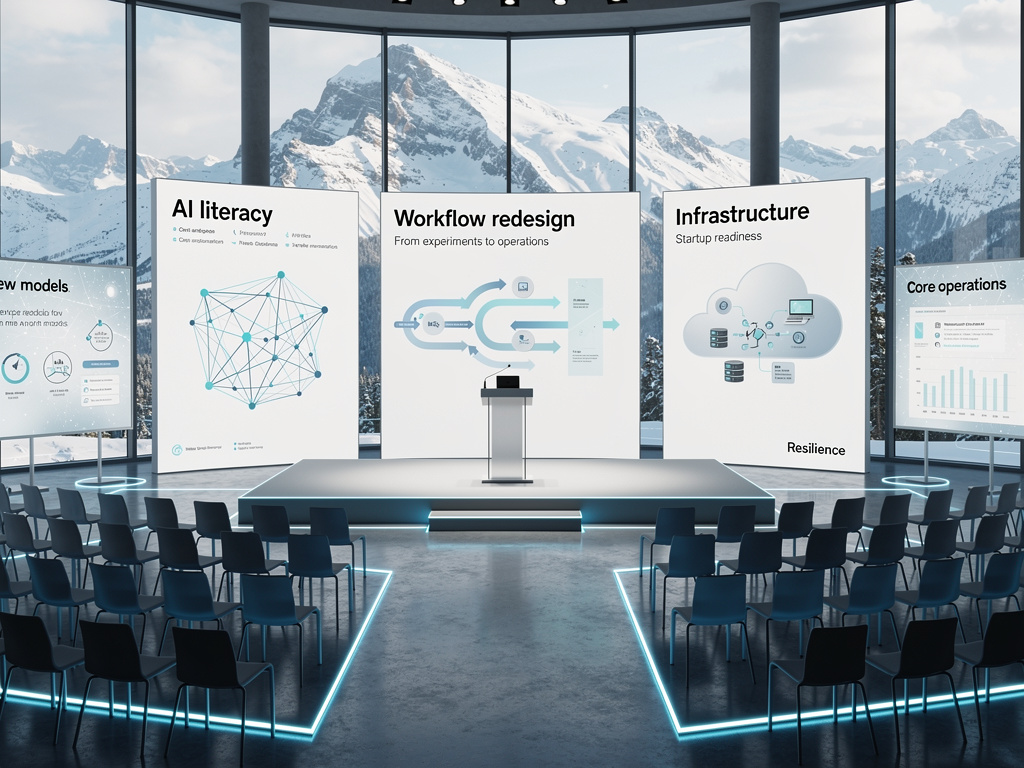
In the shadow of the World Economic Forum’s towering agendas, AI House Davos emerged as a pivotal forum where executives from OpenAI and major enterprises pivoted conversations from nascent AI pilots to embedding literacy and robust systems as business imperatives. Held alongside the January 2026 WEF gathering in Switzerland, the event convened startup leaders, researchers, and policymakers to dissect how artificial intelligence transitions into foundational operational pillars across sectors including manufacturing, healthcare, and governance.
Laura Modiano, Startups EMEA lead at OpenAI, shared direct insights from her panel on building startups amid AI proliferation. Posting on X, she highlighted five core takeaways alongside Andrew Ng of DeepLearning.AI, Andy Hock, Nicole Büttner of Merantix Momentum, and Alex Ilic. The group converged on the notion that genuine value stems from overhauling products and processes for superior results, beyond mere efficiencies.
Modiano stressed the diffusion of AI proficiency beyond engineering silos. “AI tool literacy is essential,” she posted. “The need to use AI tools like Codex and the OpenAI API platform is spreading across every role, not just engineers: product, sales, BD, and ops increasingly need to understand and work with AI directly.” This call echoed broader Davos sentiments, where Nvidia’s Jensen Huang described AI literacy as vital amid the sector’s explosive growth.
From Tools to Enterprise Fluency
At AI House, discussions underscored that AI adoption demands fluency at all organizational levels. Modiano elaborated that AI has eroded traditional time-to-value barriers, rendering velocity baseline. “Speed is now table stakes,” she noted. “AI collapsed time-to-value, and defensibility no longer comes from moving faster than humans but from workflow redesign that focuses on outcomes.”
Panelists dissected the fallacy of isolated AI applications. “Transformation ≠ automation,” Modiano asserted. “Replacing a single step with AI delivers efficiency but real impact comes from redesigning entire products and workflows to change outcomes not just cut costs.” Andy Hock and Andrew Ng reinforced this, emphasizing user-centric judgment as the emerging bottleneck when development costs plummet.
Enterprise voices amplified these shifts. Mallik Rao, Chief Technology and Enterprise Officer at Telefónica Germany, and Pravina Ladva, Group Chief Digital and Technology Officer at Swiss Re, joined Büttner’s “Great Rewiring” panel, exploring AI’s role in industrial resilience.
Infrastructure Unlocks New Frontiers
Nicole Büttner, hosting the resilience panel, captured AI’s maturation. “AI has moved far beyond experimentation,” she posted on LinkedIn, as covered by EdTech Innovation Hub. “It is no longer an add-on or efficiency tool at the margins. AI is becoming foundational infrastructure, reshaping productivity, competitiveness, and resilience across industries and economies.”
Modiano tied this to technical advances: “Faster infrastructure enables new categories. Lower latency and agentic systems don’t just improve existing products, they unlock entirely new experiences and business models.” G42’s sessions at AI House, including “Infrastructure as a Strategic Asset,” echoed this, with CEO Hassan Alnaqbi addressing scalable foundations for national AI capacity.
Büttner advocated for safeguards in high-stakes deployments. “As AI scales into mission-critical systems, governance, accountability, and human judgment are not constraints on innovation, but essential enablers of responsible scale,” she stated. Value now accrues to firms fusing data, models, and systems for process overhauls.
Governance as Scale Enabler
AI House, founded in 2023 by ETH AI Center and Merantix, positioned itself as a neutral hub for multi-stakeholder dialogue on sustainable AI progress. Spread across three floors on Davos’s Promenade 67, it hosted panels blending next-gen innovators with policymakers, fostering collaborations on agency amplification and value-aligned intelligence.
These themes resonated across WEF. Nvidia’s Huang, in dialogue with BlackRock’s Larry Fink, called AI the “largest infrastructure buildout in human history,” layering energy, compute, and applications while noting 2025’s $100 billion VC surge into AI-native ventures, per NVIDIA Blog.
Microsoft’s Satya Nadella highlighted uneven global rollout due to capital and power constraints, as reported by Euronews. “AI deployment will be unevenly distributed across the globe, constrained primarily by access to capital and infrastructure,” he warned.
Startup Imperatives in AI Era
For startups, Modiano’s final points crystallized priorities: user insight trumps raw speed. “Understanding users matters most. When building becomes cheap, deciding what to build becomes the constraint: taste, user understanding, and point of view matter more than ever.” Her X post (@LauraModiano) garnered traction among founders navigating agentic shifts.
Broadening out, Forbes noted enterprise focus for OpenAI and Anthropic at Davos, with enterprises comprising 40% and 80% of their revenues respectively, per CNBC interviews. Salesforce’s EVA agentic concierge demo exemplified workflow integration for leaders.
Fortune observed hype yielding to ROI scrutiny, with Snowflake’s Sridhar Ramaswamy voicing fears of frontier firms encroaching on data layers. Yet, economic data showed no widespread displacement, signaling gradual infusion.
Global Ripples and Power Pressures
Infrastructure strains dominated. Yahoo Finance detailed 2025’s energy surge persisting into 2026, with Nadella pinpointing power costs as the AI race decider. Huang urged Europe to leverage manufacturing for infrastructure leaps.
G42’s Ali Al Amine discussed Global South pathways at AI House, pairing inclusive systems with governance for agency. X posts from G42 highlighted resilient digital assets for competitiveness.
Credo AI’s blog from Davos advocated context-specific governance and organizational literacy investments, noting India’s push for local solutions and ecosystems.


 WebProNews is an iEntry Publication