
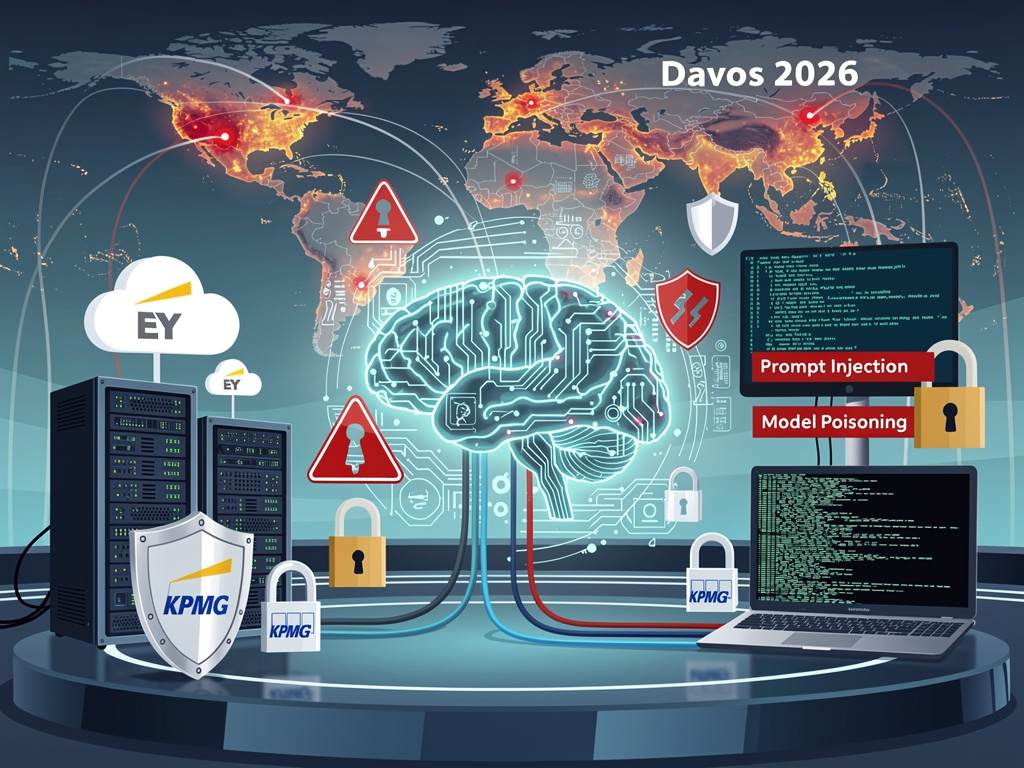
Davos 2026: AI’s Security Shadows Outweigh the Hype
At the World Economic Forum in Davos this year, the buzz around artificial intelligence reached fever pitch, but beneath the optimism, a sobering reality emerged. Executives from major firms like EY and KPMG voiced deep concerns over AI’s vulnerabilities, arguing that security issues could eclipse the technology’s potential benefits. These leaders, gathered amid the Swiss Alps, painted a picture of an industry racing ahead without adequate safeguards, where the risks of cyberattacks and data breaches threaten to undermine trust in AI systems. Drawing from discussions at the forum, it’s clear that while AI promises efficiency and innovation, its integration into business operations is fraught with perils that demand immediate attention.
One key figure highlighting these issues was Akhilesh Tuteja, global cybersecurity leader at KPMG. He emphasized that the rapid adoption of AI tools has outpaced the development of robust security measures, leaving organizations exposed. Tuteja pointed out that generative AI, in particular, introduces new attack vectors, such as prompt injection, where malicious inputs can manipulate AI outputs. This vulnerability isn’t just theoretical; it’s already being exploited in real-world scenarios, amplifying the need for proactive defenses.
Echoing these sentiments, EY’s global cybersecurity leader, Dave Burg, stressed the importance of embedding security into AI from the ground up. During panel sessions, Burg warned that traditional cybersecurity approaches fall short against AI-specific threats, like model poisoning, where adversaries tamper with training data to skew results. The consensus among these execs was unmistakable: without addressing these gaps, businesses risk not only financial losses but also reputational damage that could stall AI’s broader acceptance.
Geopolitical Tensions Amplify AI Vulnerabilities
The Davos conversations didn’t occur in a vacuum; they were shaped by broader global shifts. According to the World Economic Forum’s Global Cybersecurity Outlook 2026, produced in collaboration with Accenture, geopolitical fragmentation is intensifying cyber threats. The report notes that 64% of organizations now factor in geopolitically motivated attacks in their risk strategies, with 91% of large companies recalibrating their cybersecurity postures. This shift reflects how state-sponsored hackers are increasingly targeting AI systems to gain strategic advantages, turning technology into a battleground.
In this environment, AI’s role as both a tool and a target becomes critical. Discussions at the forum highlighted how accelerating AI adoption exacerbates inequalities in cyber capabilities, with smaller entities lagging behind in defenses. The WEF report warns of widening gaps, where sophisticated attacks grow more complex and unevenly distributed, pressuring governments and firms to adapt amid sovereignty challenges. Executives like those from EY and KPMG argued that without international cooperation, these disparities could lead to a fragmented digital ecosystem vulnerable to exploitation.
Further insights from Euronews reveal the European Commission’s push for stricter oversight of high-risk tech suppliers. New rules aim to ban companies posing security risks to the EU, though enforcement delays could hinder effectiveness. This regulatory move underscores a growing recognition that AI security isn’t just a technical issue but a policy imperative, especially as geopolitical tensions rise.
AI-Powered Attacks on the Horizon
Delving deeper into specific threats, the forum spotlighted AI-powered cyberattacks as a top concern for 2026. Tom’s Guide outlines risks ranging from misinformation campaigns to sophisticated hacks leveraging AI for speed and scale. Executives at Davos echoed this, noting that AI can automate phishing or generate deepfakes, making traditional detection methods obsolete. KPMG’s Tuteja, for instance, discussed how adversaries use AI to craft personalized attacks, evading human oversight.
Recent posts on X from industry observers reinforce this urgency. Users have shared warnings about AI agents needing root access to function effectively, potentially breaching barriers between applications and operating systems, as noted in discussions around signal privacy. Another post highlighted NVIDIA CEO Jensen Huang’s view that only AI can counter AI-driven hacks occurring at superhuman speeds, underscoring the arms race in cybersecurity.
Moreover, the Hacker News webinar by Bitdefender separates hype from genuine risks, focusing on ransomware and AI threats backed by real-world research. At Davos, this translated to calls for AI-driven defenses, like zero-trust architectures, to combat evolving dangers. EY’s Burg advocated for privacy-preserving models, aligning with trends in the AI economy where security must evolve alongside innovation.
Executive Fears and Strategic Shifts
CEOs at the forum, including Microsoft’s Satya Nadella and leaders from Anthropic and Google DeepMind, shared visions laced with caution. As reported in Euronews coverage of AI at Davos, these figures emphasized safe AI deployment amid fears of misuse. Philosopher Yuval Harari added philosophical weight, warning of existential risks if security lapses allow bad actors to weaponize AI.
This aligns with findings from the CNBC on the WEF’s global risks report, where geoeconomic confrontation tops business worries, including tariffs and AI downsides. Executives like those from EY and KPMG stressed that conventional cybersecurity won’t suffice for AI, a point echoed in Harvard Business Review research showing legacy defenses fail against adaptive systems.
X posts from users like those discussing DeepMind research suggest the real threat might be market dynamics rather than a singular AI entity, pointing to emergent risks from interconnected systems. Another post referenced Sam Altman’s fears of human misuse leading to chaos, from misinformation to bioterror, highlighting instability as the core issue.
Regulatory Responses and Industry Adaptations
In response, there’s a push for new standards. Help Net Security details a European standard outlining AI security requirements, addressing concerns for teams integrating the technology. At Davos, this was seen as a step toward harmonizing global efforts, though executives noted enforcement challenges.
The Analytics Insight explores trends like AI-driven defenses and zero-trust models, which were hot topics in forum sessions. KPMG leaders advocated for increased investments in these areas, warning that 94% of organizations lack necessary AI security despite high adoption rates, as shared in X posts from financial analysts.
Furthermore, the New York Times notes how big tech dominates Davos, with AI and Trump-related discussions sidelining other interests. Yet, cybersecurity remains a unifying concern, with execs calling for collaborative strategies to mitigate risks.
Building Resilient AI Frameworks
To counter these threats, industry insiders propose multifaceted approaches. EY’s Burg suggested integrating security into AI development cycles, using techniques like adversarial training to harden models against attacks. This involves simulating threats during training to build resilience, a method gaining traction amid rising concerns.
Discussions also turned to ethical AI governance. The WEF’s outlook emphasizes actionable insights for strategy and policy, urging leaders to bridge capability gaps. Posts on X warn of exponential AI progress potentially leading to unforeseen consequences, echoing Amodei’s comments on likely disruptions that warrant serious preparation.
In Ukraine-focused Mezha, the report’s findings on geopolitical reshaping of threats are detailed, with organizations adjusting strategies accordingly. This global perspective was evident at Davos, where execs stressed the need for cross-border alliances to tackle AI security holistically.
The Path Forward Amid Uncertainty
As AI embeds deeper into economies, the Davos dialogue underscores the imperative for vigilance. Leaders from firms like KPMG and EY are pushing for a paradigm shift, where security is not an afterthought but a foundational element. This includes investing in talent, fostering innovation in defensive AI, and advocating for regulations that keep pace with technological advances.
Recent announcements, as covered in Forbes, include breakthroughs from OpenAI and Salesforce, but these come with caveats about security integration. X users discussing rival AI CEOs’ agreements on ongoing disruptions reinforce that the curve of change is steep, demanding adaptive responses.
Ultimately, the message from Davos is clear: AI’s promise hinges on conquering its shadows. By prioritizing security, businesses can harness its power while mitigating risks, ensuring a more stable future for technological progress. This requires collective action, from boardrooms to policy halls, to safeguard against the evolving array of threats.


 WebProNews is an iEntry Publication