
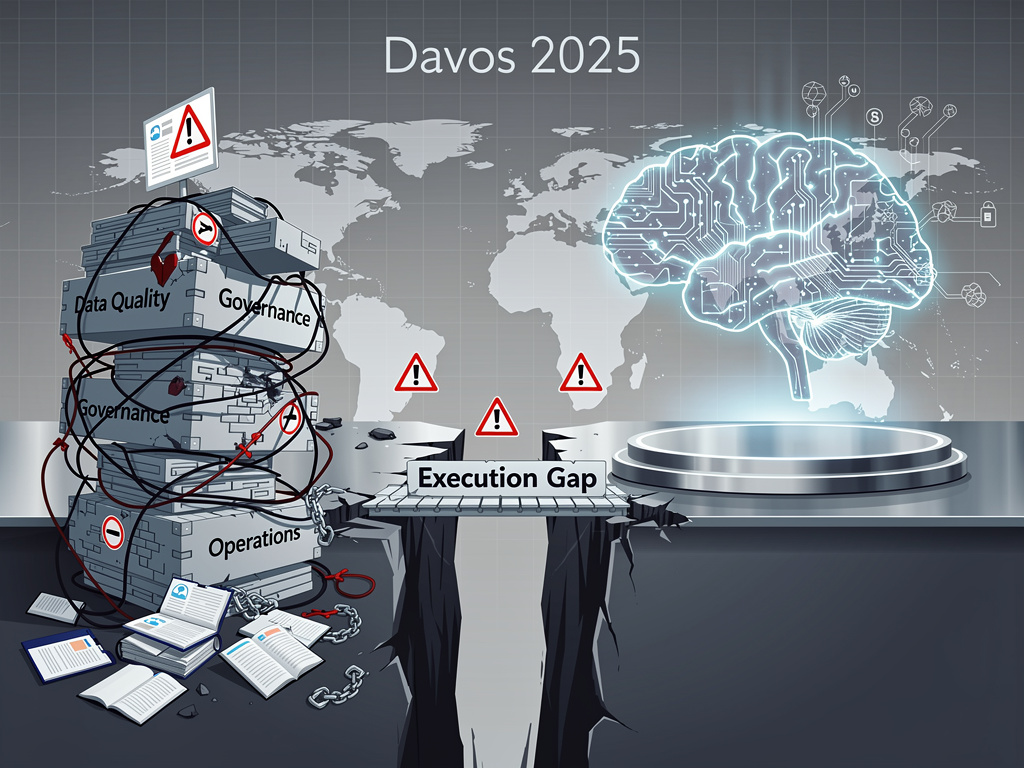
At the World Economic Forum’s annual gathering in Davos this January, artificial intelligence dominated nearly every panel, backroom negotiation, and fireside chat. But according to industry observers who attended the event, the conversation has raced so far ahead of practical implementation that many organizations risk building on foundations of sand. The gap between executive ambition and operational readiness has never been wider — and the consequences of ignoring that gap could prove costly.
As reported by TechRadar, the AI discussions at Davos 2025 have “sprinted ahead” of where most organizations actually stand, and the industry needs to return to fundamentals. The piece, authored by Tony Lorentzen of Precisely, argued that while boardrooms are buzzing with talk of agentic AI, autonomous systems, and transformative business models, many companies still lack the basic data quality and governance frameworks required to make any of those visions work.
The Davos Hype Machine and the Reality on the Ground
Every year, Davos functions as a barometer for where global business leaders believe the economy is heading. In 2025, AI wasn’t just a topic — it was the topic. According to the World Economic Forum’s own reporting, more than 60% of sessions at this year’s gathering touched on artificial intelligence in some capacity. CEOs from technology firms, financial institutions, healthcare conglomerates, and energy companies all spoke in confident terms about deploying AI agents, automating complex workflows, and fundamentally reshaping their industries within the next two to three years.
But the confidence expressed on stage often masked a more sobering reality. As Lorentzen noted in his TechRadar analysis, the excitement around AI at Davos largely skipped over the foundational work that determines whether AI projects succeed or fail. Data quality, data integrity, and governance — the unsexy but essential building blocks — were conspicuously absent from most high-profile discussions. “We need to go back to basics,” Lorentzen wrote, warning that organizations are setting themselves up for expensive failures by prioritizing flashy AI deployments over the preparatory work that makes those deployments reliable.
Data Quality: The Overlooked Bottleneck
The problem is not new, but it has grown more urgent. For years, data scientists and engineers have repeated the axiom that AI models are only as good as the data they consume. Poor data quality leads to poor outputs — a principle that holds whether you’re running a simple regression model or deploying a sophisticated large language model. Yet survey after survey reveals that most enterprises still struggle with fragmented, inconsistent, and incomplete data. A 2024 report from Gartner estimated that poor data quality costs organizations an average of $12.9 million per year. When AI systems are layered on top of that flawed foundation, the costs — financial, reputational, and operational — multiply.
What makes the current moment particularly precarious is the speed at which companies are moving. The competitive pressure to deploy AI is immense. Boards want results. Investors want to hear about AI strategies on earnings calls. And the technology itself is advancing at a pace that makes waiting feel like falling behind. But as Lorentzen argued, speed without substance is a recipe for failure. Organizations that rush to implement AI without first addressing their data infrastructure are likely to encounter hallucinations, biased outputs, compliance violations, and eroded trust — problems that are far more expensive to fix after deployment than before.
Agentic AI Raises the Stakes Even Higher
One of the hottest topics at Davos 2025 was agentic AI — systems capable of acting autonomously, making decisions, and executing tasks without continuous human oversight. The promise is enormous: AI agents that can manage supply chains, handle customer service interactions, process insurance claims, or even conduct financial transactions independently. Major technology companies including Microsoft, Google, and Salesforce have all made significant investments in agentic AI capabilities over the past year.
But the risks of agentic AI operating on unreliable data are qualitatively different from those of traditional AI tools. When a chatbot gives a wrong answer, a human can catch and correct it. When an autonomous agent makes a decision based on flawed data — say, approving a fraudulent transaction or misrouting a shipment — the error may propagate through multiple systems before anyone notices. The tolerance for data inaccuracy drops to near zero when AI systems are empowered to act on their own. This is the point that many Davos conversations glossed over, according to TechRadar: the more autonomy you give AI, the more rigorous your data governance must be.
Regulation Is Coming, Ready or Not
Adding to the urgency is the regulatory environment, which is tightening rapidly across multiple jurisdictions. The European Union’s AI Act, which began phased implementation in 2024, imposes strict requirements on high-risk AI systems, including mandates around data quality, transparency, and human oversight. In the United States, while federal legislation remains fragmented, state-level regulations and sector-specific guidelines from agencies like the SEC and the FDA are creating a patchwork of compliance obligations. Companies that have not invested in data governance and integrity frameworks will find it increasingly difficult — and expensive — to meet these requirements.
The regulatory dimension was discussed at Davos, but often in abstract terms. Panels featured debates about whether regulation stifles innovation or protects consumers, but fewer sessions addressed the practical mechanics of compliance. For CIOs and chief data officers watching from their offices, the message should be clear: regulators are not going to wait for companies to get their data houses in order. The time to act is now, not after the first enforcement action lands.
What Going Back to Basics Actually Looks Like
So what does it mean, in concrete terms, to return to fundamentals? According to Lorentzen’s analysis, it starts with data integrity — ensuring that data is accurate, consistent, and contextually appropriate across the entire organization. This means investing in data observability tools that can detect anomalies and quality issues in real time. It means establishing clear data ownership and accountability structures so that when problems arise, there is a defined process for resolution. And it means treating data governance not as a compliance checkbox but as a strategic capability that directly enables AI performance.
It also means being honest about organizational readiness. Not every company needs to deploy agentic AI in 2025. For many, the more productive investment would be in cleaning up legacy data systems, standardizing data formats across business units, and building the internal expertise needed to manage AI responsibly. The companies that will ultimately win the AI race are not necessarily those that move fastest, but those that build on the strongest foundations.
The Cost of Getting It Wrong Is Growing
Recent months have provided ample cautionary tales. In early 2025, several high-profile AI deployments were rolled back or scaled down after producing unreliable results. Air Canada faced legal consequences after its AI chatbot provided inaccurate information to a customer about bereavement fare policies — a case that underscored how even relatively simple AI applications can create liability when data and training are inadequate. These incidents are not anomalies; they are early signals of what happens when ambition outpaces preparation.
The financial markets are also beginning to differentiate between companies with genuine AI capabilities and those engaged in what some analysts have called “AI washing” — the practice of overstating AI integration to boost valuations. As investor scrutiny increases, companies that cannot demonstrate sound data governance and measurable AI outcomes may find their premium valuations difficult to sustain. The Davos conversation, for all its energy, may have inadvertently widened this credibility gap by encouraging executives to talk about AI in aspirational rather than operational terms.
A Call for Discipline in the Age of AI Exuberance
The enthusiasm at Davos 2025 was understandable. Artificial intelligence represents one of the most significant technological shifts in decades, and the business opportunities are real. But enthusiasm without discipline is dangerous. As the TechRadar piece made clear, the industry needs fewer keynotes about the transformative potential of AI and more honest conversations about the hard, unglamorous work required to make that potential real.
For business leaders who left Davos energized and eager to accelerate their AI strategies, the most valuable thing they can do upon returning to their offices is ask a simple question: Is our data ready for this? If the answer is anything other than an unequivocal yes, the smartest move is not to push forward faster — but to slow down and get the basics right. The organizations that heed this advice will be the ones still standing when the hype cycle inevitably turns.


 WebProNews is an iEntry Publication