
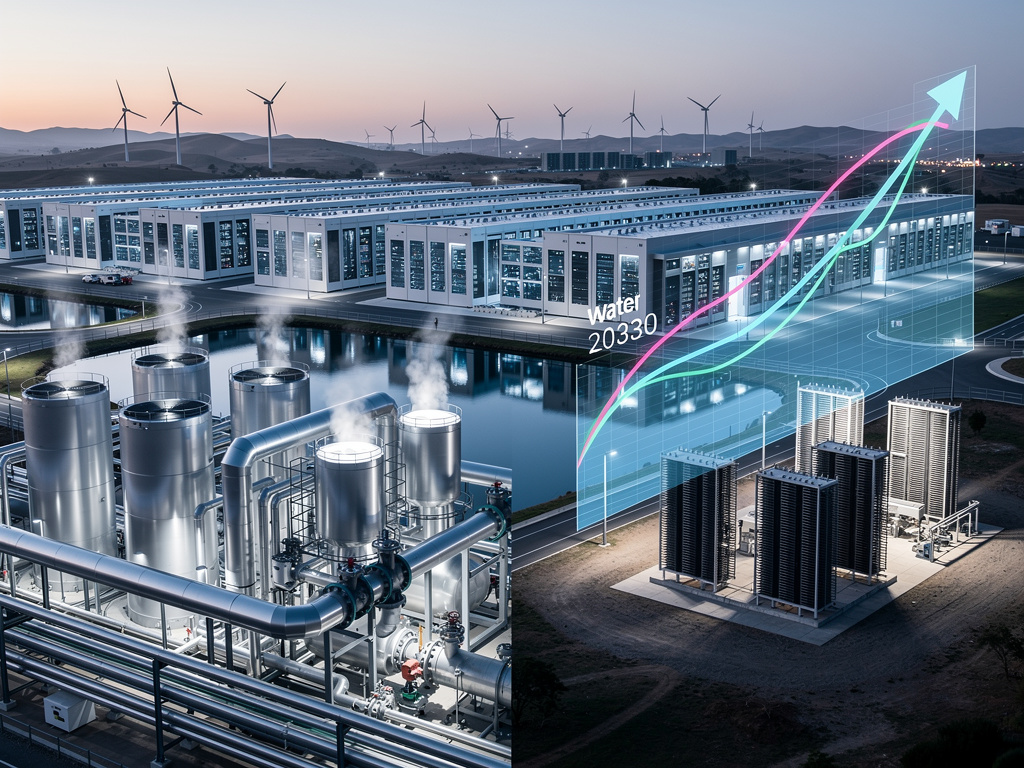
Data center operators face mounting pressure over water consumption. The AI boom drives explosive growth in facilities that need constant cooling. Yet fresh supplies run short in many regions. Short sentences capture the tension. Longer ones reveal the trade-offs between power, emissions, and local resources that operators now confront daily.
Evaporative cooling remains common. It pulls fresh water to absorb server heat before the liquid evaporates in towers. Google’s site in Council Bluffs, Iowa, for instance, used more than 1 billion gallons in 2024 alone. Ars Technica reported how this method saves energy yet leaves a visible footprint. Projections warn of escalation. A Lawrence Berkeley National Laboratory analysis from 2024 estimated hyperscale centers could reach 33 billion gallons annually by 2030 under heavy reliance on such systems.
But. Not every location suffers equally. Shaolei Ren, engineering professor at UC Riverside, calls water “a highly local, highly regional issue.” He adds it demands careful management because scarcity varies sharply by watershed. And the summer peak makes matters worse. Cooling demand surges exactly when cities draw more for residents.
Operators Experiment With Alternatives and Regional Strategies
Some companies shift away from evaporative methods entirely. Microsoft, OpenAI, and Oracle signal moves toward designs that cut direct water draw, including for the massive Stargate project in water-stressed parts of Texas. Google takes a measured path. On June 3, 2026, the company outlined commitments to replenish more freshwater than it consumes through local projects, expand reclaimed and recycled water, disclose annual usage, and apply data-driven frameworks tailored to each site’s hydrology. Ben Townsend, Google’s global head of infrastructure and sustainability, explained the logic. “Water is scarce in some regions and plentiful in others,” he said. “A one-size-fits-all strategy just doesn’t work.”
Google has conducted detailed hydrologic assessments for four years. It defended evaporative cooling in April 2026 filings to the European Union for areas with abundant supplies. Research by Ren’s team supports selective use. Full adoption of evaporative cooling during peak periods across U.S. data centers could free 10 to 30 gigawatts of power. That matters where grids strain but water does not. Skip water and power costs climb in summer. “If you don’t use water, the challenge is that you’re going to be using a lot more power in the summer, and that will push up the cost,” Ren noted.
Trade-offs abound. Less evaporative cooling can raise emissions if facilities lean on dirtier electricity. Indirect water use for power generation often exceeds on-site figures. Priscilla Johnson, who directed water strategy at Microsoft from 2017 to 2020 and now consults independently, acknowledges the complexity. “The industry has to be challenged to design smarter and simplify things,” she said. Public pressure and rules matter.
Recent examples show friction. A Quality Technology Services facility in Georgia drew nearly 30 million gallons without initial payment or full reporting, according to neighbors who noticed low pressure. The developer later owed roughly $150,000. Politico detailed the incident just weeks ago. In Texas, more than 400 centers operate or rise, with hundreds more planned. Current data center water use sits below 1 percent of state totals. Yet a University of Texas at Austin white paper warns the share could hit 3 to 9 percent by 2040 when cooling and power production combine. Manufacturing claims about 7 percent today. “There’s a lot of uncertainty surrounding the water use for data centers,” said Mariam Arzumanyan, postdoctoral fellow at the university’s Bureau of Economic Geology. The paper calls for greater transparency, shared standards, stakeholder communication, and integrated planning across hydrology, grids, land, and permits.
Broader numbers paint urgency. U.S. data centers consumed an estimated 17 billion gallons directly for cooling in 2023. Some forecasts see that quadrupling by 2028. A Bloomberg investigation found two-thirds of new U.S. facilities since 2022 sit in high water-stress zones. Large 100-megawatt sites can draw around 2 million liters daily. That equals thousands of households. And community resistance grows. A Gallup poll cited in recent coverage shows seven in 10 Americans oppose new centers, naming water scarcity their top worry.
Immersion cooling, direct-to-chip liquid systems, closed-loop setups, and free-air cooling in suitable climates gain traction. These approaches cut evaporation. Microsoft deploys zero-water designs for AI hardware in places like Wisconsin and Arizona by raising operating temperatures and pairing liquid with air rejection. It aims to slash usage sharply in desert areas. Amazon expands purified wastewater at dozens of sites, planning over 120 centers on recycled supplies by 2030 and saving hundreds of millions of gallons of fresh water yearly. Google already relies on non-potable sources at more than 25 percent of campuses in some accounts.
Discharged water carries risks too. Higher temperatures and dissolved solids affect drinking supplies, crops, and aquatic species. Legionella concerns arise in poorly maintained towers. Research stays limited, yet parallels with power plants and refineries suggest caution. Up to 85 percent of used water evaporates in traditional towers and leaves the local cycle.
States respond. At least 30 bills addressed data center water in 2025 across 13 states, with more proposed in 2026. Minnesota, Maryland, Idaho, South Dakota, Utah, and West Virginia passed measures. Many push efficiency standards below the U.S. average water usage effectiveness of 0.48 liters per kilowatt-hour or require non-potable sources like recycled water or stormwater. California examines transparency gaps. Lack of uniform reporting hampers understanding of actual draws, sources, and comparisons to other sectors.
SpaceX highlighted the issue in a June 2026 IPO amendment. Water scarcity, rules, and drought could limit development. Microsoft paused projects in Chile over permits. It faces reports of rising internal water projections despite efficiency gains. Google once funded an Oregon lawsuit to block disclosure of planned usage before shifting to annual reporting in 2023.
Operators experiment because the status quo no longer suffices. Liquid cooling now claims a large share of the market and supports denser racks with lower fan power. Yet it introduces new engineering demands around fluids, leaks, and maintenance. Some facilities explore geothermal or adsorption chillers to bypass towers. On-site solar or other renewables pair with these to trim indirect water tied to electricity.
Still, projections vary widely. A UC Riverside study with Caltech estimated peak additional daily water demand from centers could equal New York City’s supply without efficiency gains, requiring $10 billion to $58 billion in infrastructure. Even optimistic cuts leave substantial needs. Texas researchers stress unified definitions so planners, utilities, and developers speak the same language.
Tech firms invest in replenishment. Google funds watershed projects. Microsoft and others back similar local efforts. These offset consumption but do not erase local strain during peaks. Reclaimed water helps. Treatment plants gain a customer for effluent while communities preserve potable reserves. Yet not every site accesses such supplies. Rural or arid spots face harder choices.
The debate continues. Data centers consume far less than agriculture overall. One California almond crop uses vastly more than all U.S. centers combined in some comparisons. Context matters. So does concentration. Clusters in Virginia, Texas, Arizona, Georgia, and the Midwest amplify effects on specific rivers, aquifers, and treatment systems. Residents report dry wells, quality drops, and construction halts near projects.
Industry insiders watch the balance. Power savings from evaporative cooling free grid capacity for more compute. Water savings from air or immersion raise electricity draw and possibly emissions. No perfect answer exists. Regional tailoring, better disclosure, efficiency mandates, and technology shifts offer paths forward. Companies pledge neutrality or net positivity on water. Execution will decide outcomes. Recent announcements from Google and design changes at Microsoft signal seriousness. Whether they scale fast enough to match AI demand remains the open question.


 WebProNews is an iEntry Publication