
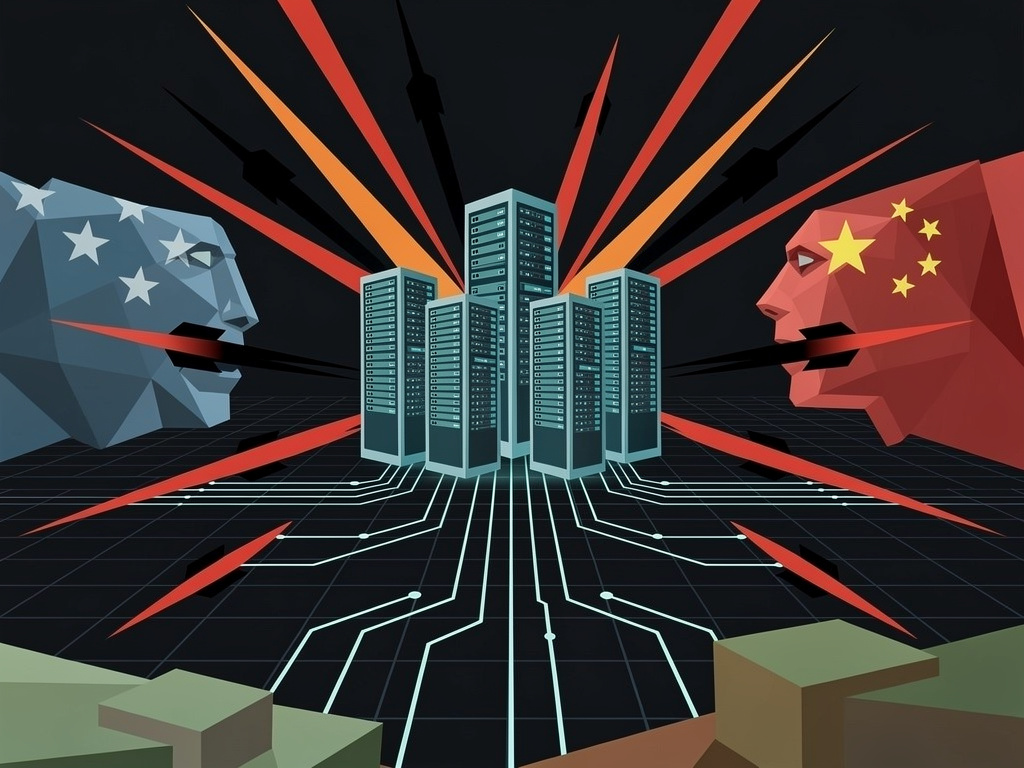
Retired Air Force Lt. Gen. David Deptula pulls no punches. Data is no longer merely a tool of commerce. It is a strategic asset. The former commander warns that a shortfall in data storage and computing capacity could prove catastrophic. Success in future warfare will depend on whether a belligerent has the capability to sense, decide and act faster than an adversary.
That speed demands enormous quantities of intelligence, reconnaissance, cyber, logistics, targeting and operational data. It requires computing capacity to train AI on all of it. Without it, even the most advanced weapons systems sit idle.
Deptula, now dean of the Mitchell Institute for Aerospace Studies, made the case in a recent Washington Post opinion piece. His timing could not be more pointed. Americans push back hard against new data centers and the power plants needed to run them. They cite higher electricity bills, strained water supplies and altered skylines. Yet these facilities have become extensions of national power. Blocking their construction carries risks that reach far beyond local zoning hearings.
And the evidence keeps mounting. During recent fighting involving Iran, U.S. and Israeli forces struck thousands of targets in the opening days. AI-powered platforms from Palantir fused data from multiple sources and delivered rapid targeting information. The results stunned observers. Pentagon leaders took notice. Emil Michael, the Defense Department’s under secretary for research and engineering, recalled his reaction on the All-In podcast. “I’m like, holy s–t, what if this software went down, some guardrail picked up, some refusal happened for the next fight like this one and we left our people at risk?”
Iran’s response drove the point home. It targeted Amazon data centers in the Middle East early in the conflict. The strikes showed adversaries now view commercial compute infrastructure as legitimate military targets. No longer abstract. Physical. Immediate.
Ukraine offers another lesson. Its forces deploy drones with growing levels of autonomous technology. These systems rely on onboard processing and constant data flows. They demonstrate how compute shapes battlefield outcomes in real time. Nearly every military function now depends on the ability to store, move, process, secure and exploit vast quantities of data at speed and scale. Deptula argues the nation with the best data infrastructure will possess a decisive advantage in the next era of warfare. The U.S. cannot afford to lose that position.
China understands this. It mobilizes industrial resources at a pace few democracies match. While the United States still leads globally in data center capacity, the gap narrows. Local resistance in dozens of communities threatens to widen it further. Rising electricity prices draw particular fire. Voters blame AI-driven demand. Utilities in regions like PJM report wholesale power prices jumped 76 percent year-over-year in early 2026, largely due to data center loads. Capacity costs surged even more. These pressures fuel moratorium bills and zoning fights from Florida to Virginia.
Yet treating data centers as mere commercial buildings misses the strategic picture. They function as modern factories for intelligence and decision superiority. Matt Wyckhouse, founder and CEO of Finite State, put it plainly in recent commentary. “Data centers are becoming the factories of the AI economy. If we are going to depend on them for national-scale compute, we should secure them with the same seriousness we apply to energy, telecommunications, defense, and financial infrastructure.” Congress now debates whether to designate AI data centers as critical infrastructure. The discussion reflects growing recognition but little consensus on implementation.
Physical vulnerabilities compound the challenge. Centralized facilities create single points of failure. Adversaries study them closely. A targeted strike, cyber intrusion or supply chain disruption could slow U.S. decision-making without a shot fired. Recent analyses from War on the Rocks describe data centers as assets on the 21st-century battlefield. Current defenses leave many exposed. Geographic dispersion helps. So does hardened power redundancy and classified computing clusters. But progress lags behind the pace of AI adoption.
Power remains the binding constraint. AI training runs consume electricity at unprecedented scale. The Pentagon’s appetite for these tools is insatiable, according to Cameron Stanley, a top DoD AI official. Field-deployable edge systems could ease some burden. They shift lighter workloads away from massive centralized sites. Still, core model development and large-scale inference demand hyperscale facilities. Retired Army chief warrant officer Bill Thompson warned that concentrating compute creates vulnerabilities Chinese forces would exploit. “If they can’t steal it, they will destroy it.”
Some look to space for answers. Orbital data centers promise compute without terrestrial power or water demands. Investment poured in. Figures climbed from $197 million in 2025 to $541 million in the first four months of 2026. Projections reach $39 billion by 2035. SpaceX, Google and Meta explore constellations of satellites packed with GPUs. Proponents highlight real-time processing near data collection points for missile warning or maritime awareness. Lori Gordon of the Aerospace Corporation notes that space-based missions are data-rich and time-constrained. Processing near the point of collection can occur in less time.
But defense officials remain skeptical. A senior Space Force officer called the concept intriguing yet embryonic. Brett Scott, director at the National Reconnaissance Office, said it remains very early days for understanding viability. One expert summed up the prevailing Pentagon view with a simple phrase. “If they build it, we might come.” Technical hurdles explain the caution. Cooling AI chips in vacuum proves expensive. Power requires vast solar arrays. Radiation hardening limits chip options. Launch costs still run thousands per kilogram. Satellites last roughly five years. Michael Pierce of Technology Strategy Partners calculates orbital facilities cost about five times more than terrestrial ones over 20 years. Replenishment never stops.
So the bulk of capability stays grounded. And the ground faces growing strain. Brookings Institution tracking shows federal AI contract obligations hit $7.2 billion in 2026, a massive jump from prior years. The Defense Department accounts for nearly all of it. That spending drives data center demand. At the same time, 27 states have advanced bills on energy costs or construction limits. Bipartisan agreement on regulation emerges even as federal policy pushes acceleration.
Local costs are real. Communities absorb higher utility rates, increased water consumption and construction traffic. Yet the alternative carries heavier weight. A compute gap hands adversaries the tempo of operations. It slows targeting cycles. It limits autonomous system performance. It cedes information dominance. Recent coverage in Breaking Defense highlights how national security planners watch commercial progress before committing. They cannot wait forever.
Deptula’s message lands at a pivotal moment. Public frustration with data centers is understandable. So is concern over energy infrastructure buildout. But these debates must incorporate the full strategic picture. Data centers no longer serve only cloud services or streaming video. They power the kill chain. They enable intelligence fusion at machine speeds. They train models that detect patterns humans miss. Denying their expansion on narrow grounds risks broader failure.
The United States retains advantages. It leads in innovation, attracts talent and commands superior energy resources. Those strengths matter only if converted into deployed capability. That conversion happens inside data centers. Policymakers face a choice. Treat these facilities as critical national assets worthy of protection and priority permitting. Or watch competitors close the gap while domestic opposition mounts. The next conflict may not offer time for catch-up.
Recent discussions at the Data Centers & National Security Summit underscore the stakes. Federal resources must accelerate infrastructure without sacrificing security standards. Partnerships with industry remain essential. Background screening, supply chain vetting and physical protections cannot be afterthoughts. The factories of AI warfare demand the same rigor once reserved for shipyards and air bases.
Short-term pain from new construction pales against long-term risk. Higher bills today. Or decisive disadvantage tomorrow. The math favors action. So does the record from recent operations. Data centers have entered the battlefield. The only question is whether America will build enough of them, fast enough, in the right places.


 WebProNews is an iEntry Publication