
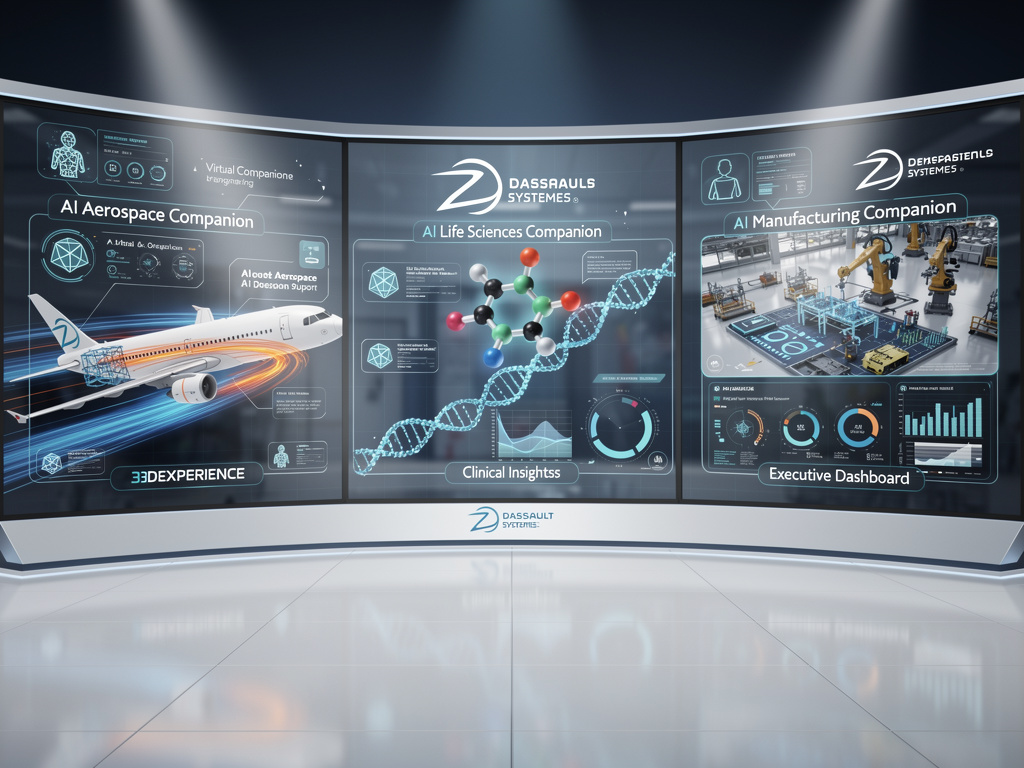
The French industrial software giant Dassault Systèmes is making one of its most ambitious moves yet in the artificial intelligence arena, unveiling a suite of AI-powered “Virtual Companions” designed to fundamentally alter how professionals across manufacturing, life sciences, and infrastructure interact with complex data and simulation tools. The announcement, made on February 11, 2025, signals a strategic pivot that positions the company not merely as a provider of design and simulation software, but as an architect of a new paradigm in industrial decision-making.
The Virtual Companions are embedded across Dassault Systèmes’ 3DEXPERIENCE platform and are purpose-built to serve specific professional roles — from engineers and scientists to supply chain managers and C-suite executives. Unlike generic AI chatbots that have proliferated across consumer and enterprise software, these companions are trained on domain-specific knowledge and integrated directly into the workflows that drive product development, regulatory compliance, and manufacturing operations, as reported by Yahoo Finance.
A Departure from Generic AI: Companions Built for Industry Professionals
Pascal Daloz, CEO of Dassault Systèmes, framed the launch as a response to the limitations of current AI implementations in industrial settings. “AI should not just answer questions — it should understand the context of the work, the constraints of the industry, and the intent of the user,” Daloz said in the company’s official announcement. The Virtual Companions are designed to do precisely that: they don’t simply retrieve information but actively assist in navigating the intricate, multi-disciplinary processes that define modern product lifecycle management.
Each companion is tailored to a specific domain within the 3DEXPERIENCE platform. For engineers working in CATIA, Dassault’s flagship computer-aided design application, the companion can suggest design modifications based on simulation results, manufacturing constraints, and historical project data. For scientists using BIOVIA in pharmaceutical research, the companion can help navigate regulatory frameworks and accelerate the identification of promising molecular candidates. The ambition is clear: to make AI not a bolt-on feature but an embedded collaborator that understands the nuances of each professional discipline.
The Strategic Calculus Behind the Move
Dassault Systèmes’ bet on role-specific AI companions comes at a time when the industrial software sector is undergoing rapid transformation. Competitors including Siemens, PTC, and Autodesk have all made significant investments in generative AI capabilities over the past 18 months. Siemens, in particular, has been aggressive in integrating AI across its Xcelerator platform, while PTC has leveraged its ServiceMax and Codebeamer acquisitions to build AI-driven service and requirements management tools.
What distinguishes Dassault’s approach, according to the company, is the depth of integration with its virtual twin technology. The 3DEXPERIENCE platform has long been built around the concept of virtual twins — high-fidelity digital replicas of products, processes, and even human biology. The Virtual Companions leverage these twins as their knowledge substrate, meaning they can reason about the physical behavior of a product, the dynamics of a supply chain, or the biological response to a drug candidate in ways that generic large language models cannot. As Yahoo Finance reported, the company emphasized that these companions are grounded in scientific accuracy and industrial know-how rather than probabilistic text generation alone.
How Virtual Companions Work in Practice
Dassault Systèmes outlined several concrete use cases during the announcement. In aerospace and defense — a sector where the company has deep roots, counting Airbus, Boeing, and Lockheed Martin among its customers — the companion for systems engineers can synthesize requirements from multiple stakeholders, flag potential conflicts between subsystems, and recommend trade-offs that balance performance, weight, and cost. This is a process that traditionally requires weeks of cross-functional meetings and manual analysis.
In the life sciences sector, where Dassault has been expanding aggressively through its MEDIDATA and BIOVIA brands, the companion for clinical researchers can help design more efficient trial protocols by analyzing historical trial data, patient demographics, and regulatory precedents. The company claims this can reduce the time from trial design to first patient enrollment by a meaningful margin, though it did not provide specific figures at the time of the announcement.
The Underlying Technology: Retrieval-Augmented Generation Meets Virtual Twins
Under the hood, the Virtual Companions employ a hybrid architecture that combines large language models with retrieval-augmented generation (RAG) techniques, drawing from the vast repositories of structured and unstructured data within the 3DEXPERIENCE platform. This approach addresses one of the most persistent criticisms of generative AI in industrial contexts: the tendency to “hallucinate” or produce plausible but incorrect outputs.
By grounding the AI’s responses in verified simulation data, validated engineering models, and curated regulatory databases, Dassault aims to deliver a level of trustworthiness that is essential in industries where errors can have catastrophic consequences. Florence Hu-Aubigny, Executive Vice President of Research & Development at Dassault Systèmes, noted that the companions are designed with “guardrails that ensure scientific and engineering rigor,” according to the company’s press materials published via Yahoo Finance. The system is built to cite its sources and explain its reasoning, giving professionals the ability to audit and validate AI-generated recommendations before acting on them.
Market Implications and the Race for Industrial AI Dominance
The timing of Dassault’s announcement is notable. The company is set to report its full-year 2024 financial results in the coming weeks, and analysts have been watching closely to see how its AI strategy translates into commercial traction. Dassault Systèmes has historically commanded premium pricing in the PLM (product lifecycle management) market, and the addition of AI companions could further justify that premium — or, if poorly executed, become a costly distraction.
Industry analysts have noted that the real test for Dassault will be adoption. Enterprise customers in aerospace, automotive, and pharmaceuticals tend to be conservative in their technology adoption, particularly when it comes to tools that influence critical design and regulatory decisions. The company will need to demonstrate not only that the companions are technically capable but that they integrate seamlessly into existing workflows without creating new bottlenecks or compliance risks. The broader industrial AI market is projected to grow substantially in the coming years, with McKinsey estimating that generative AI could add between $2.6 trillion and $4.4 trillion in value annually across industries, a figure that underscores the stakes involved.
What This Means for the Workforce and the Future of Engineering
Perhaps the most provocative aspect of Dassault’s announcement is its implicit vision for the future of professional work in engineering and science. The company is careful to frame the Virtual Companions as augmentation tools rather than replacements, but the capabilities described suggest a significant shift in how knowledge-intensive work is performed. If a companion can synthesize requirements, flag design conflicts, and recommend trade-offs, the role of the engineer evolves from one of manual analysis to one of strategic oversight and creative problem-solving.
This is a narrative that resonates across the technology sector, but it carries particular weight in industries where deep domain expertise has traditionally been the primary source of competitive advantage. The question for Dassault’s customers is whether AI companions will democratize that expertise — making it accessible to less experienced professionals — or whether they will simply accelerate the work of those who already possess it. The answer will likely vary by organization, but the direction of travel is unmistakable.
Dassault’s Long Game in the Age of Intelligent Industry
Dassault Systèmes has been building toward this moment for years. Its acquisitions of Medidata Solutions in 2019 for $5.8 billion and its steady investment in cloud infrastructure and virtual twin technology have all been laying the groundwork for an AI-first platform strategy. The Virtual Companions represent the most visible manifestation of that strategy to date, and they signal that Dassault intends to compete not just on the strength of its simulation and design tools, but on the intelligence layer that sits on top of them.
For industry insiders, the key question is whether Dassault can execute on this vision at scale. The company has a strong track record in serving the world’s most demanding manufacturers and regulators, but the integration of AI into mission-critical workflows is uncharted territory for the entire sector. If Dassault gets it right, the Virtual Companions could become as indispensable to tomorrow’s engineers as CAD software is today. If not, they risk joining the growing list of AI features that generate more hype than value. Either way, the announcement marks a defining moment in the evolution of industrial software — and the broader integration of artificial intelligence into the physical world.


 WebProNews is an iEntry Publication