
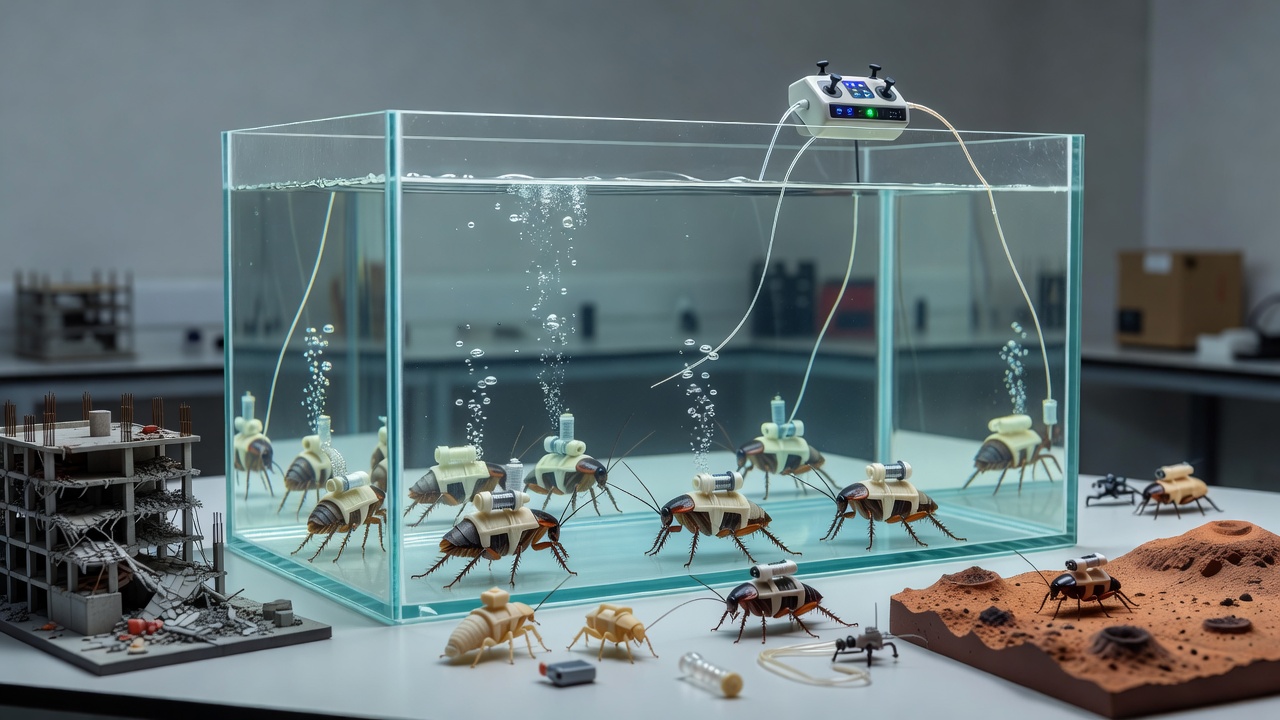
Scientists in Singapore have outfitted Madagascar hissing cockroaches with 3D-printed diving suits. The insects, already wired for remote control, can now walk underwater for up to three hours. The breakthrough pushes biohybrid robots closer to real-world deployment in flooded disaster zones. And perhaps one day on the surface of Mars.
The work comes from a team led by Hirotaka Sato at Nanyang Technological University. They published their findings in Nature Communications on June 29, 2026. The suits generate oxygen chemically. They deliver it directly to the roaches’ breathing pores. Tests showed the equipped insects maintained speed and responsiveness with few ill effects. New Scientist first detailed the project days before the journal release.
These are not the first remote-controlled cockroaches. Researchers have implanted electrodes in their antennae and cerci for years. Sato’s group demonstrated single-insect steering in 2021. By 2024 they coordinated swarms of 20. The latest advance solves a glaring weakness. Cockroaches suffocate underwater within minutes. The new suit changes that equation completely.
The design is deceptively simple. A flexible waterproof shell covers the abdomen. Tiny hoses route oxygen to thoracic spiracles. The main body of the suit stays clear of the legs. That preserves natural gait. Inside a small reactor, manganese dioxide catalyzes the breakdown of hydrogen peroxide. Oxygen flows. Water is the only byproduct. A hydrophobic membrane keeps liquid contained.
Researchers implanted the control electronics. Earlier backpack versions slowed the insects. The newer approach places the chip and tiny battery inside the body. This lowers the center of gravity. It improves stability on land and underwater. One test subject traversed narrow crevices that would trap bulkier machines. Another navigated a tunnel filled with carbon dioxide and water. The suit held. The roach kept moving.
Performance numbers impress. On dry ground the cyborgs averaged 87.5 millimeters per second. Underwater that dropped only to 78.4 millimeters per second. Angular turning slowed more due to drag. Yet the insects responded to commands for the full three hours. Five test subjects showed normal behavior three days later. No chemical leaks. No overheating. The reaction stayed at room temperature.
Energy efficiency stands out. Traditional micro-robots burn through batteries fast. These living platforms carry their own metabolic power. They need food only every few weeks. They tolerate radiation, low oxygen and high carbon dioxide. They squeeze through gaps that defeat mechanical alternatives. Tom’s Hardware noted on July 3, 2026, that some versions now carry infrared cameras. The added payload points toward practical search-and-rescue roles.
Sato sees bigger horizons. “The ultimate goal is to take this technology to space,” he told New Scientist. “It’s kind of one step, one big step, towards space suits for cyborg insects. Exploration over the Mars surface, for example.” The idea sounds far-fetched. Yet the insects’ resilience makes them candidates for planetary missions where electronics fail. They could scout lava tubes or radiation-heavy terrain. They could report back via wireless links.
Of course questions remain. Space agencies worry about biological contamination. Cockroaches carry microbes. Releasing them on another world could complicate future searches for native life. The suits themselves need refinement. Oxygen generation is passive. Future versions may add sensors to match supply to demand. Different insect species will require tailored designs. Jumping insects, for instance, cannot handle extra weight the same way.
The research builds on decades of work. DARPA funded early insect-computer hybrid efforts in the 2000s. Hobbyist kits let students build their own RoboRoaches. What began as classroom demonstrations has matured into systematic engineering. Automated assembly techniques described in related 2025 Nature Communications papers suggest swarms could be produced at scale. Vision-guided robotic arms implant electrodes in under 70 seconds. Consistency improves. Costs fall.
Critics raise ethical flags. Is it fair to turn sentient creatures into disposable drones? The roaches live up to five years in ideal conditions. The experiments appear to cause minimal harm. Yet the boundary between tool and animal blurs. Engineers counter that the insects already thrive in harsh human environments. They eat waste. They survive atomic blasts in lab tests. A few hours underwater seems minor by comparison.
Practical applications feel closer. Imagine a swarm released after an earthquake or flood. The cyborgs slip under rubble, through pipes, into submerged basements. Infrared cameras spot survivors. Tiny microphones triangulate sounds. Data streams back to operators. Traditional robots get stuck or run out of power. These do not. They refuel themselves. They tolerate conditions that destroy silicon.
Recent coverage shows growing interest. Futurism highlighted the amphibious advance on July 5, 2026. Social media erupted with jokes about cockroach armies. Yet behind the memes sits serious engineering. Related papers from 2025 and early 2026 explore solar-powered backpacks, AI that reads insect neural signals, and light-driven control without surgery. The field is accelerating.
Sato’s team has not stopped at water. They discuss extending the concept to other extremes. High radiation. Extreme cold. Toxic atmospheres. Each new suit expands the operational envelope. The insects become general-purpose platforms. Biology supplies the chassis. Engineers add the upgrades.
Challenges persist. Habituation can dull responses over time. Battery life for the implanted electronics still limits mission duration. Communication range underwater shrinks. Signal processing must improve. Integration of more sensors without overloading the host remains tricky. The paper acknowledges these limits. It frames the diving suit as one module in a larger toolkit.
Even so the results mark clear progress. Three hours underwater. Near-native speed. Full recovery afterward. That combination did not exist before. For search-and-rescue teams waiting on the next big disaster, the prospect of insect scouts is no longer science fiction. It is the next procurement specification.
And if a few of those scouts eventually crawl across Martian regolith? That would be an unexpected bonus. The cockroaches would not mind. They have survived worse.


 WebProNews is an iEntry Publication