
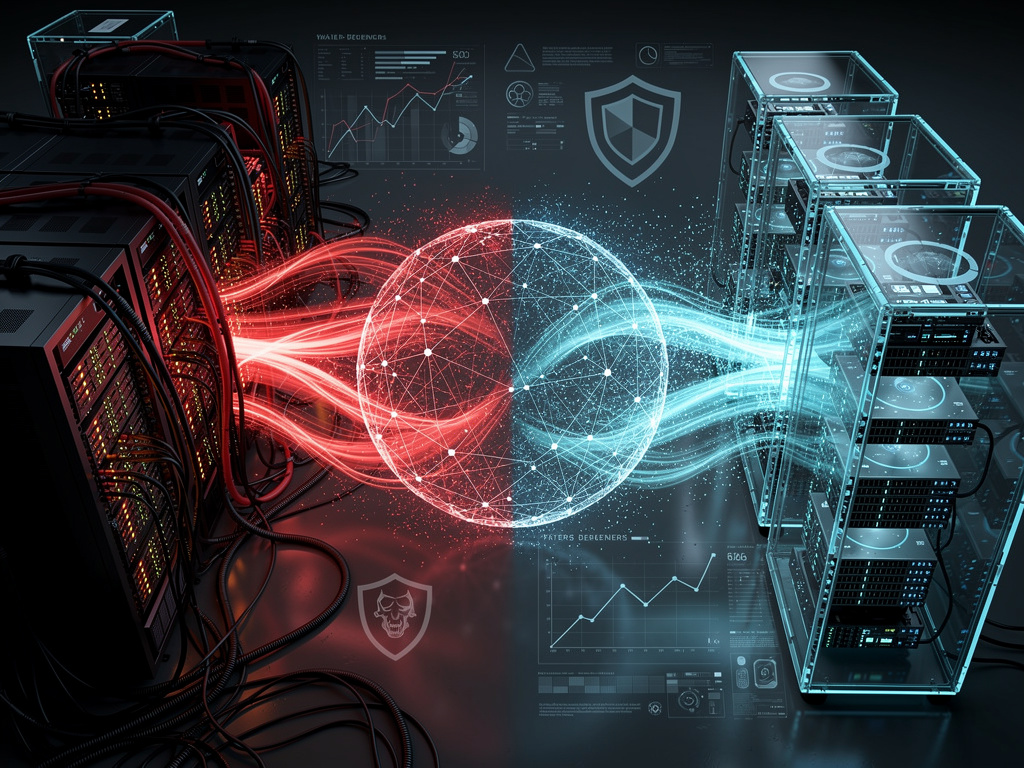
NEW YORK—The conversation around artificial intelligence in cybersecurity has long been a deafening roar of futuristic hypotheticals. For years, industry conferences and boardroom presentations have painted pictures of autonomous AI hackers battling sentient defense networks. But as 2026 approaches, the hype is dissolving, revealing a more immediate and pragmatic reality: AI is not a sentient adversary, but a powerful, versatile tool that is fundamentally reshaping the tactics of both cybercriminals and their corporate targets.
The shift is from abstract fear to tangible strategy. The most sophisticated threat actors and enterprise defenders are no longer just experimenting with AI; they are integrating it into their core operations. This has ignited a new kind of arms race, one defined not by fully autonomous agents but by the effectiveness of human-AI hybrid teams. The central question is no longer *if* AI will change cybersecurity, but who can more effectively augment human ingenuity with machine speed and scale. The winners in this new era will be those who master this symbiotic relationship first.
The End of the Typo: AI Perfects the Art of Deception
For decades, the tell-tale sign of a phishing email was a clumsy typo or awkward grammar. Generative AI has rendered that safety check obsolete. Attackers are now leveraging Large Language Models (LLMs) to craft flawless, contextually aware, and highly personalized social engineering lures at an unprecedented scale. These are not just grammatically perfect emails; they can mimic a CEO’s writing style, reference recent company events, and adopt the precise professional tone needed to trick even the most discerning employee. Experts at the cybersecurity firm Sophos predict that by 2026, the use of AI for crafting these hyper-realistic attacks will be standard operating procedure for cybercriminals, according to a recent analysis (Sophos).
The threat extends far beyond text. The rise of AI-powered voice and video synthesis has armed attackers with the ability to execute deepfake-driven business email compromise (BEC) scams with terrifying authenticity. Earlier this year, a finance worker at a multinational firm in Hong Kong was duped into transferring over $25 million after attending a video call with what he believed were his senior colleagues, but were in fact AI-generated deepfakes. This incident, reported by news outlets globally, serves as a stark illustration of the new reality (CNN). By 2026, security teams will have to contend with attackers who can not only write like the CFO but also sound and look like them on a video conference, making traditional identity verification methods dangerously inadequate.
A Force Multiplier in the Hacker’s Toolkit
Beyond crafting convincing lures, generative AI is becoming an indispensable assistant for malware development and attack execution. While early fears focused on AI creating novel, unstoppable super-malware from scratch, the more immediate impact is its role as a force multiplier. For less-skilled attackers, AI tools can help write functional malicious code, debug scripts, and identify potential exploits in software, significantly lowering the barrier to entry for sophisticated cybercrime. For elite hacking groups, AI accelerates their workflow, automating the tedious aspects of reconnaissance and vulnerability scanning, allowing them to focus their human expertise on the most critical phases of an attack.
This evolving dynamic means that defensive strategies must adapt. Security researchers have already observed threat actors discussing on dark web forums how to use generative AI tools to create polymorphic malware, which alters its code with each new victim to evade signature-based detection. This capability, once the domain of highly advanced adversaries, is becoming more accessible. A recent analysis detailed how hackers are experimenting with AI to refine and accelerate these malicious development cycles, underscoring the urgency for defenses that can identify threatening behavior rather than just matching known malware signatures (IBM Security Intelligence). The result is a faster, more agile adversary capable of launching more varied and complex attacks than ever before.
The Defender’s Co-Pilot in a Data-Driven War
As attackers augment their capabilities with AI, so too must the defenders. The sheer volume of security alerts, log data, and threat intelligence flowing into a modern Security Operations Center (SOC) has surpassed human capacity for analysis. This is where AI is proving to be the defender’s most critical new asset. AI-powered security tools can analyze billions of data points in real-time to detect subtle anomalies and patterns of behavior that would be invisible to a human analyst. It acts as a tireless digital watchman, sifting through the noise to surface the handful of alerts that truly matter.
By 2026, AI will be deeply embedded in the defensive stack, serving as a co-pilot for security professionals. According to industry analysts, generative AI is set to revolutionize security operations by providing natural language interfaces for threat hunting, automating the generation of incident reports, and suggesting remediation steps for vulnerabilities (Gartner). Instead of manually writing complex queries to search for threats, an analyst will be able to ask the system, “Show me all unusual outbound network traffic from the finance department’s servers in the last 24 hours.” This dramatically accelerates response times and frees up highly skilled human experts to focus on strategic decision-making, threat investigation, and proactive defense planning—tasks where human intuition and experience remain irreplaceable.
The Human-Machine Imperative on Both Sides
The Sophos report emphasizes a crucial point that will define the cybersecurity theater of 2026: AI is not replacing the human, but augmenting them. The most effective attacks will not be launched by a rogue AI, but by a cunning human adversary who uses AI to scale their operation, perfect their disguises, and probe defenses with machine-like efficiency. The ultimate decisions—which target to pursue, how to monetize a breach, when to deploy ransomware—will still rest with a person. The human element of creativity, strategy, and intent remains the driving force behind the attack.
Consequently, the most resilient organizations will be those that build their own formidable human-AI defensive teams. An AI can flag a suspicious process, but it takes an experienced incident responder to understand the context, determine the potential business impact, and orchestrate a response. It is this combination of machine-speed data processing and human-led critical thinking that will form the backbone of next-generation cybersecurity. The battle will be won or lost based on which side can more effectively integrate their human and artificial intelligence into a cohesive unit.
An Evolving Frontline in a Faster Conflict
Looking ahead to 2026, the pace of conflict will be the most significant change. AI-driven attacks and defenses will operate at machine speed, shrinking the window between initial compromise and full-scale breach from days or weeks to mere hours or minutes. Attackers will use AI to rapidly pivot within a network, while defenders will rely on AI-powered autonomous response systems to isolate threats before they can spread. This acceleration demands a new security paradigm focused on resilience and rapid adaptation.
The integration of AI will become the standard, not the exception. The novelty will have worn off, and the tools will be ubiquitous. The strategic advantage will belong to the organizations that have not only invested in the right technology but have also retrained their people and redesigned their processes around a human-machine teaming model. The cybersecurity challenges of 2026 will not be solved by buying a better AI, but by building a smarter, more integrated team of humans and machines working in concert to outmaneuver a similarly equipped adversary.


 WebProNews is an iEntry Publication