
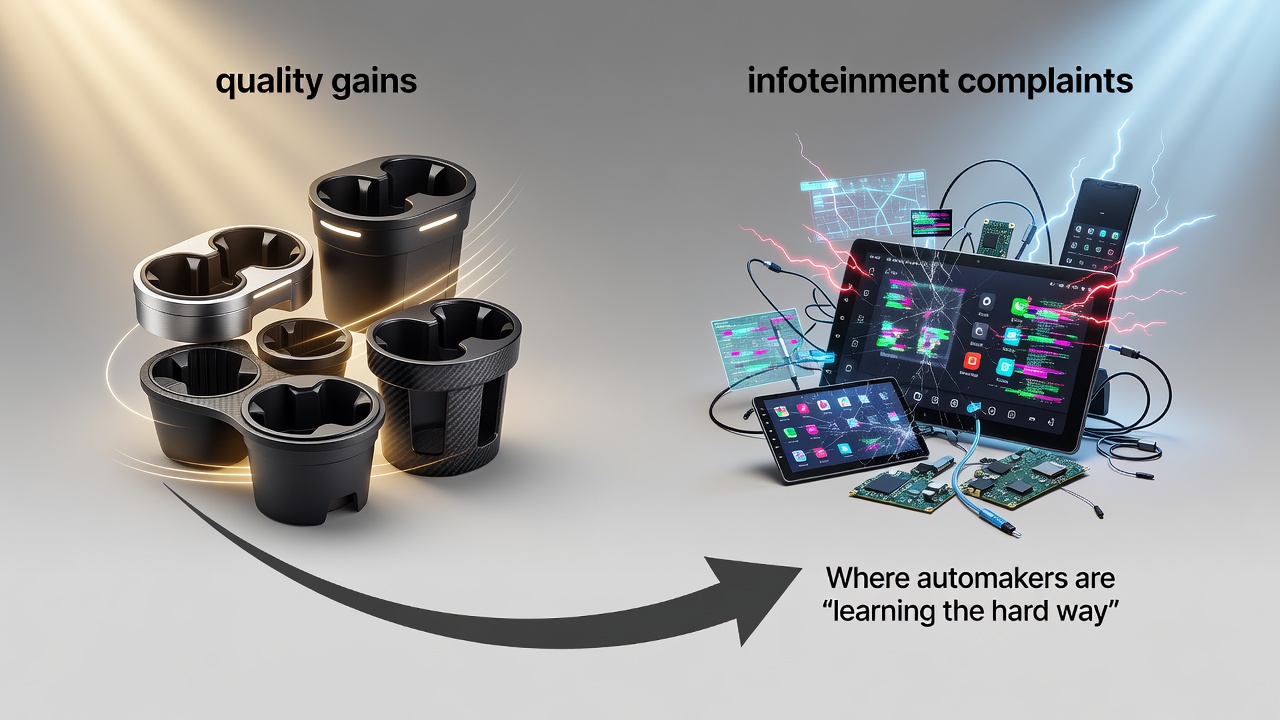
Automakers have poured billions into dashboards that look like command centers. Yet the feature that generates the most tangible daily satisfaction for drivers remains something far simpler. A place to put your coffee.
Cupholder engineering has quietly reached new heights.
Buyers notice. They complain less about beverage holders than ever before. The opposite holds for the glossy touchscreens that dominate modern interiors. Data from the past year shows this split widening. And the contrast reveals much about what actually sways purchase decisions once the novelty of new metal wears off.
J.D. Power’s 2026 U.S. Initial Quality Study delivered the clearest picture yet. Overall vehicle quality jumped to 175 problems per 100 vehicles. That marks the biggest year-over-year gain since 1997. Nine of ten categories improved. Gizmodo reported the standout winner: cupholders. Better placement and adaptability to today’s array of tumblers and bottles drove the gains. Infotainment alone worsened. It climbed to 44.4 problems per 100 vehicles in mass-market brands and 38.3 in premium ones.
Connectivity headaches with Apple CarPlay and Android Auto accounted for much of the rise. Those glitches added 1.4 problems per 100 vehicles. Among drivers who reported distracted-driving incidents, 46 percent traced the issue to infotainment screens or touch controls. Frank Hanley, senior director of auto benchmarking at J.D. Power, put it plainly. “As more technology is introduced into vehicles, keeping the experience simple matters more than ever.” He added that the largest quality improvements stem from features that prove easy to operate and behave as customers anticipate. Complexity invites trouble.
But why do cupholders matter so much? They represent one of the most frequent physical interactions in a car. Americans log roughly 50 minutes daily in their vehicles on average. A wobbly large iced latte or a holder too narrow for a Stanley tumbler creates irritation that repeats for years. Chris Fischer, Nissan’s lead engineer dedicated to cupholders, has spent years wrestling with this reality. “That cup holders work well is important to customer satisfaction,” he told WIRED. “It’s a key decider when buying a car.”
Fischer described the staggering variety of containers that enter vehicles. Small espresso cups. Tall Hydro Flasks. Oversized McDonald’s drinks. Mugs with handles. Heights vary so much that a holder deep enough for one risks letting another tip over. Styling teams often demand clean circular openings that clash with functional needs. Early collaboration between designers and engineers proves essential. Nissan has tested everything from Starbucks cups to 1-liter water bottles. Solutions include adjustable springs, deeper wells, and clever door-pocket integrations. Push-button shifters have freed console real estate for more versatile holders. The 2026 Kia Sportage earned praise on social media for its accommodating designs. Subaru models routinely top lists with 18 or 19 total holders across rows.
Two decades ago a PricewaterhouseCoopers survey already flagged cupholder count as a top purchase factor for American buyers. That priority has not faded. Recent J.D. Power data from the 2025 study, analyzed by DealershipGuy, showed 42.6 infotainment complaints per 100 vehicles. It remained the single largest pain point despite modest overall quality gains. Hanley noted that larger screens look appealing yet their operation creates mounting frustration. Functions once handled by physical knobs now require menu dives or repeated taps. Climate controls. Garage-door openers. Even glove-box releases. Drivers divert attention from the road. Some brands have reversed course. Porsche, Honda, and Volkswagen have reintroduced buttons and dials. Volkswagen’s design chief Andreas Mindt stated the lesson clearly. “We will never, ever make this mistake anymore. It’s not a phone, it’s a car.”
The pattern repeats across model years. Infotainment and connectivity issues generate more complaints than powertrain glitches or exterior fit problems. Carmakers chase software-defined vehicles and subscription features. Owners simply want their drink to stay upright and their music to connect without drama. Market research from 2025 and 2026 projects the automotive cupholder segment itself growing at 5.5 percent annually through 2035. Demand for smart temperature-controlled versions and larger capacities fuels that expansion.
Yet complexity keeps creeping in. Some 2026 models ditch Android Auto entirely in favor of native systems built around AI assistants. General Motors leads this shift in its EVs, citing data ownership and customization. Other manufacturers eye similar moves. The result? More screens. More updates. More opportunities for the system to freeze or demand a restart while you hunt for the right climate setting. And still the cupholder sits there, judged every single commute.
Fischer’s team iterates constantly. They balance depth, diameter, and grip strength against console styling. One innovation seen in recent Nissans involves channels cut between circular holders so handled travel mugs fit without tilting. Door bins now accommodate the tallest bottles with easy one-handed access. These refinements accumulate. They explain why J.D. Power recorded the sharpest drop in cupholder-related gripes this year.
Premium brands did not escape the trend. Porsche posted the best overall score at 138 problems per 100 vehicles. Genesis followed at 151, Lexus at 156. Among mass-market names, Ford led with 152, trailed by Nissan and Buick. The study surveyed more than 78,500 new-vehicle owners and lessees after 90 days. Repair data from dealerships supplemented the responses. The methodology has matured over four decades. Its findings carry weight with product planners.
So what explains the disconnect? Engineers can perfect a mechanical holder that adapts to dozens of container shapes. Software teams struggle to deliver interfaces that feel intuitive at 70 miles per hour. Touch targets shrink. Haptic feedback proves inconsistent. Voice commands mishear road noise. Over-the-air updates introduce fresh bugs. Drivers forgive a quirky climate menu far less readily than they once did. They certainly don’t forgive a drink that spills onto the console.
Recent coverage reinforces the pattern. Engadget reported in June 2026 that several automakers plan to phase out Android Auto and Apple CarPlay in coming years. Subscriptions, data collection, and proprietary AI systems drive the decision. The move risks alienating buyers who prefer familiar phone mirroring. Meanwhile, vehicles like the Hyundai Santa Fe boast up to 18 cupholders. The Kia EV9 offers 12 to 14. Practicality sells when the screen fails to impress.
Buyers vote with their attention. They remember the holder that securely gripped their morning espresso without blocking the wireless charger. They forget the 14-inch touchscreen after the third time it lagged during navigation input. Automotive designers have absorbed the message. Expect continued refinement of simple mechanical solutions alongside cautious experimentation with cabin interfaces. The cupholder has become a quiet benchmark for thoughtful design. Infotainment still searches for the same level of everyday competence.
And that gap may define the next wave of owner loyalty more than any horsepower figure or pixel density ever could.


 WebProNews is an iEntry Publication