
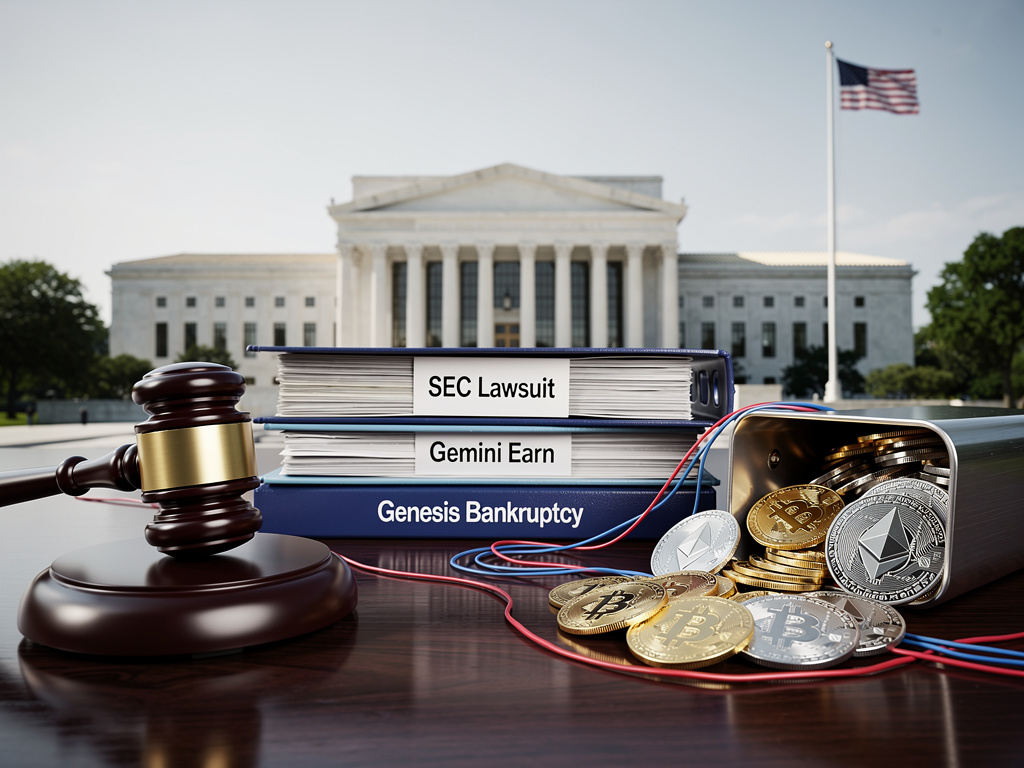
Crypto’s Reckoning: Inside the SEC’s High-Stakes Legal War With the Winklevoss Twins
WASHINGTON—For years, Cameron and Tyler Winklevoss, the twin entrepreneurs famous for their early bet on Bitcoin and their legal battle over the creation of Facebook, have worked to portray their cryptocurrency exchange, Gemini, as the regulated, trustworthy gateway to the digital asset revolution. They sought to build a crypto empire on the bedrock of compliance, a stark contrast to the freewheeling ethos of many rivals. That carefully crafted image is now facing its most severe test in a sprawling legal and financial conflict with the U.S. government’s top markets regulator.
At the center of the dispute is the Gemini Earn program, a product that promised retail investors high-yield returns on their crypto deposits, and its catastrophic collapse, which has ensnared hundreds of thousands of customers and billions of dollars in assets. The fallout has pitted the Winklevoss twins against their former business partner, Genesis Global Capital, and its parent company, Digital Currency Group. More significantly, it has drawn them into the direct line of fire of the Securities and Exchange Commission and its chairman, Gary Gensler, who has launched an aggressive campaign to bring the digital asset industry to heel.
The Genesis of a Lucrative, and Later Lethal, Partnership
The Gemini Earn program, launched in 2021, appeared simple and alluring. Customers could lend their crypto assets through Gemini to a third party, Genesis, which would then re-lend those assets to institutional borrowers at higher rates. In return, Gemini Earn users were promised interest rates of over 7%, a tantalizing offer in an era of near-zero yields in traditional finance. Gemini acted as the agent, connecting its vast customer base with Genesis, the engine generating the returns.
This arrangement unraveled with stunning speed in late 2022 following the implosion of the crypto exchange FTX and the earlier failure of hedge fund Three Arrows Capital, both of which were major borrowers from Genesis. On November 16, 2022, Genesis abruptly halted withdrawals, citing “unprecedented market turmoil.” The move immediately froze the assets of approximately 340,000 Gemini Earn customers, locking away what was later revealed to be over $900 million. The suspension cascaded into a full-blown crisis, forcing Genesis to file for Chapter 11 bankruptcy protection in January 2023, as reported by Reuters.
Washington’s Watchdog Enters the Fray
Just as Genesis was heading for bankruptcy court, the SEC made its move. The agency filed a lawsuit against both Gemini and Genesis, alleging that the Earn program constituted the unregistered offer and sale of securities to retail investors. In its official announcement, the SEC argued that by pooling customer assets and promising a return based on the efforts of Genesis’s lending business, the firms had created an investment contract that fell squarely under U.S. securities laws and required registration and disclosure.
The Winklevoss twins vehemently rejected the charges, framing the lawsuit as a counterproductive distraction from their efforts to recover user funds. Tyler Winklevoss decried the action as a “manufactured parking ticket” and argued that the SEC was engaging in “regulation by enforcement” rather than providing clear rules for the industry. The public feud escalated when Gemini filed its own lawsuit against Digital Currency Group and its founder, Barry Silbert, accusing them of fraud, a move detailed by The Wall Street Journal. This created a complex, multi-front war being fought in federal court, bankruptcy court, and the court of public opinion.
A Critical Courtroom Victory for the SEC
For over a year, Gemini and Genesis fought to have the SEC’s case thrown out, arguing that the Earn program involved simple loans, not securities. But in a pivotal moment for the SEC’s regulatory campaign, a federal judge rejected their motion to dismiss the case in March 2024. U.S. District Judge Edgardo Ramos found that the SEC had “plausibly alleged” that the firms had violated securities laws, allowing the lawsuit to proceed. The ruling, covered by outlets including Bloomberg Law, was a significant validation of the SEC’s application of the Howey Test—a decades-old legal standard—to modern crypto lending products.
While the legal battle with the SEC continues, Gemini has focused on making its Earn customers whole through the convoluted Genesis bankruptcy process. After months of contentious negotiations, a breakthrough occurred. In May 2024, Gemini announced it had secured a settlement that would see 100% of Earn users’ digital assets returned in kind. According to a Gemini blog post, this meant that if a user had lent one bitcoin, they would receive one bitcoin back, allowing them to benefit from the significant appreciation in asset prices since the withdrawals were first halted. The first distributions, representing about 97% of the total assets, were made available shortly after the announcement.
The Wider War on Crypto
The SEC’s case against Gemini is not an isolated event but a key battle in a much broader offensive. Under Chairman Gensler, the agency has pursued an aggressive enforcement-first approach, viewing much of the digital asset sector as a “Wild West” rife with non-compliance. This campaign has resulted in high-profile lawsuits against other major industry players, including Coinbase and Binance, for allegedly operating as unregistered securities exchanges, brokers, and clearinghouses.
This regulatory crusade, chronicled by publications like The New York Times, has created a deep schism between the industry and Washington. Crypto executives argue that the SEC is stifling innovation by applying antiquated laws to a novel technology without providing a clear path to registration. The Winklevoss twins, who once championed a compliance-first approach, now find themselves among the most vocal critics of a regulatory regime they see as fundamentally broken and hostile to their industry’s future.
An Uncertain Future Shaped by Precedent and Politics
The final outcome of the SEC’s lawsuit against Gemini could establish a powerful precedent for the entire American crypto industry. A victory for the SEC would solidify its authority to regulate a wide array of crypto lending and staking products as securities, potentially forcing a radical restructuring of how such services are offered to U.S. investors. This would likely push more crypto activity offshore or force firms to severely limit their product offerings, fundamentally altering the competitive dynamics of the market.
Meanwhile, the frustration with the SEC’s approach has fueled a bipartisan push in Congress to establish a new regulatory framework specifically for digital assets. The recent passage of the Financial Innovation and Technology for the 21st Century Act (FIT21) in the U.S. House of Representatives, as reported by CoinDesk, represents the most significant legislative effort to date to assign regulatory authority and create bespoke rules for the industry. While its fate in the Senate is uncertain, the bill signals a growing political desire to end the regulatory ambiguity that has led to clashes like the one between the SEC and Gemini. For the Winklevoss twins and the industry they helped build, the resolution of these legal and political battles will determine whether their vision of a regulated crypto future can survive its collision with Washington’s old guard.


 WebProNews is an iEntry Publication