
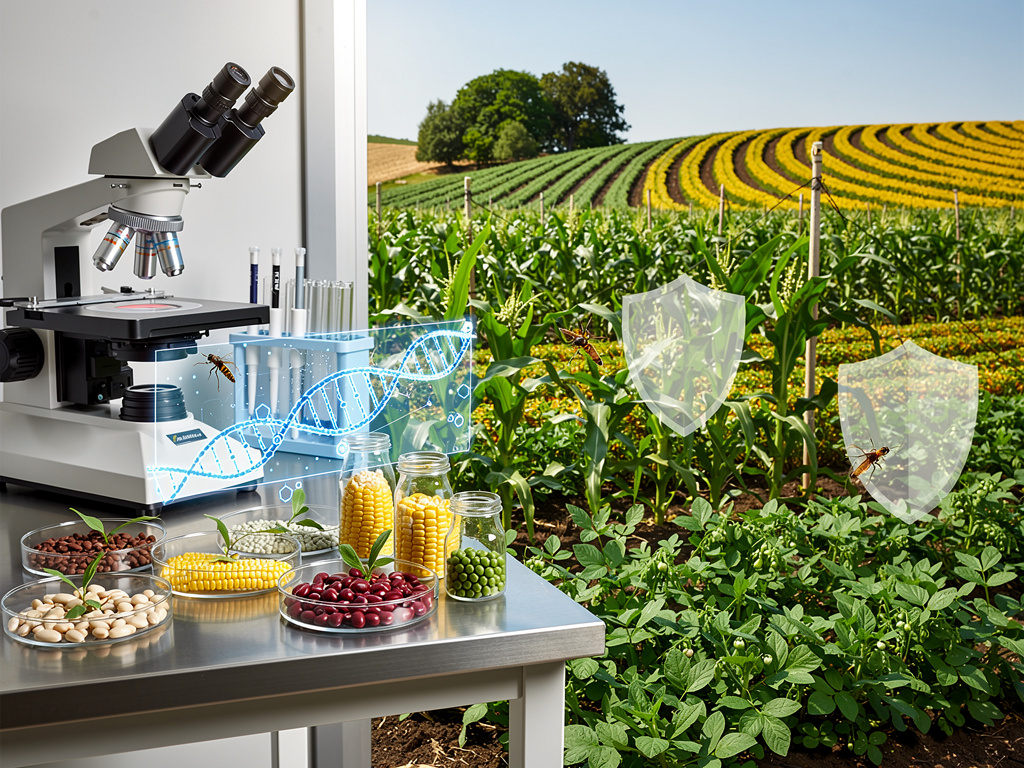
In the ever-evolving world of agricultural biotechnology, a groundbreaking development is poised to reshape how farmers combat one of farming’s oldest foes: insect pests. Scientists have harnessed gene editing to make staple crops like corn, beans, and peas inherently resistant to bugs that devour their starches, potentially slashing the need for chemical pesticides. This innovation, detailed in a recent review by researchers from the University of California, Davis, and published in the journal Crop Biotech Update by ISAAA, centers on enhancing natural proteins called alpha-amylase inhibitors (AIPs). These proteins, already present in some plants, can be fine-tuned through CRISPR technology to render crop starches indigestible to pests, offering a biological shield rather than relying on synthetic sprays.
The approach draws from nature’s own defenses. Certain wild plants produce AIPs that disrupt the digestive enzymes of insects, preventing them from breaking down starches into usable energy. By editing genes to amplify or optimize these inhibitors in commercial crops, researchers aim to create varieties that pests simply can’t stomach. This isn’t about introducing foreign genes, as in traditional genetic modification, but rather precision tweaks to existing plant genomes. The result? Insects starve or move on, while the crops remain nutritious for humans and livestock. Early lab tests on model organisms suggest this could reduce pest damage by up to 50% in affected fields, a boon for regions where starch-loving bugs like weevils and borers wreak havoc on yields.
Beyond the lab, this technology addresses pressing global challenges. With climate change intensifying pest pressures—warmer temperatures allow insects to breed faster and expand ranges—farmers in developing nations often bear the brunt. In sub-Saharan Africa, for instance, post-harvest losses from pests can claim 20-40% of stored grains, exacerbating food insecurity. Gene-edited crops could fortify these supplies without the environmental toll of broad-spectrum insecticides, which harm beneficial pollinators and contaminate waterways.
Unlocking Natural Defenses Through Precision Editing
The science behind this pest resistance builds on decades of biotechnology research. CRISPR-Cas9, the Nobel Prize-winning tool, allows scientists to snip and rewrite DNA sequences with surgical accuracy. In the case of AIP enhancement, researchers target genes that code for these inhibitor proteins, boosting their expression or altering their structure for maximum efficacy against specific pests. A study highlighted in PMC traces the history of genetic modification back to ancient selective breeding, but notes how modern tools like CRISPR accelerate improvements that once took generations.
Field trials are already underway in controlled environments, with promising results. For corn, a crop that feeds billions, edited varieties have shown resilience against the corn earworm, a notorious destroyer. Beans and peas, vital protein sources in many diets, could see similar protections, potentially increasing global output by millions of tons annually. Experts from the FDA, as outlined in their overview on agricultural biotechnology, emphasize that such edits are safe for consumption, undergoing rigorous evaluations to ensure no unintended allergens or toxins emerge.
However, regulatory hurdles vary by country. In the U.S., the EPA and USDA have streamlined approvals for gene-edited crops that don’t introduce foreign DNA, treating them more like conventionally bred varieties. This contrasts with stricter regimes in parts of Europe, where debates over new genomic techniques continue, as discussed in a recent piece from Science Speaks by ISAAA. Proponents argue that harmonizing regulations could speed adoption, especially as food demands rise with a projected population of 9.7 billion by 2050.
Balancing Innovation with Environmental Concerns
Public perception plays a pivotal role in biotechnology’s rollout. While supporters highlight benefits like reduced pesticide use—potentially cutting applications by 30% in edited fields—skeptics worry about long-term ecological effects. Posts on X, formerly Twitter, reflect this divide: some users celebrate breakthroughs in drought-tolerant rice and low-pungency mustard from Indian researchers, crediting genome editing for sustainable gains, while others express alarm over untested genetic tweaks, echoing concerns from activists about interfering with DNA without full knowledge of consequences.
A review in ScienceDirect compares CRISPR to traditional GM methods, noting that gene editing often leaves no detectable trace, making it harder to regulate but potentially safer. This subtlety has fueled debates, with figures like Bill Gates investing heavily in related ventures, as mentioned in various X discussions about synthetic RNA applications in crops. Critics on the platform have raised alarms about potential toxins or unintended alterations, though scientific consensus, including from the WHO in their Q&A on genetically modified foods, affirms the safety of approved biotech products after extensive testing.
Economically, the stakes are high. The global market for genetically modified crops is projected to reach $38 billion by 2032, growing at 5.5% annually, according to Coherent Market Insights. Innovations like pest-indigestible crops could capture a significant share, particularly in Asia and Latin America, where biotech adoption has surged. In 2023, trends reported in another ScienceDirect article showed GM crops boosting yields by 10-20%, with stacked traits for multiple resistances becoming standard.
Case Studies from the Field: Real-World Applications
India’s pivot from traditional GM to genome-edited crops exemplifies this shift. As detailed in Rau’s IAS, progress stalled after Bt cotton’s approval in 2006, but recent genome edits promise drought-resistant rice and other staples. X posts from Indian officials highlight these as transformative for smallholder farmers, potentially reducing import dependencies and enhancing food security.
In the Americas, companies are experimenting with edited soybeans and corn. A breakthrough from the Boyce Thompson Institute, shared on X, used CRISPR to domesticate goldenberry, making it shorter and more harvestable— a model for adapting wild traits into commercial agriculture. Similarly, innovations in nitrogen-fixing crops, like those enabling self-fertilization through root mutations, could complement pest resistance, as noted in various X threads about reducing fertilizer needs.
Challenges remain, including intellectual property rights. A publication in the American Journal of Polymer Science and Technology explores how biotech patents influence public acceptance, with debates over who benefits from these technologies. Farmers in developing regions often face high seed costs, prompting calls for open-source editing tools.
Future Horizons: Integrating Biotech with Sustainable Farming
Looking ahead, integrating gene-edited pest resistance with other traits could create super-crops. For instance, combining AIP enhancements with drought tolerance, as seen in Farmonaut’s 2025 innovations outlined in their news update, addresses multiple climate threats. X buzz around Chinese scientists’ chromosome-editing tools suggests even larger-scale modifications are on the horizon, enabling flawless rewrites of plant genomes.
Environmental groups advocate for transparency. The Frontiers journal’s article on rethinking GM discourse calls for balanced discussions, emphasizing benefits like lower chemical runoff while acknowledging risks. In Europe, the push for new genomic techniques, as per ISAAA’s coverage, could lead to relaxed rules, fostering innovation.
Ultimately, this pest-fighting strategy represents a paradigm of smart agriculture. By making crops indigestible to invaders, it minimizes losses without heavy chemical intervention, aligning with global sustainability goals. As trials expand, the focus will be on equitable access, ensuring small farms aren’t left behind in this biotech revolution.
Navigating Ethical and Global Implications
Ethical considerations loom large. X posts criticizing ventures like those backed by Gates warn of “meddling with nature,” but evidence from FDA resources counters with data on safe biotech history since the 1990s. The EPA’s role in approving such edits, without requiring foreign gene insertions, streamlines paths to market.
Globally, adoption varies. In Africa, where pests decimate maize, edited varieties could transform economies, per insights from AgriBusiness Global’s 2025 innovations list shared on X. Yet, resistance persists in regions with strong organic movements, highlighting the need for education.
As biotechnology advances, collaborations between academia, industry, and governments will be key. The potential to feed more people with fewer resources underscores why these developments matter, even as debates continue to shape their implementation.


 WebProNews is an iEntry Publication