
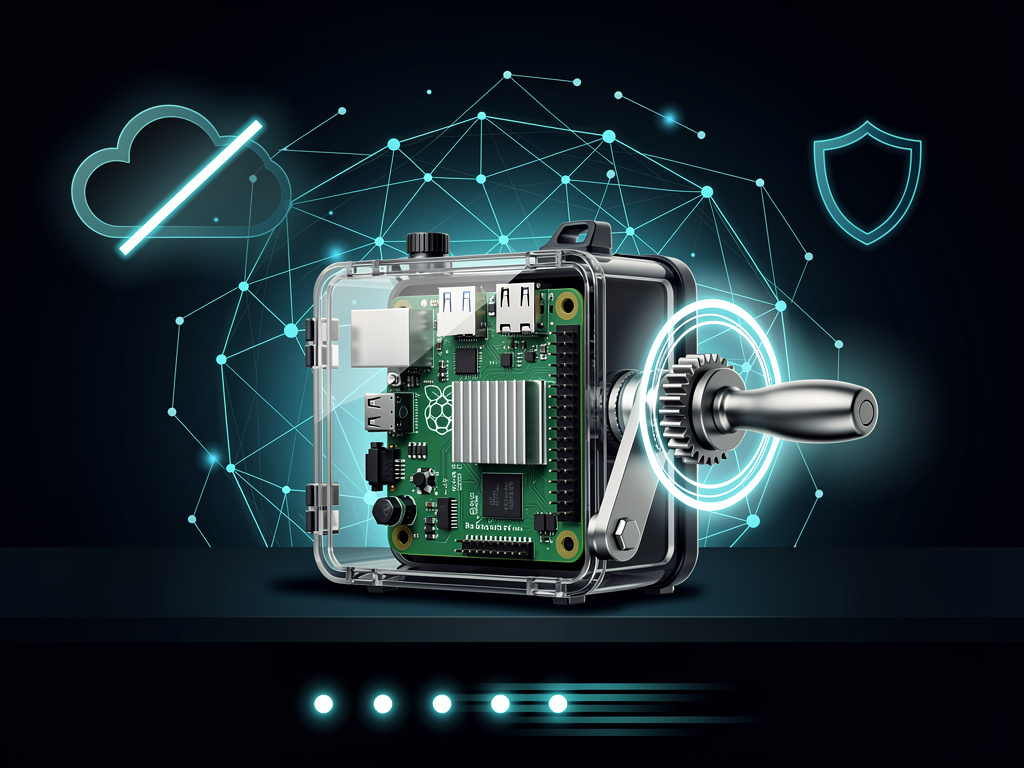
Power failures used to mean silence. Now they could mean conversation. Squeez Labs built CrankGPT, a voice assistant that boots from a hand crank, runs entirely offline and answers questions without ever touching a data center or battery.
The device pairs a stock Raspberry Pi 5 with 8GB of RAM and a cooling fan. A 20-watt emergency hand generator supplies electricity. A custom capacitor board smooths the output and holds roughly 20 seconds of reserve power. Turn the crank. Speak. Receive spoken answers. No cloud. No grid. Just muscle, silicon and small models.
Power draw tells the story. The Pi idles near 4 watts. Speech recognition pushes it to 8 watts. Inference plus text-to-speech climbs toward 15 watts. Spikes once threatened brownouts. The capacitor bank prevents them. Crank steadily and the system stays alive. Stop and it coasts on stored charge for a short window. The Register reported that sustained cranking from a group could theoretically scale output high enough to illustrate broader energy contrasts. One person feels the difference immediately. Inference makes the handle noticeably harder to turn.
Software choices keep demands low. DietPi provides a stripped-down operating system for quick boots. Moonshine performs speech recognition. Silero VAD detects voice activity. The language model runs through llama.cpp. Options include Liquid AI’s LFM2 at 350 million or 1.2 billion parameters and Google’s Gemma 3 at 1 billion parameters, all quantized to Q4_K_M. Piper generates speech and streams it sentence by sentence to cut perceived latency. Hackster.io detailed how the fastest configuration answers in under one second.
Startup takes about 30 seconds from the first crank. Ten to 15 seconds for the Pi to boot, a few more for the OS, then 10 to 15 seconds to load the agent. Time to first response ranges from 0.8 seconds on the smallest model to 2.9 seconds on the largest. The project page notes that an Orange Pi 5 Pro with faster DDR5 memory improves generation speed by 29 to 58 percent. Yet the team stuck with the Raspberry Pi for its accessibility and software support.
Capabilities extend beyond simple chat. The same hardware has generated small images, written bad poetry and produced code. Simultaneous translation works in demos. Squeez Labs spent a week on the initial proof of concept and several months refining the board and kernel so conversation would feel natural on constrained hardware. Boing Boing quoted the team: “It even makes bad poetry.”
The motivation runs deeper than novelty. Current assumptions tie intelligence to wall sockets and massive compute clusters. CrankGPT challenges both. “CrankGPT is a small argument that neither has to be true,” the creators wrote on their project page. They add that local models are private models. “Why give away what we don’t have to?” The project also reflects irritation at the industry’s focus on scale. “Everyone is busy making things bigger. We figured opportunities abound to make things smaller.”
Privacy stands out as a practical benefit. No data leaves the box. No account links to queries. In an era of expanding data-center energy demands and growing concerns over centralized AI, a device powered by human effort offers a pointed counterexample. TechRadar highlighted the long-term durability claim from the inventors: “Provided the electronics are kept dry and at a reasonable temperature, there’s no reason this thing won’t still work in a hundred years, though you’ll definitely need a fresh SD card.”
Limitations remain obvious. The crank is noisy enough to interfere with speech recognition if not managed. Boot time sits at a 30-second floor due to Raspberry Pi firmware. The SD card will need periodic replacement. Electronics must stay protected from moisture and extreme heat. Cost has risen. Builder Kauffmann spent about $150 last year. RAM price increases pushed the current estimate near $300. The Register captured that shift.
But the concept resonates. Recent coverage shows growing interest in offline, low-power AI. Hackster.io author Nick Bild wrote that while CrankGPT “won’t solve the world’s energy problems,” it ensures “if you ever find yourself without power you can still get your AI fix.” The project page itself argues that plenty of useful work fits on a device a person can power by hand. And it supplies “something to worship after the bombs fall,” in the wry phrasing from Boing Boing’s coverage.
Builders can replicate the design. The project shares hardware choices, software stack and even links to the exact crank and audio HAT. Enthusiasts on Reddit’s r/LocalLLaMA and other forums have already begun discussing variations. Some suggest swapping in newer, more efficient models as they appear. Others talk about rugged enclosures for field use.
Squeez Labs, the small team behind the build, continues to iterate. Their site mentions plans for smaller models, non-autoregressive architectures and code optimizations in C or Rust that could shave seconds off startup. The core idea stays fixed. Intelligence need not depend on distant servers or constant electricity. It can run on what a person is willing to crank.
That message lands at a moment when data-center power consumption draws increasing scrutiny and governments debate AI infrastructure needs. CrankGPT does not compete with frontier models on capability. It competes on independence. One person, one handle, one conversation at a time. The resistance in the crank reminds the user exactly how much effort each answer requires. Few cloud services make the cost so tangible.
Engineering a Human-Scale AI
Success hinged on careful balancing. The team selected models small enough to fit in 8GB RAM yet capable of coherent dialogue. Quantization and efficient runtimes like llama.cpp squeezed out acceptable speed. Streaming TTS avoided long pauses that would break conversational flow. The capacitor solution proved elegant. It buffers exactly the energy needed for brief interruptions without adding a battery that would defeat the no-grid goal.
Power curves dictate experience. Light queries feel easy. Complex reasoning makes the crank fight back. That physical feedback creates an unusual relationship with the machine. Users literally invest effort in each exchange. The team experimented with audio HATs until they found one that balanced input quality against power draw. Microphone placement matters because crank noise travels.
Why It Matters Beyond the Apocalypse
Practical applications exist today. Remote field work, areas with unreliable electricity, or users who prioritize data privacy all gain from a self-contained assistant. Schools in low-resource settings could deploy similar boxes without ongoing cloud costs. The design also serves as a teaching tool. It demonstrates how model size, hardware efficiency and power management interact in real time.
Industry trends favor ever-larger models and centralized training. CrankGPT stands as proof that smaller, local systems can deliver value. Its creators do not claim it replaces commercial AI. They argue it expands the options. Not every task needs a data center. Not every answer needs to cost kilowatt-hours of remote compute.
The project remains open for others to build upon. Parts lists, code and design files sit on the project page. Cost estimates help newcomers gauge feasibility. As component prices fluctuate and new efficient models emerge, the barrier to entry may drop further. For now, the sight of someone cranking a handle to wake an AI captures attention. It makes the abstract energy debate concrete. One turn at a time.


 WebProNews is an iEntry Publication