
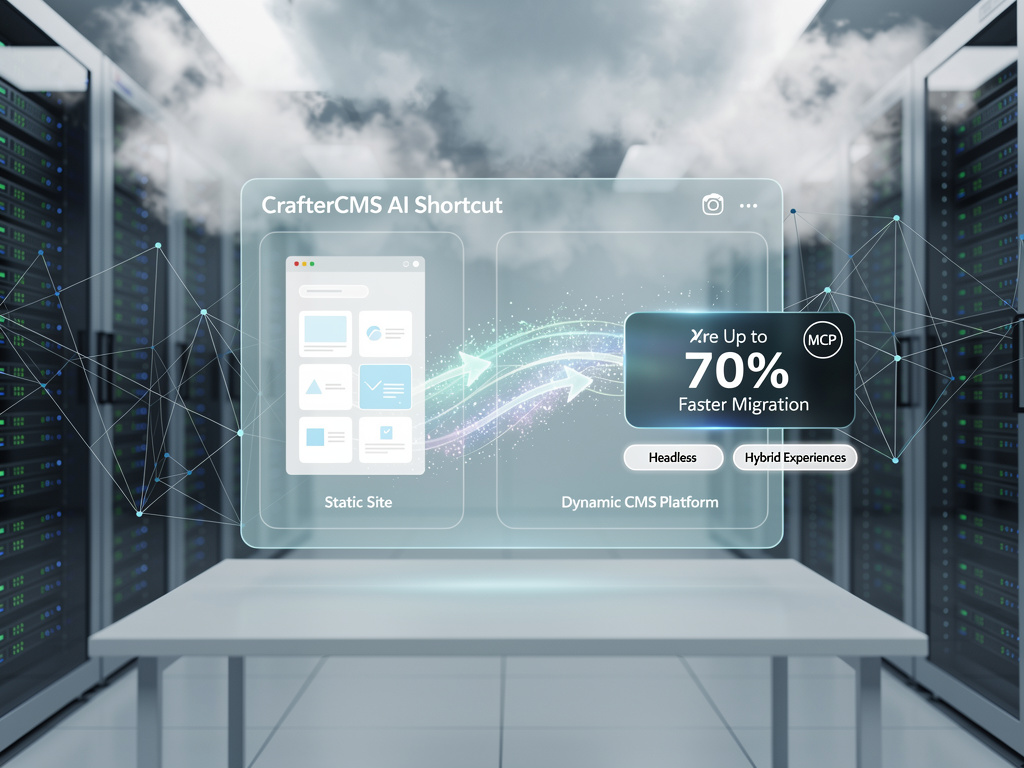
In a move poised to reshape enterprise content management, CrafterCMS has unveiled an AI-powered tool that automates the conversion of static websites into fully managed, dynamic platforms. The “AI Shortcut,” as it’s branded, promises to slash development timelines by enabling developers to ingest HTML templates and output CMS-ready components with minimal manual intervention. This innovation arrives amid surging demand for hybrid site architectures that blend static speed with dynamic personalization.
Russ Danner, vice president of products and customer success at CrafterCMS, described the tool as a “game-changer for teams bogged down by legacy migrations.” The process leverages machine learning to parse static code, identify reusable patterns, and generate editable content models, all while preserving site performance. Early adopters report up to 70% faster workflows, according to internal benchmarks shared by the company.
Roots in Headless Evolution
CrafterCMS, built on Java and Git with support for React and Freemarker frontends, has long positioned itself as a bridge between static and dynamic experiences. A 2019 CrafterCMS blog post highlighted its dual capabilities, noting that traditional CMS platforms often force binary choices. The AI Shortcut builds on this foundation, integrating with the platform’s headless API to deliver pre-rendered static pages alongside real-time content updates.
The tool’s debut was detailed in a recent CMSWire article, which emphasized its role in accelerating digital experience stacks. Developers upload static site repositories, and the AI analyzes markup to propose component taxonomies—think extracting navigation menus or hero banners into modular CrafterCMS types. Human oversight ensures fidelity, but automation handles the grunt work.
Technical Gears Under the Hood
At its core, the AI employs natural language processing and computer vision techniques adapted for code. It scans HTML for semantic patterns, such as repeating structures in lists or forms, then maps them to CrafterCMS’s content modeling schema. Integration with Git-based workflows allows version-controlled previews, minimizing deployment risks. CrafterCMS documentation reveals compatibility with static generators like Gatsby or Next.js, enabling incremental migrations.
This isn’t isolated innovation. CrafterCMS’s recent launch of an MCP Client Plugin, announced in an Erie Times News press release, extends AI interoperability via the Model Context Protocol. MCP, detailed in a CrafterCMS technical blog, standardizes connections between CMS APIs and AI agents, allowing custom tools to query content dynamically. Danner noted in the release, “This plugin showcases how MCP… can unlock powerful new content workflows.”
Enterprise Migration Imperatives
Enterprises grapple with aging static sites that lack scalability for personalized experiences. A 2022 CrafterCMS analysis compared static, client-side, and server-side rendering, underscoring trade-offs in speed versus flexibility. The AI Shortcut addresses this by hybridizing outputs: static for high-traffic pages, dynamic for user-specific content. Duracell, a client highlighted in recent CMSWire X posts, ditched legacy CMS constraints for CrafterCMS, citing reduced technical drag.
Implementation involves a dashboard where AI suggestions are reviewed and refined. For instance, a static e-commerce site’s product grids become editable catalogs, with AI inferring fields like price and SKU from attributes. Security features include automated sanitization of ingested code, aligning with enterprise compliance needs.
AI-First Workflows Take Shape
CrafterCMS’s push aligns with broader AI-CMS trends. A June 2025 CrafterCMS post outlined AI-first strategies, from generative content to predictive personalization. The platform now supports AI agents that draft pages from prompts, with the Shortcut serving as the ingestion layer. “AI content overwhelm isn’t just about volume,” noted a January 2026 CMSWire X update, urging structured, human-centered approaches.
Competitive pressures mount. While tools like Content Buddy for Craft CMS offer AI generation, per a Convergine blog, they target smaller sites. CrafterCMS differentiates via enterprise-scale headless delivery. A Nerdisa review praised its 95% faster editing, validated by user metrics.
Benchmarking Speed and Scale
Pilot programs with financial services firms converted 10,000-page static intranets in weeks, not months. The AI reduces custom coding by pattern-matching against a trained dataset of millions of web components. Output includes Sitemap.xml generation and SEO-optimized models, crucial for global deployments.
Challenges persist: complex JavaScript-heavy sites may require preprocessing, and AI accuracy hovers at 85-90% for initial passes, per CrafterCMS disclosures. Fine-tuning via user feedback loops improves this over time, akin to adaptive learning in LLMs.
Market Ripples and Future Vectors
As of January 2026, posts on X from CMSWire underscore AI’s role in GTM strategies, with CrafterCMS gaining traction among B2B leaders. A MarketingProfs AI update flagged similar tools, but CrafterCMS’s open-source ethos—via Marketplace plugins—sets it apart. Roadmap teases integrations with emerging protocols like MCP for agentic workflows.
Rivals like those in static site CMS rankings, from a Simply Static guide, focus on generation but lack dynamic pivots. CrafterCMS’s AI Shortcut positions it as the fulcrum for enterprises eyeing AI-driven DX platforms, potentially redefining content operations in 2026 and beyond.


 WebProNews is an iEntry Publication