
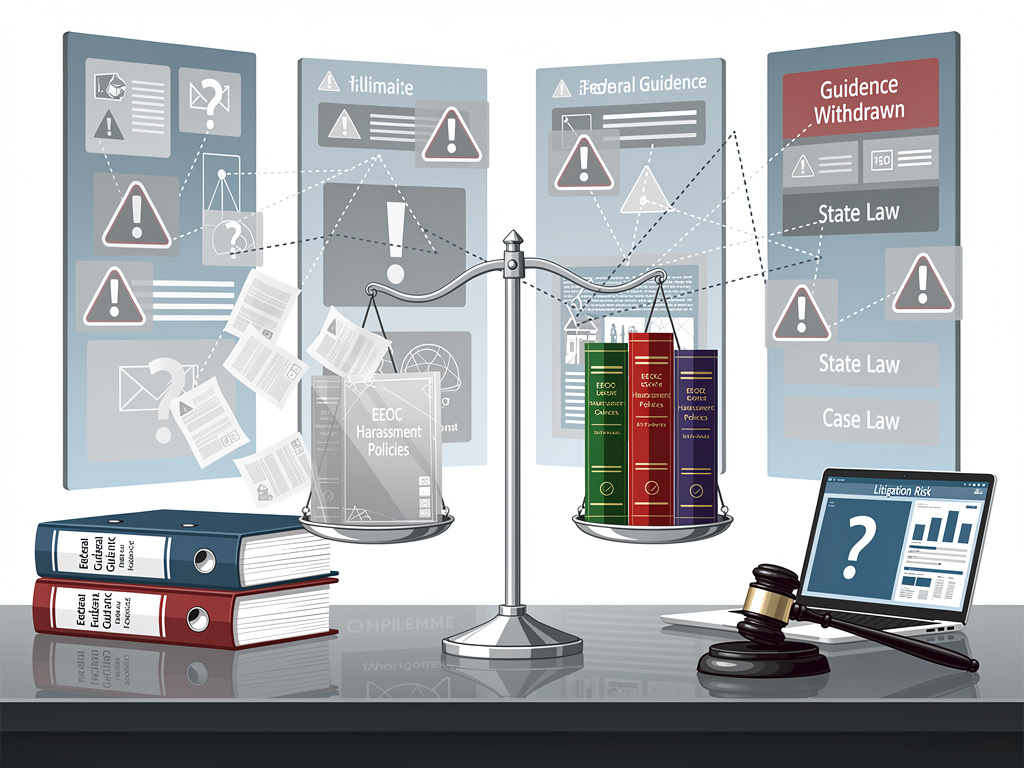
The sudden withdrawal of comprehensive workplace harassment guidance by the Equal Employment Opportunity Commission has left human resources professionals and employment attorneys scrambling to advise their clients on compliance strategies. The move, which eliminates a detailed framework that employers had relied upon for years, creates a regulatory vacuum at a time when workplace harassment claims continue to evolve in complexity and scope.
“It’s going to be uncertain and a real risk calculus for employers for a while,” Sam Schwartz-Fenwick, partner at Seyfarth Shaw, told HR Dive. The statement captures the anxiety rippling through corporate legal departments as they confront the reality of navigating harassment prevention without the regulatory roadmap they had previously consulted.
The EEOC’s guidance, which had provided detailed interpretations of Title VII of the Civil Rights Act and other anti-discrimination statutes, offered employers practical examples of prohibited conduct, best practices for prevention, and frameworks for investigating complaints. Its removal leaves companies without clear federal direction on emerging issues such as harassment in remote work environments, social media conduct, and third-party harassment scenarios that have become increasingly common in modern workplaces.
The Regulatory Void and Its Immediate Impact
Employment law experts note that the withdrawal doesn’t change the underlying statutory prohibitions against workplace harassment, but it does eliminate the detailed interpretive framework that helped employers understand how to comply with those laws. Companies must now rely more heavily on case law, which varies by jurisdiction and can be inconsistent in its application to novel situations.
The timing of the withdrawal has raised concerns among compliance professionals who have been working to update their policies to address contemporary workplace challenges. According to SHRM, the Society for Human Resource Management, many organizations had recently revised their harassment prevention programs based on the EEOC’s comprehensive guidance, which was last updated to reflect current workplace realities.
Legal practitioners are advising clients to maintain robust anti-harassment policies despite the guidance withdrawal. The absence of federal guidance doesn’t provide a safe harbor from liability; rather, it may increase litigation risk as employers and employees alike struggle to understand the boundaries of acceptable workplace conduct without clear regulatory interpretation.
State-Level Responses Fill the Federal Gap
As federal guidance disappears, state and local jurisdictions are stepping into the breach with their own requirements. California, New York, Illinois, and several other states have enacted comprehensive harassment prevention laws that often exceed federal requirements in their specificity and scope. These state-level frameworks now become even more critical as reference points for employers seeking compliance guidance.
The patchwork of state regulations creates additional complexity for multi-state employers who must navigate varying requirements across different jurisdictions. What constitutes adequate harassment prevention training in one state may fall short of requirements in another, forcing companies to adopt the most stringent standards across their entire operations or maintain multiple compliance programs tailored to specific locations.
According to employment law specialists interviewed by Law360, this fragmentation of regulatory guidance may actually increase compliance costs for employers as they work to ensure their policies meet the highest standards across all jurisdictions where they operate. The alternative—maintaining location-specific programs—raises its own challenges in terms of consistency and administrative burden.
The Role of Judicial Precedent in Shaping Workplace Standards
With administrative guidance withdrawn, court decisions take on heightened importance in defining the contours of prohibited harassment. Recent Supreme Court decisions and circuit court rulings will likely receive increased scrutiny from employers seeking to understand their obligations and potential liability exposure.
Legal experts point to landmark cases such as Faragher v. City of Boca Raton and Burlington Industries v. Ellerth, which established the framework for employer liability in harassment cases, as foundational precedents that remain binding regardless of EEOC guidance. However, these decisions predate many contemporary workplace challenges, including the rise of remote work, digital communication platforms, and evolving understandings of protected characteristics.
The withdrawal of guidance may lead to increased litigation as parties test the boundaries of harassment law without clear administrative interpretation. Plaintiffs’ attorneys may see opportunity in the regulatory uncertainty, while employers face difficult decisions about how aggressively to defend practices that might have been validated under prior EEOC guidance but now exist in a gray area.
Industry-Specific Challenges and Considerations
Certain industries face unique challenges in the absence of comprehensive federal guidance. Healthcare organizations, for example, must contend with harassment issues involving patients and third parties, situations that the withdrawn guidance had specifically addressed. Similarly, hospitality and retail sectors, where customer interactions are frequent and varied, lose detailed frameworks for handling third-party harassment scenarios.
Technology companies face particular uncertainty regarding harassment in virtual workspaces and through digital communication channels. The EEOC guidance had begun to address these modern workplace realities, providing interpretations of how traditional harassment principles applied to email, messaging platforms, and video conferencing. Without this guidance, tech employers must develop their own interpretations of how to prevent and address digital harassment.
Manufacturing and construction industries, which have historically faced higher rates of harassment complaints, now must rely more heavily on internal policies and industry best practices rather than federal guidance. Trade associations and industry groups are stepping up to provide model policies and training programs to fill the void left by the EEOC’s withdrawal.
The Training and Prevention Dilemma
One of the most immediate practical challenges facing employers involves harassment prevention training programs. Many organizations had designed their training curricula around examples and scenarios drawn from EEOC guidance. The withdrawal raises questions about whether these programs remain adequate or require revision.
Employment attorneys are advising clients to maintain comprehensive training programs even without federal guidance, noting that such programs remain a critical component of the affirmative defense to harassment claims established in Faragher and Ellerth. However, the content and frequency of training may require adjustment as employers navigate the new regulatory environment.
According to workplace training experts cited by HRD America, the focus may shift from compliance-based training that emphasizes regulatory requirements to culture-based programs that emphasize organizational values and behavioral expectations. This approach may prove more sustainable in the absence of specific federal guidance while still providing legal protection.
Insurance and Risk Management Implications
The withdrawal of EEOC guidance has implications for employment practices liability insurance (EPLI) and corporate risk management strategies. Insurance carriers may adjust their underwriting criteria and coverage terms in response to the increased uncertainty surrounding harassment claims and employer liability.
Risk management professionals are reassessing their organizations’ exposure to harassment-related claims in light of the guidance withdrawal. Some are recommending increased reserves for potential litigation, while others are advocating for enhanced prevention measures to reduce the likelihood of claims arising in the first place.
The cost-benefit analysis of various prevention strategies becomes more complex without clear regulatory guidance. Employers must weigh the expense of comprehensive prevention programs against the potential costs of litigation and reputational damage, all while operating with less certainty about what measures will be deemed adequate by courts and regulators.
Looking Ahead: Strategies for Navigating Uncertainty
Employment law practitioners are recommending that employers adopt a proactive stance despite the regulatory uncertainty. This includes maintaining robust anti-harassment policies, conducting regular training, establishing clear reporting mechanisms, and ensuring prompt and thorough investigations of complaints. These fundamentals remain critical regardless of the presence or absence of EEOC guidance.
Organizations are also being advised to document their good-faith efforts to prevent and address harassment, as such documentation may prove valuable in defending against claims. This includes maintaining records of policy distributions, training attendance, investigation procedures, and remedial actions taken in response to complaints.
The current environment may also drive increased reliance on outside counsel and consultants to help navigate the regulatory uncertainty. Law firms and HR consulting practices are developing new service offerings designed to help employers maintain compliance in the absence of comprehensive federal guidance, potentially increasing the overall cost of harassment prevention for many organizations.
As the business community adjusts to this new reality, one certainty remains: workplace harassment prevention will continue to demand significant attention and resources from employers, regardless of the presence or absence of federal administrative guidance. The legal obligations under Title VII and other anti-discrimination statutes persist, even as the interpretive framework for understanding those obligations becomes less clear. For corporate America, the challenge ahead involves maintaining effective harassment prevention programs while managing the increased legal and financial risks that accompany regulatory uncertainty.


 WebProNews is an iEntry Publication