
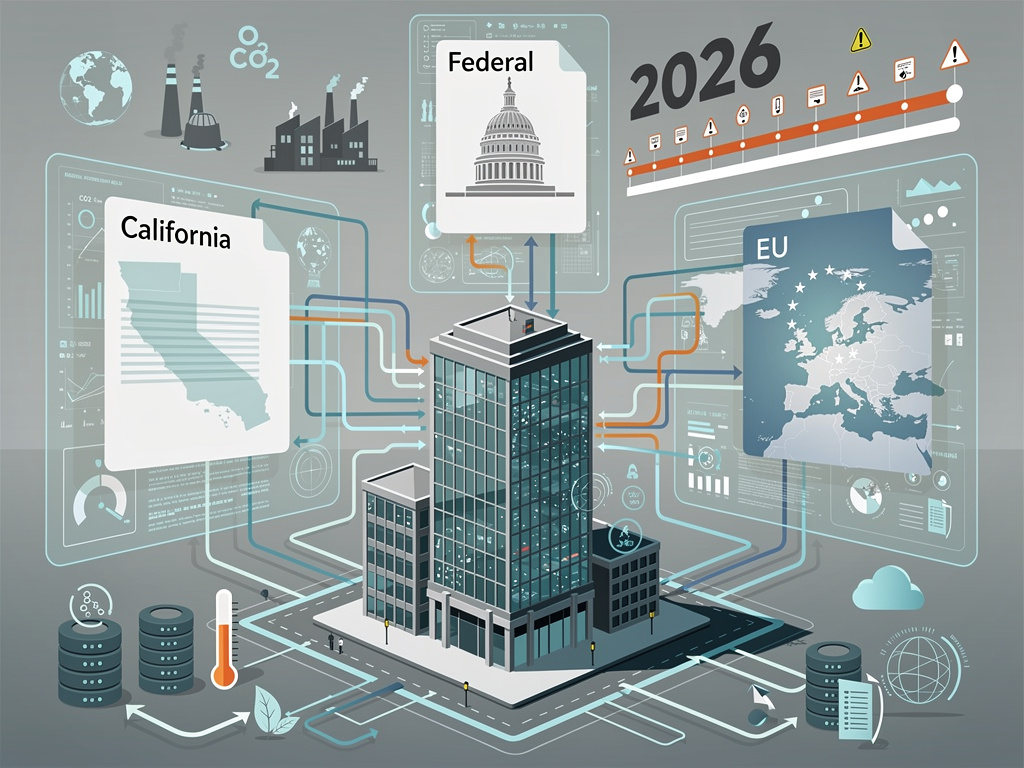
As corporations prepare for a new era of environmental accountability, they face an increasingly complex web of climate risk disclosure requirements that vary dramatically across jurisdictions. The convergence of regulatory mandates from California to Brussels, combined with evolving federal expectations, has created what industry experts describe as an unprecedented compliance challenge for multinational enterprises navigating 2026 deadlines.
The regulatory fragmentation stems from divergent approaches between state-level legislation, international frameworks, and voluntary standards that companies have adopted over the past decade. According to ESG Dive, organizations must now reconcile requirements from California’s climate disclosure laws, the European Union’s Corporate Sustainability Reporting Directive, and potential Securities and Exchange Commission mandates, each with distinct timelines, scopes, and methodologies. This regulatory patchwork forces companies to maintain multiple reporting frameworks simultaneously, significantly increasing compliance costs and operational complexity.
The situation has become particularly acute for publicly traded companies with operations spanning multiple jurisdictions. While some organizations have advocated for harmonized global standards, the reality is that regional priorities and political considerations have produced materially different disclosure regimes. The International Sustainability Standards Board has attempted to provide a unified framework, but adoption remains voluntary in many markets, leaving companies to determine which standards carry the greatest legal and reputational weight.
California’s Pioneering Legislation Sets Aggressive Timeline
California’s groundbreaking climate disclosure laws, signed in 2023, represent some of the most comprehensive state-level environmental reporting requirements in the United States. Senate Bills 253 and 261 mandate that large companies doing business in California disclose their greenhouse gas emissions across all three scopes and report climate-related financial risks. The legislation affects thousands of public and private companies with revenues exceeding specified thresholds, regardless of where they are headquartered.
The California requirements distinguish themselves through their scope three emissions mandate, which compels companies to account for indirect emissions throughout their entire value chain. This provision has generated significant concern among business groups, as scope three calculations require extensive data collection from suppliers, distributors, and customers who may lack sophisticated tracking systems. Implementation timelines begin in 2026 for scope one and two emissions, with scope three reporting following in 2027, creating compressed preparation windows for affected entities.
European Union Raises the Regulatory Bar
Across the Atlantic, the European Union’s Corporate Sustainability Reporting Directive represents an even more ambitious regulatory framework that extends beyond climate metrics to encompass broader environmental, social, and governance factors. The CSRD applies to all large companies operating in EU member states, including non-European firms with substantial European operations. Beginning in 2024 for the largest entities, the directive phases in requirements that will ultimately affect approximately 50,000 companies by 2028.
The CSRD’s double materiality principle requires companies to report not only how climate risks affect their financial performance but also how their operations impact the environment and society. This bidirectional approach marks a philosophical departure from traditional financial disclosure frameworks that focus primarily on investor-relevant information. Companies must engage with detailed European Sustainability Reporting Standards that specify hundreds of data points across environmental, social, and governance dimensions, creating substantial data collection and verification burdens.
The extraterritorial reach of EU regulations means that many U.S.-based corporations must comply with CSRD requirements even as they navigate domestic regulatory uncertainty. This dynamic has prompted some organizations to adopt EU standards as their global baseline, reasoning that meeting the most stringent requirements will satisfy less demanding jurisdictions. However, this strategy carries risks, as different regulatory frameworks may require incompatible methodologies or definitions that prevent simple harmonization.
Federal Uncertainty Complicates Strategic Planning
The U.S. Securities and Exchange Commission’s climate disclosure rule, finalized in March 2024, faced immediate legal challenges that have left its implementation timeline uncertain. The rule would require publicly traded companies to disclose material climate risks, greenhouse gas emissions, and the financial impacts of severe weather events in their annual reports. However, the scope of the final rule was significantly narrowed from initial proposals, eliminating mandatory scope three reporting and limiting emissions disclosure requirements to large accelerated filers.
Political headwinds have intensified around federal climate disclosure mandates, with critics arguing that the SEC exceeded its statutory authority by imposing environmental reporting requirements. Multiple lawsuits challenging the rule have resulted in a stay of implementation, leaving companies in limbo about whether and when federal requirements will take effect. This uncertainty complicates long-term planning, as organizations must decide whether to invest in compliance infrastructure for rules that may never be enforced or face potential penalties if requirements are ultimately upheld.
The regulatory vacuum at the federal level has emboldened state-level action, with California serving as the most prominent example but not the only jurisdiction considering climate disclosure mandates. This state-by-state approach threatens to create a balkanized regulatory environment where companies face different requirements depending on where they operate, sell products, or maintain facilities. For multinational corporations accustomed to navigating international regulatory differences, the prospect of significant variation within a single national market presents novel compliance challenges.
Data Collection Emerges as Critical Bottleneck
Regardless of which regulatory framework ultimately prevails, companies consistently identify data collection and verification as their most significant implementation challenge. Greenhouse gas emissions accounting requires detailed information about energy consumption, transportation, production processes, and supply chain activities that many organizations have not historically tracked with the precision now demanded by regulators. Scope three emissions present particular difficulties, as companies must obtain data from third parties who may view such information as proprietary or lack the systems to provide it.
The quality and reliability of climate data has emerged as a critical concern for both regulators and investors. Unlike financial information subject to decades of standardized accounting principles and audit procedures, environmental data often relies on estimates, assumptions, and methodologies that vary significantly across industries and companies. Several high-profile instances of greenwashing and misleading environmental claims have heightened scrutiny of corporate sustainability assertions, prompting calls for independent verification and assurance of climate disclosures.
Technology providers have responded to this challenge with a proliferation of software platforms, consulting services, and data management tools designed to streamline climate reporting. The carbon accounting industry has experienced rapid growth, with both established audit firms and specialized startups offering services to help companies measure, track, and report emissions data. However, the lack of standardization in methodologies and the relative immaturity of the sector mean that different service providers may produce materially different results for the same company using the same underlying data.
Financial Implications Extend Beyond Compliance Costs
The direct costs of climate disclosure compliance represent only a portion of the financial impact on corporations. Organizations must invest in new data management systems, hire specialized personnel, engage external consultants and auditors, and potentially restructure operations to reduce emissions in areas where disclosure might reveal unfavorable comparisons to competitors. For large multinational corporations, these investments can reach tens of millions of dollars annually, with ongoing costs persisting indefinitely as reporting becomes a permanent business function.
Beyond compliance expenses, climate disclosure requirements carry strategic implications for competitive positioning and stakeholder relationships. Investors increasingly incorporate environmental performance into valuation models and investment decisions, with major asset managers establishing climate-related investment criteria and engagement priorities. Companies that report higher emissions intensity or greater climate risk exposure may face higher capital costs, reduced access to certain investor pools, or pressure to adopt more aggressive decarbonization targets. Conversely, organizations that demonstrate strong environmental performance may benefit from enhanced reputation, improved access to sustainable finance, and stronger relationships with environmentally conscious customers and employees.
The disclosure requirements also create new litigation and liability risks, as plaintiffs’ attorneys scrutinize corporate climate statements for potential securities fraud, consumer protection violations, or breaches of fiduciary duty. Several companies have already faced lawsuits alleging that their climate disclosures were misleading or that they failed to adequately disclose material climate risks. These legal challenges add another layer of complexity to disclosure decisions, as companies must balance transparency with legal exposure in an evolving area of law where precedents remain limited.
Industry Groups Advocate for Harmonization
Business organizations across sectors have consistently called for regulatory harmonization to reduce compliance burdens and create a more predictable operating environment. Trade associations argue that overlapping and inconsistent requirements force companies to divert resources from actual emissions reductions to redundant reporting exercises. They advocate for international coordination among regulators to align definitions, methodologies, and timelines, pointing to the success of financial accounting standards harmonization as a potential model.
Some progress toward alignment has occurred through voluntary standard-setting bodies and international cooperation initiatives. The International Sustainability Standards Board, established under the IFRS Foundation, has developed baseline sustainability disclosure standards intended to create a global framework comparable to international financial reporting standards. However, adoption of ISSB standards remains voluntary in most jurisdictions, and significant differences persist between ISSB standards and mandatory requirements in the EU and California, particularly regarding scope three emissions and double materiality.
The tension between harmonization advocates and those who view climate disclosure as an area where regulatory experimentation and competition can drive innovation remains unresolved. Supporters of diverse approaches argue that different jurisdictions have legitimate policy priorities that justify tailored requirements, and that allowing regulatory variation enables learning about which frameworks most effectively drive environmental improvement. This debate will likely continue as companies, regulators, and stakeholders assess the effectiveness of different disclosure regimes in achieving their stated objectives of transparency, accountability, and emissions reduction.


 WebProNews is an iEntry Publication