
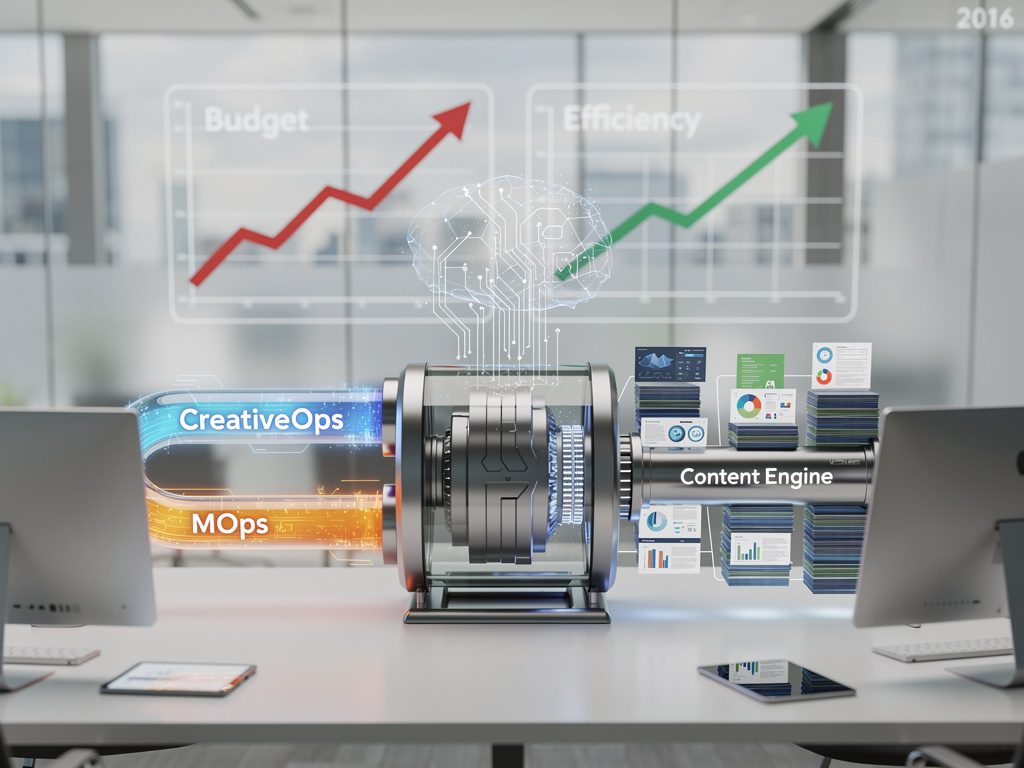
In the tightening grip of budget constraints, marketing leaders face a stark reality: CreativeOps and Marketing Operations (MOps) can no longer function as isolated silos. As Gareth Chilton argues in MarTech, “Creation, decisioning and activation now operate as one engine. Separating creative and marketing operations adds cost, complexity and operational drag.” Digitized workflows powered by generative AI, automation tools, and integrated platforms have rendered traditional handoffs obsolete, forcing a convergence that promises efficiency amid shrinking resources.
Marketing budgets plummeted to 7.7% of company revenue in 2024, a 15% drop from 9.1% the prior year, according to Gartner’s 2024 CMO Spend Survey. This “era of less,” as Gartner terms it, amplifies the friction of divided operations. CreativeOps, once focused on studio throughput like briefing and approvals, now designs modular assets with metadata for automated assembly. MOps, handling campaign launches and data fixes, increasingly governs decision logic and feedback loops. Their separation breeds duplicate processes and middleware reconciliation, eroding ROI.
Macro Pressures Driving Unity
AI acceleration intensifies this shift. McKinsey’s 2025 State of AI reveals 62% of organizations experimenting with AI agents that redefine workflows across functions, moving bottlenecks from production to governance. Forrester’s 2024 Digital Asset Management Wave positions DAM platforms as omnichannel infrastructure, enabling AI-driven personalization that blurs creative and ops boundaries. Adobe’s trends highlight surging content demands—more volume, variants, and speeds—necessitating integrated systems with templates and real-time loops.
Chilton notes, “The content problem is more volume across more variants, for more contexts, at higher speeds.” Without unity, teams duplicate leadership and platforms, funding internal fixes over customer impact. Consolidated models promise shared stewardship of templates, metadata, and KPIs like responsiveness and error rates.
Evolving Roles in the Unified Engine
CreativeOps evolves from job management to system architecture: encoding guardrails, taxonomy stewardship, and quality loops. MOps shifts to real-time system health, integrating data, content, and channels. Sue Wolski, in MarTech, urges mutual learning: CreativeOps precision for campaign SLAs, MOps analytics for briefs. “When MOps and CreativeOps learn from each other, marketing becomes an intelligent, interconnected system,” she writes.
Reporting structures amplify these tensions. Nickole Brown, in another MarTech piece, weighs options: Creative autonomy risks silos, while MOps alignment unlocks tools and data. Cella’s 2024 CIR shows only 39% of in-house creatives in planning, underscoring gaps. Brown advises integration for elevation: “If you’re considering moving creative ops under MOps, do it to elevate creative’s influence.”
Practical Paths to Consolidation
Leaders must assign senior accountability for the end-to-end engine. Pilots with cross-functional teams, shared dashboards, and system metrics map handoffs and codify wins. Screendragon’s 2025 trends, drawn from summit leaders, emphasize data flywheels: “Connect briefing, creative development, and performance data into one seamless process,” says Tom Blenkin. Fergus Ashe adds, “Modern tools link project planning with resourcing and delivery for real-time alignment.”
Hybrid roles emerge—creatives versed in metadata, ops in journeys—as AI multipliers. Events like MOps-Apalooza and Creative Operations Summit highlight community momentum toward unified ops. Chilton warns, “In most enterprise environments, CreativeOps and MOps must either consolidate… or quietly become the most significant source of operational drag.”
Cultural and Structural Hurdles Ahead
The real barrier is cultural: function-first mindsets versus system outcomes. Org charts lag martech reality, fostering shadow operations. Wolski recommends joint planning and retrospectives to validate forecasts against capacity. Brown stresses partnerships: shared goals, transparency, data flows.
2026 demands action. High-performers redesign workflows, invest in hybrids, and measure holistically. As Chilton concludes, “Over the next five years, the organizations that perform best will be those that can move past the old divide and operate content as what it already is—one interconnected system.”


 WebProNews is an iEntry Publication