
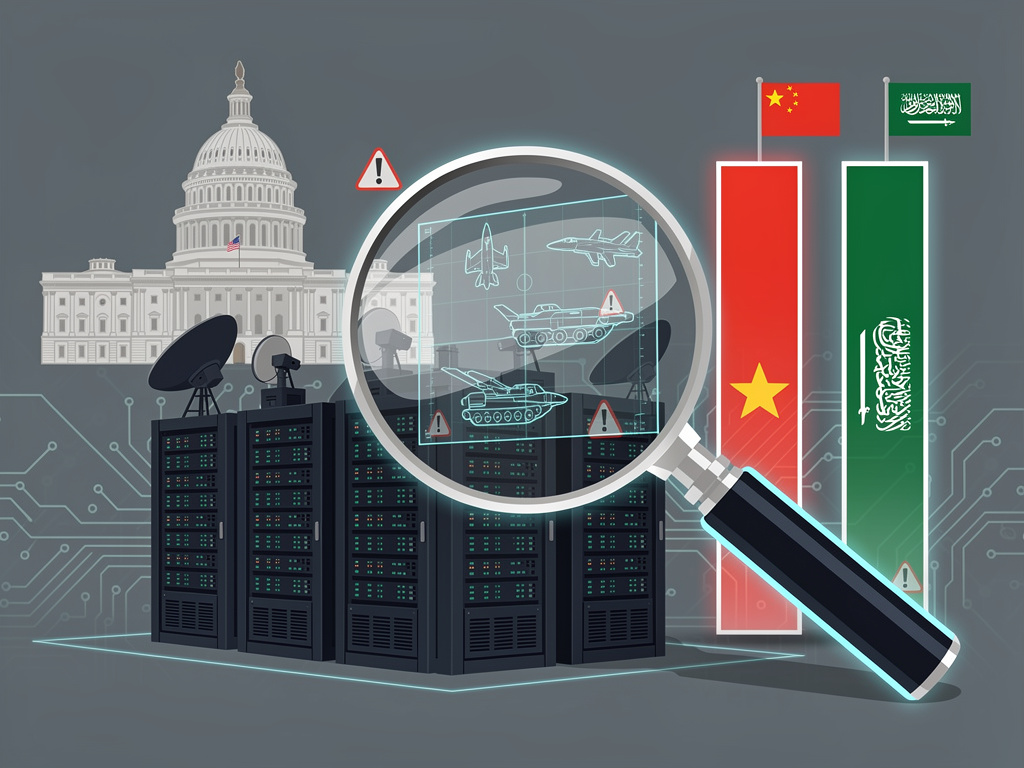
WASHINGTON—A proposed $5.5 billion acquisition of a U.S. technology firm with sensitive military contracts has triggered alarm bells on Capitol Hill, placing the powerful Committee on Foreign Investment in the United States (CFIUS) under intense pressure to intervene. In a pointed letter to Treasury Secretary Janet Yellen, two high-ranking congressmen are demanding a full national security review of the sale of a company identified as Entertainment Arts Research Inc. to a consortium led by South Korean gaming giant Nexon, citing significant risks posed by the involvement of Saudi and Chinese capital.
The bipartisan push is being led by Representatives Mike Gallagher (R-WI) and Raja Krishnamoorthi (D-IL), the Chairman and Ranking Member, respectively, of the House Select Committee on the Strategic Competition Between the United States and the Chinese Communist Party. Their involvement elevates the transaction from a standard business deal to a flashpoint in the escalating economic and technological rivalry between Washington and Beijing. The lawmakers are particularly concerned that the deal could grant the Chinese Communist Party (CCP) backdoor access to sophisticated U.S. military simulation technology and the personal data of American citizens.
At the heart of their concern is the composition of the acquiring consortium. While led by Nexon, a publicly-traded company based in South Korea and listed in Tokyo, the financing includes Saudi Arabia’s Public Investment Fund (PIF) and, most critically in the eyes of the committee, “several untested and opaque China-based gaming companies.” The letter, detailed in a press release from the Select Committee, argues that the inclusion of these entities creates an unacceptable risk of technology transfer to a strategic adversary.
The Blurring Lines Between Gaming and Defense
The stakes are amplified by the nature of the target company’s business. According to the congressmen, Entertainment Arts Research Inc. develops “hyper-realistic military simulation software for the U.S. Department of Defense and its allies.” This places the firm squarely at the intersection of commercial entertainment technology and classified defense applications, a domain that is drawing increasing scrutiny from national security officials. The letter explicitly warns that the acquisition could compromise the U.S. military’s technological edge.
The lawmakers connected the potential threat directly to Beijing’s official policy of “Military-Civil Fusion,” a state-led strategy that aims to co-opt technology from the private sector to advance the capabilities of the People’s Liberation Army. “We are concerned that the CCP will be able to leverage the access and control of the PRC-based limited partners to steal, for the benefit of the PLA, [the company’s] hyper-realistic military simulation and training software,” the letter states. This concern reflects a broader anxiety in Washington that any Chinese commercial entity, regardless of its stated independence, can be compelled by the state to act in the interest of national security.
Beyond military hardware, the congressmen also raised the issue of data security, a recurring theme in CFIUS reviews of foreign acquisitions in the tech sector. They noted the risk of the consortium gaining access to “sensitive personal data of millions of Americans.” While the specific data held by the company was not detailed, the concern aligns with previous actions against companies like TikTok and Grindr, where the potential for foreign governments to access and exploit large datasets on U.S. citizens was deemed a national security threat.
Scrutinizing the ‘Passive Investor’ Firewall
In response to the mounting pressure, Nexon has sought to allay fears by characterizing its partners’ roles as strictly financial. According to a report from Engadget, the company asserted that it would be the “sole controlling entity” of the acquired firm. The consortium, Nexon claims, was assembled primarily for financing purposes, with the Chinese firms and the Saudi PIF acting as passive investors who would hold no board seats, possess no governance rights, and be firewalled from any access to sensitive technology, source code, or user data.
This “passive investor” defense is a common strategy for foreign-led consortiums seeking to pass CFIUS review. By contractually isolating investors from countries of concern, companies hope to demonstrate that no undue foreign influence or control will be exerted over the U.S. entity. However, Reps. Gallagher and Krishnamoorthi have explicitly rejected this argument as insufficient, reflecting a growing skepticism in Congress toward such arrangements when Chinese entities are involved.
Their letter contends that China’s National Intelligence Law of 2017 effectively negates any contractual firewall, as it obligates all Chinese organizations and citizens to “support, assist and cooperate with the state intelligence work.” From this perspective, even a passive investment provides a foothold that the CCP could exploit for intelligence gathering or technology acquisition. This hawkish view suggests that for some in Washington, the mere presence of Chinese capital in a deal involving sensitive U.S. assets is a non-starter, regardless of the protective structures put in place.
A Widening Dragnet on Foreign Capital
The public pressure campaign surrounding this deal is indicative of a broader trend of intensified scrutiny over foreign investment in strategic U.S. sectors. CFIUS, an inter-agency body chaired by the Treasury Secretary, has historically operated behind a veil of confidentiality. The decision by the House Select Committee to publicize its letter is a clear political maneuver designed to force the committee’s hand and ensure the transaction does not pass without a rigorous, top-to-bottom review.
The inclusion of Saudi Arabia’s PIF in the letter, while secondary to the concerns about China, also points to a more complex geopolitical calculus. The PIF has been on an aggressive global investment spree, pouring billions into the video game industry to diversify the kingdom’s economy away from oil. While Saudi Arabia is a U.S. partner, the PIF’s status as a sovereign wealth fund controlled by the Saudi government makes its investments a subject of interest for regulators monitoring foreign influence.
For dealmakers and investors, this case serves as a stark warning. The definition of “national security” is expanding rapidly to encompass not just defense contractors but also companies in software, artificial intelligence, biotechnology, and consumer technology that control vast amounts of data. Any transaction involving a U.S. asset in these fields, particularly one with capital from China, will now almost certainly face a complex and politically charged regulatory gauntlet.
Implications for the Broader Tech and Gaming Market
Adding a layer of intrigue to the situation is the relative obscurity of the target company. “Entertainment Arts Research Inc.” does not have a significant public profile commensurate with a $5.5 billion valuation and major Department of Defense contracts, leading to speculation among industry observers about its precise identity. Regardless, the principles articulated by the congressmen are intended to reverberate far beyond this single transaction.
The letter is a clear signal to the entire technology and entertainment M&A market that the era of unscrutinized globalization of capital is over. Geopolitical due diligence has become as crucial as financial modeling. Law firms and investment banks structuring these deals must now navigate not only the formal CFIUS process but also the unpredictable court of public and political opinion, where a single press release from a powerful committee can threaten to derail a multi-billion-dollar enterprise.
Whether CFIUS ultimately blocks the deal, approves it with stringent mitigation measures, or the parties abandon it under the weight of political pressure, the outcome will establish a significant precedent. For a globalized industry built on cross-border investment and talent, Washington is drawing new, clearer red lines. The message is that when it comes to critical technology and data, the origin of the capital matters more than ever.


 WebProNews is an iEntry Publication