
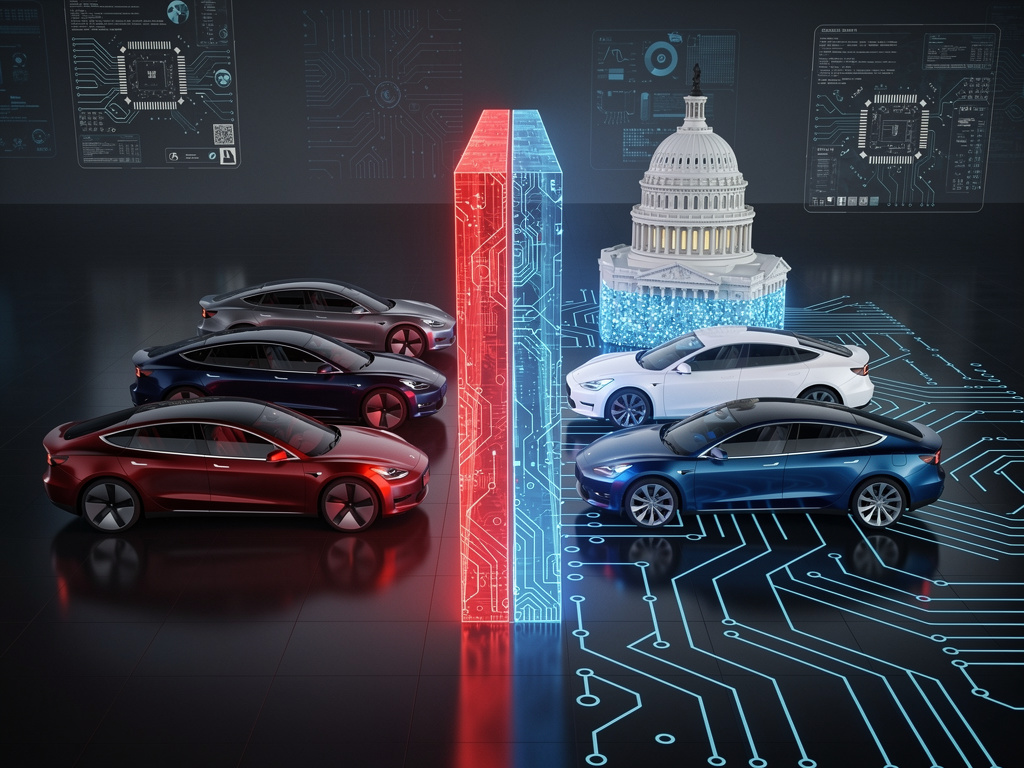
Lawmakers from both parties just introduced legislation that would make it all but impossible for Chinese-made vehicles or their key technologies to reach American roads. The bill comes at a tense moment. President Donald Trump prepares to sit down with Chinese President Xi Jinping even as concerns mount that any trade deal might open a back door for Beijing’s automakers.
Rep. John Moolenaar, the Michigan Republican who chairs the House Select Committee on the Chinese Communist Party, joined Rep. Debbie Dingell, a Democrat from the same state, to unveil the Connected Vehicle Security Act in the House on May 11. A companion measure in the Senate, introduced weeks earlier by Sen. Bernie Moreno, Republican of Ohio, and Sen. Elissa Slotkin, Democrat of Michigan, carries the same name and goals. The proposals seek to turn temporary restrictions from the final days of the Biden administration into permanent law.
The measures go further. They would ban not only imports but also the manufacture and sale of connected vehicles tied to China or other designated adversary nations. That includes Russia, North Korea and Iran. Even cars assembled inside the United States could fall under the prohibition if they rely on Chinese-developed software or hardware for connectivity. Penalties start at $1.5 million per violation.
Modern cars function as sophisticated data platforms. They collect location information, capture images of surroundings, monitor driver behavior and communicate constantly with other vehicles and infrastructure. Supporters of the legislation argue those capabilities create unacceptable risks when the technology comes from companies subject to Chinese law. Beijing can compel cooperation from its firms on intelligence matters. The result, they say, turns every car into a potential surveillance device.
“Chinese cars are surveillance packages on wheels, with the ability to collect on American citizens and sensitive sites,” Slotkin said in a statement released by Moreno’s office. She pointed to the Chinese Communist Party’s strategy of heavy subsidies, aggressive undercutting of competitors and pursuit of market dominance. Moreno framed the issue in even starker terms. He called Chinese vehicles an “existential threat” to the American auto industry and warned that the United States must avoid the mistakes that allowed subsidized foreign producers to damage other sectors.
Moolenaar struck a similar note. “The American auto industry is vital for jobs, national security, and the future of America’s manufacturing base,” he said. “China cheats in every industry, and in autos it is overproducing vehicles and components, and selling them for cheap in hopes they will put our companies out of business.” Dingell warned against repeating past errors that hollowed out manufacturing communities. “I am not interested in repeating the mistakes that hollowed out manufacturing communities across this country while politicians told workers globalization would somehow magically work itself out,” she declared.
These voices reflect deep anxiety in the Midwest. Michigan and Ohio depend on auto manufacturing for hundreds of thousands of jobs. Union leaders, traditional manufacturers and parts suppliers see Chinese electric vehicles as an immediate competitive danger. Chinese companies export nearly eight million vehicles a year, twice the volume of any other country. Many benefit from government support that allows pricing well below what American or European rivals can match. Some critics also point to reports of forced labor in supply chains linked to firms such as BYD and CATL.
The legislation builds directly on rules finalized by the Biden administration in January 2025. Those regulations, grounded in an executive order originally signed by Trump in 2019, barred transactions involving connected vehicle software and hardware linked to China. Software restrictions are scheduled to begin in 2027. Hardware rules follow in 2030. The new bills would codify those timelines while adding enforcement tools, waiver processes and mechanisms for industry to seek guidance from the Commerce Department.
Industry groups have lined up in support. General Motors issued a statement commending the Senate sponsors. “General Motors supports policies that protect and strengthen American manufacturing and the global competitiveness of U.S. automakers,” the company said. The United Auto Workers president, Shawn Fain, endorsed the effort. He argued that rebuilding U.S. manufacturing requires preventing offshoring and protecting good union jobs. Trade associations representing automakers, suppliers and dealers sent letters urging the Trump administration to maintain the barriers. More than 120 House members from both parties signed appeals to keep Chinese vehicles out.
Yet questions linger about the administration’s ultimate stance. Trump has at times signaled openness to Chinese companies building factories on American soil if they hire local workers. Commerce Secretary Howard Lutnick and Trade Representative Jamieson Greer have said the existing rules face no immediate review. Still, the timing of the legislation, released just before Trump’s trip to Beijing, sends a clear signal from Capitol Hill. Lawmakers want to raise the political cost of any concessions.
The Chinese Embassy in Washington pushed back. It called on the United States to “stop overstretching the concept of national security, cease discriminatory and exclusionary measures and provide a fair, transparent, and non-discriminatory business environment.” Chinese officials maintain that their vehicles meet high standards and that security concerns serve as cover for protectionism.
Analysts note that consumer interest in affordable Chinese electric vehicles has grown despite steep tariffs already in place. Surveys show some American buyers drawn to the lower prices and advanced features. But the combination of existing tariffs, the Biden-era rules and now potential legislation creates a formidable wall. Few expect Chinese brands to appear in U.S. showrooms anytime soon.
The bills also address supply chain realities. They prohibit components and software from joint ventures or entities under Chinese control. That language aims to close loopholes that might allow a Chinese firm to partner with an American or third-country manufacturer and still gain market access. The Commerce Department would gain authority to identify high-risk technologies and block transactions that threaten security or economic interests.
Supporters present the legislation as simple prudence. Connected vehicles, they argue, represent a new domain of strategic competition. Data flows from millions of cars could reveal patterns of life, infrastructure vulnerabilities or military movements. Allowing an adversary to dominate that data layer carries risks beyond lost factory jobs. Opponents counter that such fears exaggerate the threat and that American companies already partner globally without catastrophe. The debate pits national security hawks against those who favor open markets and lower consumer prices.
Passage remains uncertain but far from impossible. The issue draws unusual bipartisan agreement in a polarized Congress. Michigan lawmakers from both parties have strong incentives to protect their state’s signature industry. The Senate version already has momentum. House sponsors hope to attach the measure to must-pass legislation such as a transportation spending bill later this year.
Even if the bills become law, implementation will test regulators. The Commerce Department must create workable processes for declarations of conformity, advisory opinions and waivers. Carmakers and suppliers will scramble to audit supply chains and replace prohibited parts. The phased timeline gives some breathing room. Software rules hit first in 2027. Hardware follows three years later. That gap allows time to develop domestic alternatives or secure supplies from friendly nations.
The effort forms part of a broader pattern. Washington has moved aggressively in recent years to restrict Chinese involvement in critical technologies from semiconductors to batteries to telecommunications. Autos now join that list. The industry’s transformation toward electrification and software-defined vehicles only heightens the stakes. Chinese firms lead in battery production and have demonstrated rapid progress in vehicle connectivity. American companies counter that they excel in safety, brand trust and integration with existing infrastructure.
Whether the legislation ultimately passes in its current form or evolves through negotiation, one outcome seems clear. The door for direct Chinese vehicle sales in the world’s largest auto market looks likely to stay shut for the foreseeable future. Lawmakers have drawn a line. The question now is how firmly the executive branch will hold it.


 WebProNews is an iEntry Publication