
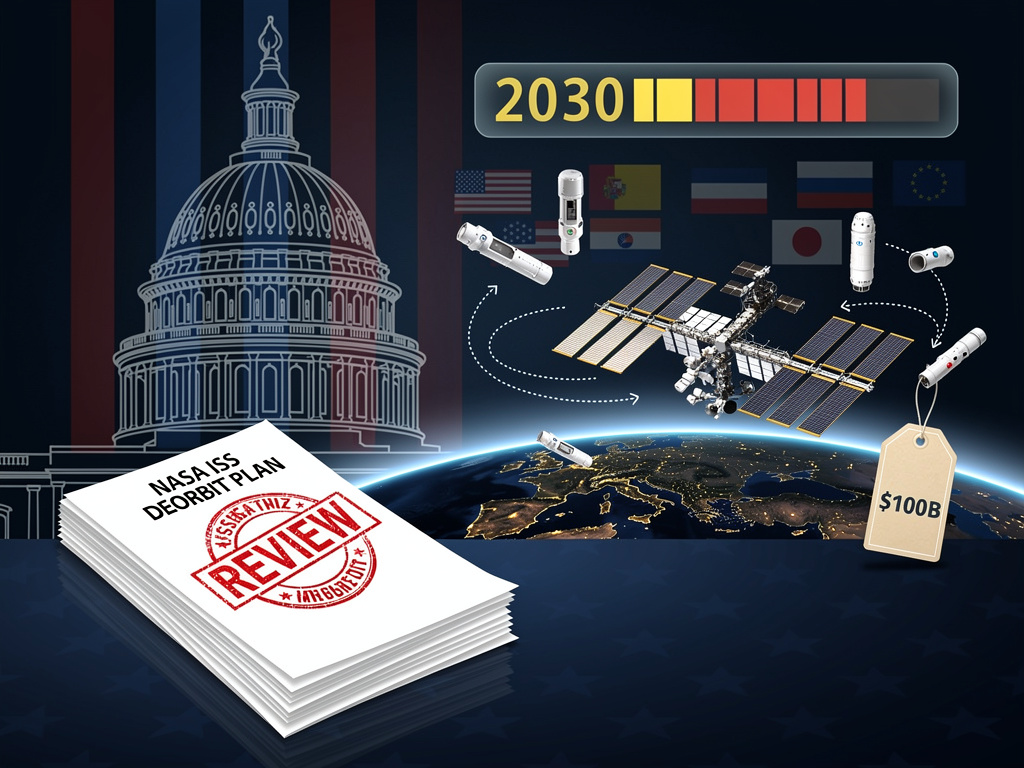
For more than two decades, the International Space Station has served as humanity’s permanent outpost in low Earth orbit — a marvel of international cooperation, scientific discovery, and engineering prowess. But as NASA barrels toward a planned 2030 deorbit of the aging facility, a bipartisan coalition in Congress is pumping the brakes, advancing legislation that would force the space agency to take a hard second look at whether sending the station to a watery grave is truly the wisest course of action.
The bill, which has gained significant traction on Capitol Hill, reflects growing unease among lawmakers, industry stakeholders, and space policy experts about the gap that could emerge between the station’s retirement and the readiness of commercial replacements. With billions of taxpayer dollars invested in the ISS and no commercially operated successor yet proven flight-ready, the stakes of getting this transition wrong are enormous — not just for American leadership in space, but for the nation’s scientific enterprise and geopolitical standing.
A Legislative Intervention Years in the Making
As reported by Ars Technica, Congress has advanced a bill that would require NASA to formally reconsider its plan to deorbit the International Space Station. The legislation mandates that the agency conduct a thorough review of alternatives to the current deorbit strategy, including the possibility of extending the station’s operational life, transferring portions of the station to commercial operators, or finding other means of preserving the orbital infrastructure that has cost American taxpayers well over $100 billion to build and maintain.
The bill’s advancement is not a surprise to those who have been tracking the growing skepticism on Capitol Hill about NASA’s commercial space station transition strategy. For years, members of key authorization and appropriations committees have raised pointed questions about whether the commercial space stations being developed under NASA’s Commercial Low Earth Orbit Destinations (CLD) program — by companies including Axiom Space, Vast, and Blue Origin’s Orbital Reef partnership — will be ready in time to prevent a gap in American crewed presence in low Earth orbit. The legislation effectively codifies that skepticism into a formal requirement for NASA to show its work.
The $1 Billion Deorbit Problem
Central to the debate is NASA’s plan to use a specially designed deorbit vehicle to guide the ISS to a controlled reentry over an uninhabited stretch of the Pacific Ocean, likely around 2030. The agency awarded SpaceX a contract worth approximately $843 million to build the U.S. Deorbit Vehicle (USDV), a modified Dragon spacecraft powerful enough to push the 420,000-kilogram station out of orbit. But the cost and complexity of the deorbit mission itself have drawn scrutiny. Some lawmakers and analysts have questioned whether spending nearly a billion dollars to destroy a functional — if aging — asset represents the best use of federal funds, particularly when the alternatives to the ISS remain unproven.
The ISS was originally designed for a 15-year operational life, but NASA and its international partners have repeatedly extended its mission. The station’s primary structure has held up remarkably well, though it has not been without issues. Cracks in the Russian Zvezda service module, aging thermal control systems, and other maintenance challenges have raised legitimate engineering questions about how long the station can safely operate. NASA has maintained that the station can be kept operational through 2030 with proper maintenance, but extending significantly beyond that date would require substantial investment in repairs and upgrades — a cost that must be weighed against the expense of deorbiting and the investment in commercial replacements.
Commercial Stations: Promise and Peril
NASA’s strategy for the post-ISS era hinges on the success of its Commercial Low Earth Orbit Destinations program, through which the agency has provided seed funding to private companies developing their own orbital habitats. Axiom Space, which has already attached a module to the ISS and plans to eventually detach it as the core of a free-flying station, is widely considered the furthest along. Vast has unveiled plans for its Haven-1 station, while Blue Origin and Sierra Space have been developing the Orbital Reef concept. Yet none of these ventures has demonstrated the full capability to replace the ISS’s research capacity, crew accommodations, or international partnership framework.
The concern among legislators is straightforward: if commercial stations are not ready by 2030 and the ISS has already been deorbited, the United States would face an unprecedented gap in its crewed low Earth orbit presence. Such a gap would not only disrupt decades of continuous scientific research but could also cede strategic ground to China, which has been aggressively expanding its own Tiangong space station program. China’s station is already operational and hosting rotating crews, and Beijing has signaled its willingness to welcome international partners — a direct challenge to the collaborative model that the ISS has embodied since the late 1990s.
Geopolitical Dimensions of an Orbital Vacuum
The geopolitical implications of the ISS transition have become impossible to ignore. The station has long served as one of the few remaining venues for U.S.-Russia cooperation, even as relations between Washington and Moscow have deteriorated sharply in the wake of Russia’s invasion of Ukraine. Russia’s space agency, Roscosmos, has at various times signaled its intent to withdraw from the ISS partnership, though it has also repeatedly extended its commitment. The interplay between international diplomacy and orbital mechanics adds another layer of complexity to the deorbit decision — one that Congress appears increasingly unwilling to leave solely in NASA’s hands.
Beyond the U.S.-Russia dynamic, the ISS partnership includes the European Space Agency, the Japan Aerospace Exploration Agency, and the Canadian Space Agency. Each of these partners has invested significantly in the station and has a stake in its future. Any decision to extend or deorbit the ISS must be coordinated with these international stakeholders, and the bill advancing through Congress implicitly acknowledges this by requiring NASA to consider the full range of diplomatic and scientific consequences before proceeding with deorbit.
Engineering Realities and the Limits of Extension
While the legislative push to reconsider deorbiting the ISS has broad support, it is not without its critics. Some engineers and space policy analysts argue that extending the station’s life significantly beyond 2030 would be throwing good money after bad. The station’s Russian segment, in particular, has shown signs of wear that could become increasingly difficult and expensive to manage. Micrometeorite impacts, metal fatigue, and the degradation of seals and thermal protection systems are all realities of operating a structure in the harsh environment of low Earth orbit for a quarter century.
NASA’s own internal assessments have acknowledged these challenges while maintaining that the station remains safe for crew operations through the end of the decade. The agency has invested in ongoing maintenance and has worked with its international partners to address known issues. But there is a meaningful difference between keeping the station operational through 2030 and extending it to 2035 or beyond, and the engineering analysis required to support such an extension would be substantial. The bill advancing through Congress would, in effect, require NASA to conduct precisely that analysis and present it to lawmakers before any irreversible deorbit actions are taken.
The Budget Battle Behind the Policy Debate
Underlying the entire ISS debate is the perennial tension in NASA’s budget between maintaining existing programs and investing in new capabilities. The station costs NASA roughly $3 billion to $4 billion per year to operate — a significant portion of the agency’s approximately $25 billion annual budget. Proponents of deorbiting argue that freeing up those funds would allow NASA to accelerate its Artemis lunar program, invest more heavily in deep space exploration, and support the maturation of commercial space stations. Opponents counter that the ISS’s operational costs are a known quantity that delivers proven value, while the returns on alternative investments are speculative.
This budgetary calculus is further complicated by the broader fiscal environment in Washington, where deficit concerns and competing spending priorities make any increase in NASA’s top-line budget unlikely. If the agency cannot grow its overall funding, every dollar spent on the ISS is a dollar not spent on the Moon, Mars, or commercial station development. The bill requiring NASA to reconsider deorbiting does not resolve this tension, but it does force the agency to make its case transparently — and gives Congress a formal mechanism to weigh in before a decision of historic consequence is finalized.
What Comes Next for America’s Orbital Ambitions
The advancement of this legislation marks a significant moment in the ongoing debate about America’s future in low Earth orbit. It signals that Congress is not content to simply rubber-stamp NASA’s current plan and is prepared to assert its oversight authority on one of the most consequential decisions in the history of human spaceflight. Whether the bill ultimately leads to an extension of the ISS, a modification of the deorbit timeline, or simply a more rigorous public accounting of the risks and trade-offs involved, it ensures that the decision will not be made quietly or without scrutiny.
For the commercial space companies racing to build the next generation of orbital habitats, the message from Capitol Hill is clear: the timeline may be more flexible than NASA has suggested, but the expectations for readiness and capability are not. If Congress succeeds in delaying or complicating the ISS deorbit, it could provide these companies with additional time to mature their technologies — but it could also reduce the urgency that has been driving their development timelines. The interplay between legislative action, agency planning, and commercial innovation will define the trajectory of American human spaceflight for the next decade and beyond.
As the bill moves through the legislative process, all eyes will be on NASA’s response and the technical analyses that will follow. The International Space Station, humanity’s most ambitious construction project in space, may yet have chapters left to write — if Congress has its way, the final page will not be turned without a thorough and public deliberation about what comes after.


 WebProNews is an iEntry Publication