
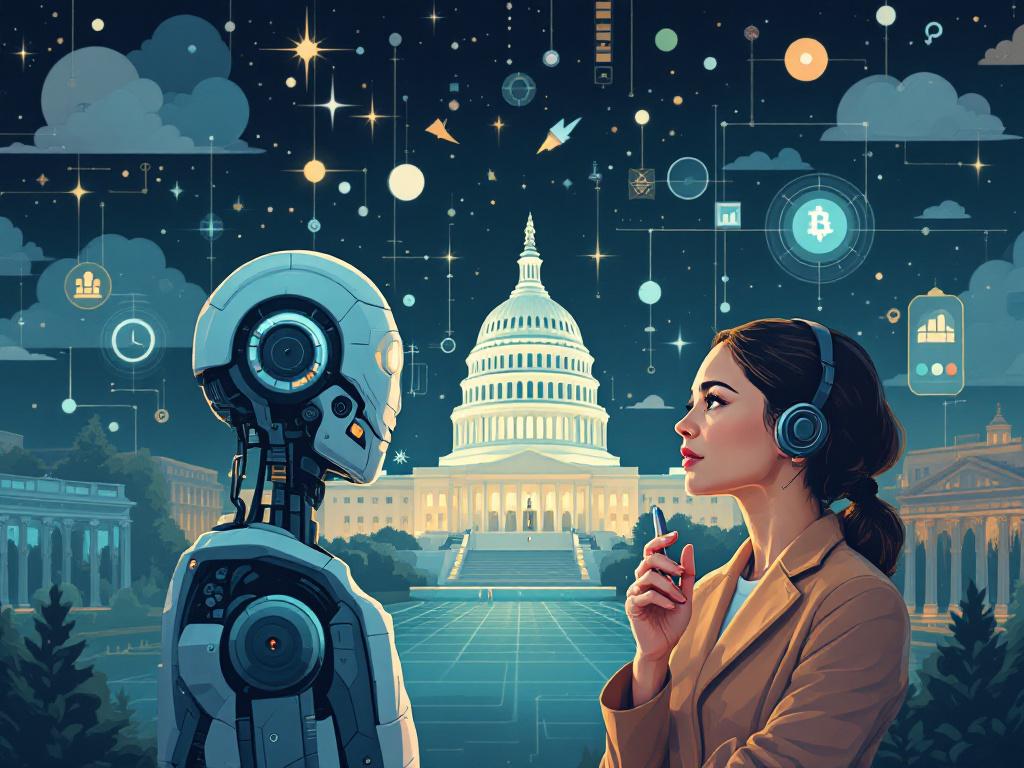
Whispers of an AI Overvaluation Reverberate on Capitol Hill
In the corridors of power in Washington, a new specter is emerging amid the rapid ascent of artificial intelligence: the possibility of an economic bubble fueled by hype and unchecked investment. As 2025 draws to a close, lawmakers are beginning to grapple with warnings that the AI boom could mirror past market frenzies, potentially leading to widespread fallout if it bursts. Rep. Alexandria Ocasio-Cortez, the progressive firebrand from New York, has been among the most vocal, sounding alarms about overinflated valuations and the risks to everyday Americans. Her concerns echo a growing chorus in tech circles, but on Capitol Hill, consensus remains elusive.
The debate gained traction following a surge in AI-related investments, with companies like Nvidia and OpenAI commanding astronomical market caps. According to recent analyses, AI firms have driven a significant portion of U.S. stock market gains this year, prompting questions about sustainability. Ocasio-Cortez, in a series of public statements, has highlighted how such concentration could exacerbate inequality, drawing parallels to the dot-com crash of the early 2000s. Yet, many of her colleagues across the aisle and even within her party express skepticism, viewing the AI surge as a genuine technological revolution rather than mere speculation.
This divergence reflects broader uncertainties in the sector. While some politicians see AI as a national imperative for maintaining global competitiveness, others worry about the environmental and economic costs, including massive energy demands from data centers. The discussion is slowly infiltrating committee hearings and policy briefings, signaling that what started as investor chatter is now poised to influence regulatory agendas.
Voices from the Hill: Divergent Views on AI’s Economic Trajectory
Lawmakers’ positions on the AI bubble often align with their ideological leanings and regional interests. For instance, representatives from tech-heavy states like California are more inclined to downplay bubble risks, emphasizing innovation’s benefits. In contrast, those from manufacturing heartlands express caution, fearing job disruptions and financial instability. A recent House subcommittee hearing underscored this split, with testimony from economists debating whether current valuations are justified by real-world applications or propped up by speculative fervor.
One key figure in this discourse is Sen. Chuck Schumer, who has long championed AI regulation but remains measured on bubble concerns. His office has pointed to ongoing investments in infrastructure as evidence of long-term viability, rather than short-term hype. Meanwhile, Republican voices like Rep. Dusty Johnson have raised alarms about safety and international competition, suggesting that unchecked AI development could lead to strategic vulnerabilities against rivals like China.
The political discourse is informed by external analyses, such as a deep dive from Derek Thompson’s newsletter, which outlines 12 key statistics dominating the bubble debate, from soaring capex in AI hardware to lagging consumer adoption rates. These metrics highlight a disconnect between investment levels and tangible returns, fueling arguments on both sides.
Echoes from Industry Titans: Leaders Weigh In
Beyond Capitol Hill, business luminaries have stoked the flames of this debate. OpenAI’s Sam Altman has acknowledged bubble risks while advocating for continued funding, warning that underinvestment could cede ground to foreign competitors. In a similar vein, Microsoft’s Bill Gates has expressed tempered optimism, noting AI’s transformative potential but cautioning against overreliance on unproven models. Investor Mark Cuban, known for his contrarian takes, dismisses outright bubble comparisons, arguing that AI’s utility in sectors like healthcare and logistics sets it apart from past manias.
These perspectives have trickled into policy circles, influencing briefings and proposed legislation. For example, a recent Senate hearing on AI regulation featured discussions on federal moratoriums tied to broadband funding, as reported by Reuters. The push for such measures underscores fears that fragmented state rules could exacerbate economic imbalances if a bubble were to deflate.
Social media platforms, particularly X (formerly Twitter), have amplified grassroots sentiment on the issue. Posts from users highlight statistics like AI companies accounting for 80% of 2025 U.S. stock gains and 40% of GDP growth, with warnings of an impending burst that could burden ordinary workers. Other threads debate whether the AI surge is a true revolution or a government-propped facade, with calls for national security-driven investments to prevent collapse.
Market Indicators: Charts and Data Fueling the Fire
Visual evidence from financial analyses paints a mixed picture. Charts tracking AI investment flows show exponential growth, with venture capital pouring billions into startups despite uneven profitability. A report from The Washington Post presents data on soaring valuations alongside reasons for calm, such as increasing enterprise adoption, and causes for concern, like ballooning debt from tech giants funding AI ambitions.
Nvidia’s stock performance has become a bellwether, with recent news highlighting debates over its $177 share price amid threats from competitors like Google’s TPUs. As detailed in a TechStock² analysis, this volatility underscores investor divisions, with some viewing it as evidence of overvaluation and others as a sign of enduring demand.
Moreover, projections from frontier labs, as shared in X discussions, suggest no slowdown in progress, with revenue forecasts for companies like OpenAI pointing to massive economic impacts. Yet, critics argue this optimism masks underlying risks, including energy constraints and regulatory hurdles.
Policy Implications: Navigating Regulation Amid Uncertainty
As the bubble debate intensifies, policymakers are contemplating interventions to mitigate potential fallout. Proposals range from enhanced oversight of AI investments to subsidies for infrastructure, aiming to balance innovation with stability. The R Street Institute’s commentary on mid-2025 AI policy, found at their site, details how congressional hearings have evolved, emphasizing the need for coherent federal strategies.
International dimensions add complexity, with U.S. leaders wary of China’s AI advancements. X posts from industry observers note calls for federal backstops on data center buildouts, framing AI as a geopolitical imperative. This rhetoric has led to discussions in the National Defense Authorization Act, where accelerationist lobbies push for relaxed rules to maintain leadership.
However, safety advocates warn of blowback if labs ignore ethical concerns, as seen in leaked executive orders and PAC spending blitzes. The interplay between economic hype and regulatory caution could define the next phase of AI governance.
Economic Parallels: Lessons from History
Drawing from historical precedents, analysts compare the current AI fervor to the dot-com era, where promises outpaced delivery. A Substack piece by Steven Hill in DemocracySOS explores how polarized politics and misinformation amplify bubble risks, potentially leading to societal divides.
Today’s environment differs in key ways, with AI demonstrating real applications in fields like drug discovery and autonomous systems. Yet, the scale of investment—trillions pledged for capex—raises red flags, as noted in sentiment analyses from AI CERTs News, which divide investors between rational optimists and cautious skeptics.
Politico’s coverage of Capitol Hill dysfunction, detailed at their newsletter, illustrates how broader legislative gridlock hampers decisive action on AI, leaving the bubble debate simmering without resolution.
Future Horizons: Balancing Hype and Reality
Looking ahead, the trajectory of AI’s economic impact hinges on technological breakthroughs and market corrections. Industry insiders point to upcoming models that could justify current valuations, while skeptics predict a reckoning if adoption stalls. X conversations emphasize the role of government in propping up the sector through contracts and incentives, potentially averting a full collapse.
The involvement of tech executives in Capitol Hill meetings, such as those in 2023 with figures like Elon Musk and Mark Zuckerberg, as recalled in The Washington Post archives, sets a precedent for ongoing dialogue. These interactions highlight the need for collaborative frameworks to address both opportunities and perils.
Ultimately, as Washington wades deeper into this debate, the stakes extend beyond finance to national security and societal equity. Ocasio-Cortez’s warnings, amplified in Business Insider, serve as a catalyst, urging a reevaluation of AI’s place in the American economy.
Global Ramifications: AI’s Ripple Effects Worldwide
The U.S.-centric bubble discussion has international echoes, with European regulators already imposing stricter AI rules that could influence American policy. Debates over debt-financed expansions by firms like Alphabet and Meta, as critiqued in X posts referencing Economist articles, reveal systemic risks that transcend borders.
In Asia, China’s aggressive AI investments heighten competitive pressures, prompting U.S. calls for energy buildouts to keep pace. This dynamic, explored in another Business Insider piece, shows leaders divided on whether the market frenzy is a bubble or a necessary escalation.
As 2025 transitions to 2026, the convergence of political, economic, and technological forces will likely shape whether AI fulfills its promise or becomes another cautionary tale.
Strategic Responses: Pathways Forward for Stakeholders
For industry players, navigating this uncertainty requires diversification and proof-of-concept demonstrations. Venture capitalists, as discussed in X threads comparing AI to the dot-com bubble, are advised to focus on sustainable growth over hype-driven funding.
Policymakers, meanwhile, must weigh interventionist measures against free-market principles. Proposals for oversight shifts, like California’s SB 53, signal a patchwork approach that federal action could streamline.
In the end, the AI bubble debate on Capitol Hill encapsulates broader tensions in an era of rapid technological change, where optimism clashes with prudence in defining the future.


 WebProNews is an iEntry Publication