
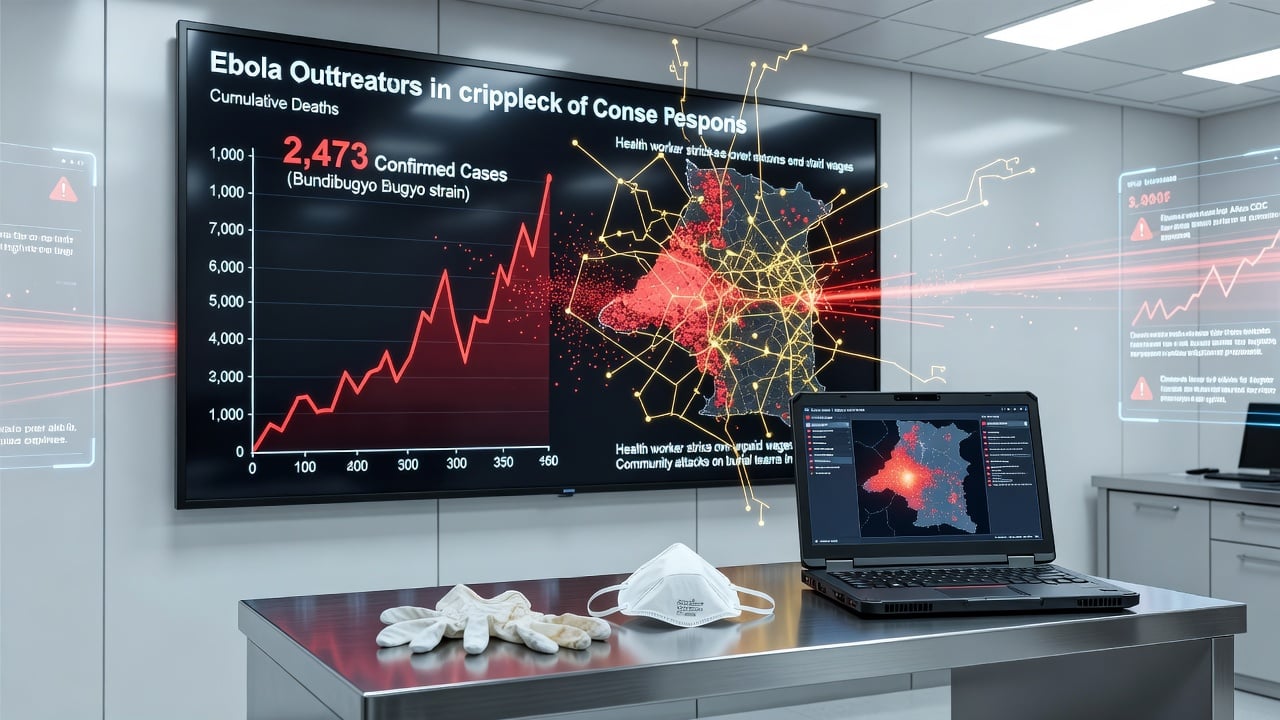
The death toll from Ebola in the Democratic Republic of the Congo has climbed past 1,000. Official figures released this week show 2,473 confirmed cases and 999 deaths as of July 20, with the true scale likely far larger. Health officials describe the outbreak as the fastest on record. But frontline workers walking off the job and communities turning violent against response teams have left containment efforts struggling to keep pace.
This is Congo’s 17th Ebola outbreak since 1976. The virus this time is the Bundibugyo strain. No approved vaccine or specific treatment exists for it. That fact alone sets the current emergency apart from recent surges involving more studied variants. The World Health Organization declared it a public health emergency of international concern on May 17, just days after the formal announcement on May 15. At that point, authorities had tallied eight lab-confirmed cases, 246 suspected ones and 80 suspected deaths concentrated in Ituri province’s Bunia, Rwampara and Mongbwalu health zones. Two confirmed cases had already reached Uganda’s capital, Kampala.
Numbers exploded from there. By mid-July cases topped 2,000. Deaths passed 750 and kept rising. Al Jazeera reported the toll reaching 1,031 by July 22, citing Africa CDC Director-General Jean Kaseya. He spoke at a health conference in Ghana. “If we do not stop this outbreak today, it could become one of the worst Ebola outbreaks the world has ever documented,” Kaseya said. He added that people “are dying because we don’t have vaccines, we don’t have medicine, we don’t have funding.”
The pace alarms experts. The 2013-2016 West Africa epidemic, the deadliest in history, took roughly eight months to reach 1,000 deaths from more than 28,000 cases. This one hit the mark in under 10 weeks. More than 60 percent of deaths occur in the community before patients reach care. Pierre Akilimali, Ebola response incident manager at Congo’s National Public Health Institute, pointed to that statistic. It suggests many infections slip past detection and isolation.
And. The outbreak keeps expanding. Cases now appear across five provinces: Ituri, which accounts for more than 90 percent of infections and 80 percent of fatalities, plus North Kivu, South Kivu, Haut-Uele and Tshopo. Some have reached Kisangani with no local secondary transmission yet. All traced back to Ituri. Signs of stabilization have emerged in places like Mongbwalu and Goma. Yet overall the virus remains ahead of the response. Thierno Balde, WHO incident manager for the Bundibugyo outbreak, said as much. “The outbreak remains ahead of us and we are still in a phase of catching up.”
Conflict and distrust compound the problem. Eastern Congo simmers with rebel activity. The Allied Democratic Forces, linked to Islamic State, adds to the chaos. One local military administrator in Ituri’s Irumu territory called Ebola a bigger threat than that insurgency. Insecurity blocks access to remote areas. It hampers contact tracing. Less than 9 percent of expected contacts from confirmed cases receive monitoring, according to Africa CDC data. WHO estimates the real outbreak size could run two to four times higher than documented figures.
Community resistance runs high. Families insist on traditional burials that involve close contact with bodies. Safe and dignified burial teams face refusal or outright hostility. Robert Ndjalonga, head of civil protection in Ituri, described the dynamic. “The biggest challenge remains resistance from, or outright refusal by, some communities to accept response teams.” On several occasions security forces had to escort burial teams. Shortages of supplies delay responses further. Some health zones still lack functional teams entirely.
Attacks have escalated the danger. A burial team member suffered injury when assailants threw stones at their vehicle returning from a site in Bunia. Health facilities and response convoys have come under fire elsewhere, forcing aid groups to pull staff. Angry mobs target workers they associate with the disease or with outside interference. Such incidents erode trust even more.
Then came the strikes. Health workers at the epicenter stopped work in early July. They had received no pay or bonuses since the outbreak declaration in mid-May. Staff at Bunia General Hospital barricaded entrances. Teams handling surveillance, outreach, safe burials and security at Ebola treatment centers joined in. The action disrupted hospital operations and contact tracing at a critical moment. Some returned after short-term promises of payment. Others threatened full-scale walkouts with no minimum services. The timing could not have been worse. Cases had already surpassed 1,700 with deaths near 600 when the first strikes hit, according to contemporaneous reports.
Frontline exhaustion is real. Workers operate in full protective gear under intense heat. They manage isolation wards filled with 737 patients at last count. They trace contacts in insecure zones. And they do it without consistent salaries. The government has pledged to clear arrears. Progress remains slow. International partners including the WHO, Africa CDC and Doctors Without Borders have scaled up isolation units, treatment centers and community outreach. Yet funding gaps persist. Kaseya highlighted them explicitly.
Cross-border risks add another layer. Uganda recorded 20 confirmed cases and two deaths. Its last patient left care on July 16, starting the 42-day countdown toward official declaration of the end. No new infections reported there for weeks. Still, U.S. authorities maintain travel restrictions on recent visitors from Congo, Uganda and South Sudan. Kaseya wrote to U.S. Health Secretary Robert F. Kennedy Jr. urging their lift for Uganda. Regional coordination continues. Uganda’s president recently hosted a DRC ministerial delegation to align efforts, share expertise and plan treatment centers closer to affected communities.
Efforts focus on several fronts. Rapid response teams deploy to new hotspots. Burial and referral systems expand in high-burden zones. Clinical management improves. A strategy targets movement along the Congo River. Community engagement campaigns try to build acceptance for testing, isolation and safe practices. Success in Kisangani, where imported cases produced no further spread, offers a model. But with 80 percent of new cases arising from unknown transmission chains, the gaps in surveillance remain glaring.
Health authorities race against time. The Bundibugyo virus spreads through direct contact with bodily fluids. It proves fatal in many cases without supportive care. In a region already burdened by conflict, poverty and weak infrastructure, the outbreak tests the limits of both local systems and global response mechanisms. Signs of stabilization in isolated health zones provide faint hope. The overall trajectory, however, points to continued growth unless payment disputes resolve quickly, attacks cease and communities begin to cooperate with burial and treatment protocols.
Recent coverage reinforces the urgency. UN News noted on July 21 that the outbreak continues expanding despite some encouraging trends, with insecurity the primary barrier. Doctors Without Borders updated its response summary just yesterday, calling for urgent scale-up two months after declaration as cases near 2,000 and deaths exceed 700. The organization stresses needs for more treatment capacity and community trust-building. These accounts align with government and WHO data while highlighting operational shortfalls that strikes and violence only worsen.
Officials from Congo’s health ministry, the WHO and Africa CDC continue daily briefings. They adjust tactics to match local realities. Yet the combination of a vaccine-less strain, geographic inaccessibility, labor unrest and active hostility creates a perfect storm. The next weeks will prove decisive. Either coordinated action brings transmission under control or the toll mounts into territory that echoes the darkest chapters of Ebola history. For now the virus holds the upper hand. And the workers asked to stop it remain unpaid, unprotected and under attack.


 WebProNews is an iEntry Publication