
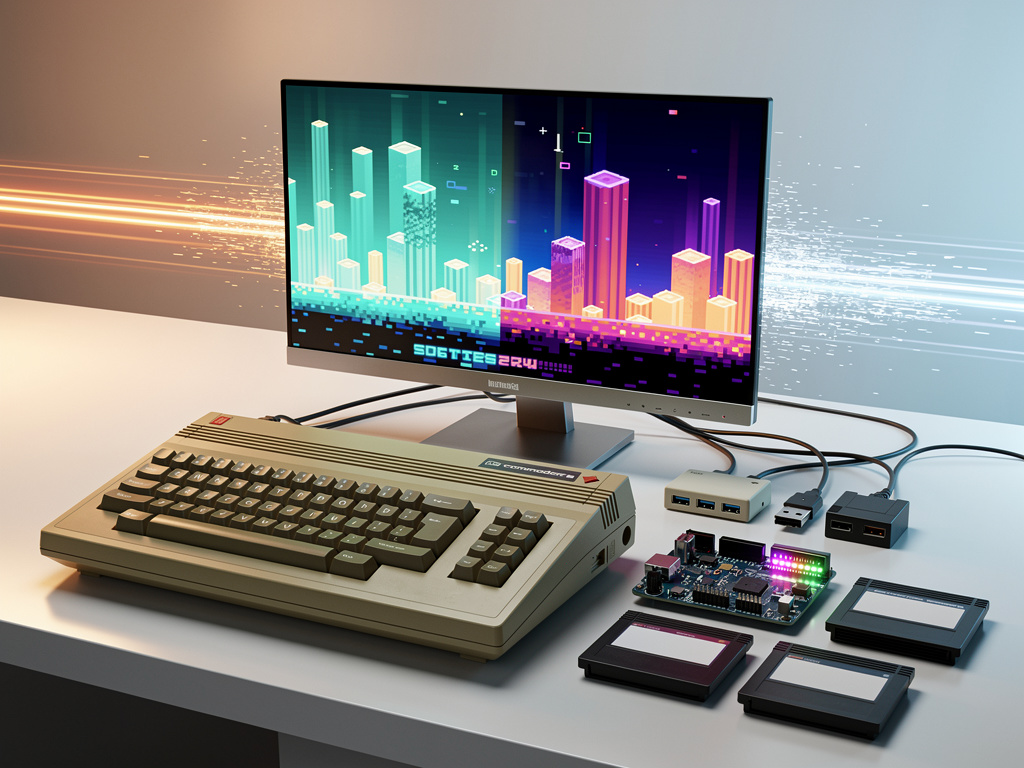
Reviving the Pixelated Past: The Commodore 64 Ultimate’s Bold Leap into Modern Nostalgia
In an era where computing power doubles seemingly overnight, a curious revival is capturing the attention of tech enthusiasts and historians alike. The Commodore 64 Ultimate, a meticulously crafted remake of the iconic 1982 home computer, has emerged as a bridge between vintage charm and contemporary convenience. Launched by a team of dedicated retro computing aficionados, this device isn’t just a nostalgic toy; it’s a serious piece of hardware aimed at preserving the essence of early personal computing while incorporating subtle modern upgrades. Drawing from hands-on experiences and expert analyses, this deep dive explores what makes the Commodore 64 Ultimate a standout in the realm of retro revivals.
At its core, the Commodore 64 Ultimate faithfully replicates the original machine’s architecture, boasting a 1MHz processor and 64KB of RAM—specifications that once defined the cutting edge of home computing. Yet, it’s the thoughtful enhancements that set it apart. For instance, it includes HDMI output for seamless connection to modern displays, USB ports for easy file transfers, and even support for original peripherals like joysticks and tape drives. This blend of authenticity and accessibility addresses a long-standing pain point for collectors: the fragility of aging hardware. As noted in a recent review by WIRED, the device is “an astonishing remake—but daunting if you weren’t there the first time around,” highlighting its appeal to veterans while acknowledging the learning curve for newcomers.
The project’s origins trace back to a group of Commodore enthusiasts, including former staff and retro computing personalities, who acquired the brand rights. This isn’t merely a cash-in on nostalgia; it’s a passionate endeavor to keep the spirit of 8-bit computing alive. Reviews across the board praise its build quality, with the system encased in a breadbin-style chassis that mimics the original’s aesthetic down to the tactile keyboard feel. Users can boot into BASIC, load classic games via cartridge or disk emulation, and even tinker with assembly code, evoking the DIY ethos that made the original Commodore 64 a bestseller with over 17 million units sold.
Engineering the Perfect Retro Fusion
Delving deeper into the technical specs, the Commodore 64 Ultimate employs FPGA technology to emulate the original MOS 6510 processor and VIC-II graphics chip with pinpoint accuracy. This isn’t software emulation running on a Raspberry Pi; it’s hardware-level recreation that ensures cycle-exact performance, crucial for running period-specific software without glitches. Musicians, in particular, will appreciate the inclusion of a genuine SID sound chip option, allowing for authentic chiptune audio that has influenced generations of electronic music. According to an in-depth analysis from Tom’s Hardware, the machine serves as “a platform for retro gaming, retro homebrew, and video game preservation,” underscoring its role in archiving digital history.
Pricing at around $300, the Commodore 64 Ultimate positions itself as a premium offering in a market flooded with mini consoles and emulators. It’s not cheap, but as Tom’s Hardware points out, the cost reflects new hardware reliability, avoiding the pitfalls of sourcing decades-old components that could fail at any moment. This reliability extends to its audio capabilities, where the SID chip’s warmth is preserved without the hiss or degradation common in vintage units. For developers and hobbyists, the system supports modern SD card storage, enabling easy loading of ROMs and homebrew applications, which has sparked a wave of new software development for the platform.
Industry insiders note that this revival taps into a broader trend of tangible computing experiences amid an increasingly cloud-based world. Posts on X from retro computing communities buzz with excitement, sharing demos of smooth-scrolling shoot-em-ups and discussions on the VIC-II chip’s hardware registers. One prominent voice likened it to a “portal to a time when computing was fun,” echoing sentiments from official Commodore accounts that celebrate the device’s launch. This social media chatter reveals a vibrant ecosystem of users experimenting with the hardware, from coding simple games to interfacing with modern IoT devices.
Unpacking the Cultural Resonance
Beyond the circuitry, the Commodore 64 Ultimate carries profound cultural weight. The original machine democratized computing in the 1980s, introducing millions to programming through its accessible BASIC interpreter. It powered early games like “The Last Ninja” and “California Games,” fostering a generation of tech innovators. Today’s remake revives that educational spark, making it an ideal tool for STEM programs or history lessons on computing evolution. A review in GamesRadar+ suggests it “could spark a massive microcomputing revival,” pointing to its potential to inspire new waves of tinkerers in an age dominated by sealed black-box devices.
However, not everything is pixel-perfect. Some early users have reported minor sound issues in specific games, such as distorted voice samples, as discussed in online forums like Lemon64. These glitches, while rare, highlight the challenges of emulating vintage hardware flawlessly. The team behind the project has been responsive, issuing firmware updates via USB, which demonstrates a commitment to ongoing support—a rarity in retro hardware circles. In contrast to cheaper alternatives like the C64 Mini, the Ultimate’s full-sized keyboard and expansion ports offer a more immersive experience, though they demand space and setup akin to the original.
For industry professionals, the Commodore 64 Ultimate represents a case study in intellectual property revival. The brand, dormant for decades, was acquired by a consortium including retro YouTuber Christian “Perifractic” Simpson and others, as detailed in coverage from Time Extension. This move not only legitimizes the product but also opens doors for future expansions, such as Amiga revivals or new peripherals. Financially, it’s a calculated bet on the growing retro market, estimated to be worth billions, driven by collectors and gamers seeking authenticity over emulation.
Navigating Challenges and Innovations
Critics have mixed views on its accessibility. While veterans dive right in, typing “LOAD ‘*’,8,1” to boot games, newcomers might find the command-line interface intimidating. WIRED’s review emphasizes this divide, noting the device’s daunting nature for those without prior exposure. To mitigate this, the Ultimate includes preloaded games and a modern menu system, blending ease with education. It’s a smart compromise that encourages exploration without dumbing down the experience.
On the innovation front, the inclusion of HDMI and USB isn’t just convenient; it enables hybrid uses, like connecting to modern monitors for high-definition output or using USB controllers for multiplayer sessions. Hackster.io’s hands-on review, available at Hackster.io, questions whether it’s a “triumphant return” or mere “nostalgia grab,” ultimately leaning toward the former due to its hackable nature. Enthusiasts are already modding it for custom firmware, expanding its capabilities beyond the 1980s blueprint.
Social sentiment on platforms like X amplifies this enthusiasm, with posts from outlets like IGN repeatedly praising its “pixel-perfect 8-bit joy.” One viral thread compared it to bridging incompatible tech worlds, reminiscent of 1984 photos showing users transferring files between Commodore and Apple systems. This resonance underscores a desire for hands-on tech in an abstracted digital age, where understanding hardware fundamentals is increasingly rare.
Market Implications and Future Horizons
From a market perspective, the Commodore 64 Ultimate arrives amid a surge in retro tech demand. Recent news highlights extremely rare devices, like an East German game console from the 1970s fetching $1,000 at auction, as covered by Tom’s Hardware in a separate piece. Such stories illustrate the premium placed on preserved computing artifacts. The Ultimate, with its production-line revival after 30 years, as reported by TechRadar, taps into this fervor, shipping in time for holidays and appealing to both collectors and casual fans.
Competitively, it stands out against emulators and mini consoles by offering expandability. IGN’s review, found at IGN, affirms that it “does justice to the original,” scoring high on authenticity and tweaks. This positions it as a gold standard, potentially influencing future revivals of systems like the ZX Spectrum or Atari 2600.
Looking ahead, the Commodore 64 Ultimate could evolve into a platform for new content creation. Developers are porting modern indie games to its architecture, blending old-school constraints with fresh ideas. Archyde’s recent coverage notes over 70% of consumers expressing interest in retro tech for its tangible, hackable qualities, signaling a shift toward experiential computing. As firmware updates roll out, addressing issues like sound inaccuracies, the device promises longevity.
The Enduring Allure of 8-Bit Ingenuity
In reflecting on its place in tech history, the Commodore 64 Ultimate embodies the enduring appeal of simplicity in a complex world. It reminds us that innovation once stemmed from limitations, fostering creativity that modern abundance sometimes stifles. For insiders, it’s a tool for preservation, education, and experimentation.
The project’s community-driven approach, evident in X discussions and forum feedback, ensures it evolves with user input. Whether composing SID tunes or debugging BASIC code, users engage deeply, rediscovering the joy of computing’s roots.
Ultimately, this remake isn’t just about reliving the past; it’s about inspiring future generations to appreciate where it all began. As retro computing gains momentum, the Commodore 64 Ultimate leads the charge, proving that some legends never truly fade.


 WebProNews is an iEntry Publication