
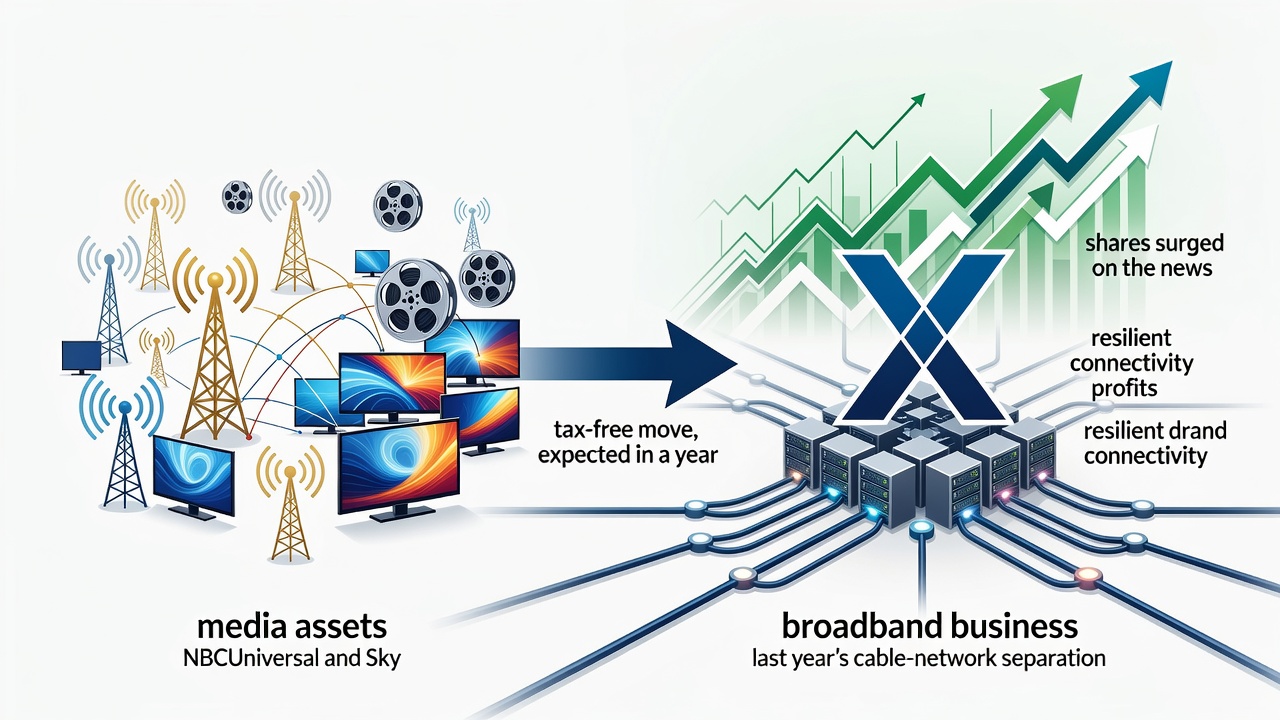
Comcast is splitting in two. The company announced Monday it will spin off NBCUniversal and its Sky operations into a standalone public company. One entity will focus on broadband, wireless and business services. The other will house theme parks, film studios, NBC broadcast, Peacock streaming, Bravo cable and the British pay-TV assets.
Shares of Comcast jumped as much as 24 percent in premarket trading on the news. Investors appear to like the idea of isolating the steady cash flows from connectivity away from the volatile advertising and content businesses. But the move also reflects deeper forces reshaping the industry.
This isn’t Comcast’s first separation. In November 2024 the company said it would spin off a package of cable networks including USA, E!, SYFY, CNBC and MSNBC along with Fandango and Rotten Tomatoes. That entity, later named Versant Media, completed its separation in January 2026. AP News reported how the latest announcement builds directly on that earlier step. The cable networks had become a drag. Now the company is going further.
The proposed transaction is structured as a tax-free spin-off to Comcast shareholders. It should close in about one year, subject to board approval, regulatory clearances and financing. Comcast plans to retain up to a 19.9 percent stake in the new media company for as long as a year afterward. Executives said they would monetize that holding over time in a tax-efficient manner. Reuters detailed the retained stake and potential for the spun-off entity to draw acquisition interest.
Brian L. Roberts will stay actively involved with both companies. He will continue as chairman of the broadband-focused firm and hold a role with the media business as well. Super-voting shares that give the Roberts family control are expected to carry over to the new NBCUniversal with a dual-class structure.
Leadership changes accompany the split. Mike Cavanagh, currently co-CEO of Comcast, will become CEO of the independent NBCUniversal. Michael Angelakis, a former Comcast CFO, will return as CEO of the connectivity company. In the official release, Cavanagh said the separation “positions us for success” with its portfolio of iconic brands. Roberts added that the move “unlocks an entrepreneurial approach and new opportunities.” Comcast’s corporate press release captured those comments directly.
The numbers tell part of the story. In 2025 the connectivity businesses generated $70.7 billion in revenue, more than half the company’s total. The media side, including studios, networks, Peacock and theme parks, contributed about $27 billion. Theme parks have been a bright spot. Studios and Peacock face the familiar pressures of streaming economics and softening ad markets.
And yet analysts immediately began to view the spun-off NBCUniversal as an attractive takeover candidate. Some pointed to possible interest from streaming giants such as Netflix that might want its content library, studio output and valuable theme-park business. The new company would enter the market with an investment-grade balance sheet and significant scale. Still, executives pushed back on any suggestion the spin sets up an immediate sale.
This transaction effectively unwinds much of the 2011 deal in which Comcast acquired a controlling stake in NBCUniversal from General Electric. At the time, the combination of distribution and content looked like a defensive masterstroke against rising digital threats. Cable subscriptions were still growing. Linear TV dominated viewing.
That world has vanished. Cord-cutting accelerated. Streaming services fragmented audiences and advertising dollars. Traditional cable networks lost pricing power. Comcast’s broadband business, by contrast, remained remarkably resilient even as it faced fixed wireless competition from T-Mobile and Verizon.
Other media conglomerates have made similar calculations. AT&T unwound its Time Warner acquisition. Warner Bros. Discovery emerged from that turmoil. Paramount Global has spent years seeking a buyer or merger partner. Disney has restructured aggressively around its streaming priorities while protecting its parks and studios.
Comcast’s decision stands out because it keeps the profitable distribution arm intact under the Comcast name while freeing the content and experiential assets. The broadband company will continue to invest in its network, wireless offerings and business services. The media company can pursue partnerships, content bets or acquisitions without the drag of quarterly comparisons to high-margin cable cash flows.
But challenges await the new NBCUniversal. Peacock has grown subscribers yet still burns cash in a crowded field. Linear networks, even the stronger ones like Bravo, continue to shed viewers. Sky faces competitive pressures in Europe. Theme parks deliver strong returns but are sensitive to economic cycles and international travel.
Wall Street’s early reaction suggests many believe the sum of the parts will exceed the current whole. Comcast shares had traded at a conglomerate discount for years. Separating the businesses may let each trade on its own merits. The retained stake gives Comcast a way to participate in any upside while gradually exiting.
Industry watchers note this could accelerate further deal-making. A standalone NBCUniversal with clean financials and desirable assets might invite bids. At minimum, it sets a template for other legacy media owners still tethered to distribution or older business models.
Roberts has steered Comcast through multiple eras. He bought NBCUniversal when few others saw the value. He expanded Sky in a bold European bet. Now he is reversing course. The founder’s son knows when to hold and when to fold. This spin-off looks like a calculated exit from the old media-television marriage.
Executives insist both new companies will emerge stronger and more focused. They point to investment-grade balance sheets for each and the ability to pursue distinct strategies. Yet the road to separation involves complex financing, regulatory reviews and operational disentanglement. Success is not guaranteed.
For now, investors are cheering. The market has spoken. Traditional media conglomerates built on cable bundles no longer command the same premiums. Pure-play connectivity carries appeal. Content and experiences can stand alone if managed with agility.
Comcast’s announcement closes one chapter. The coming year of planning and execution will determine whether two stronger companies replace one that had grown mismatched with its times. The industry will watch closely. So will shareholders on both sides of the eventual split.


 WebProNews is an iEntry Publication