
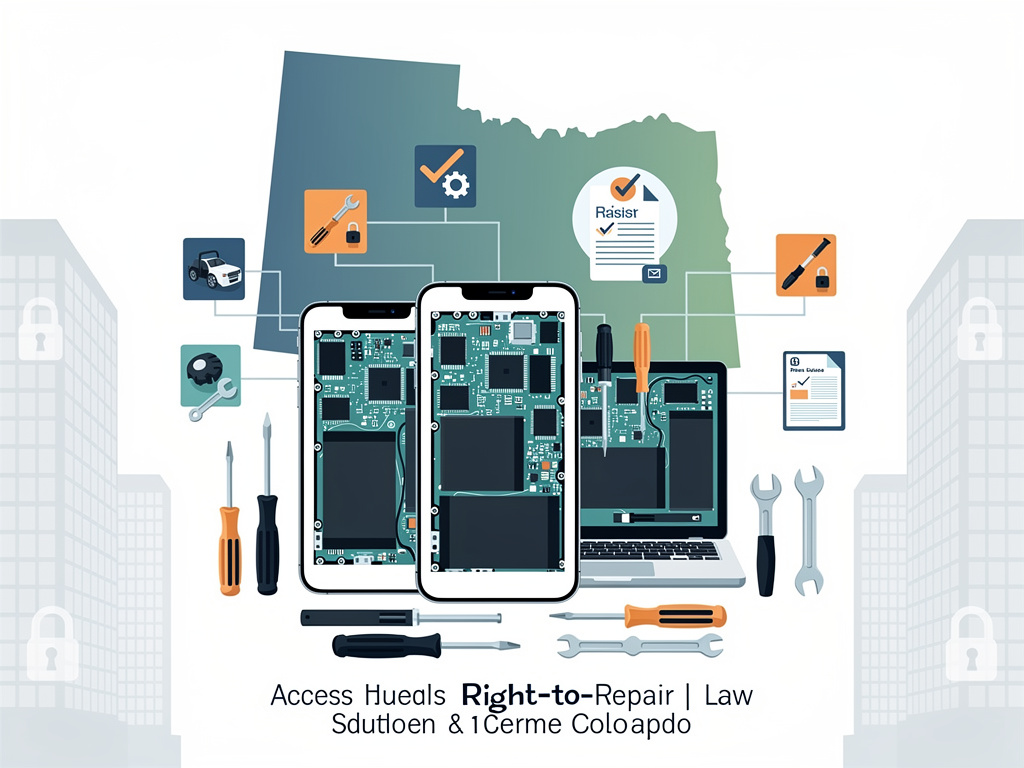
Colorado has become the latest state to challenge the stranglehold that major technology companies maintain over the repair of consumer electronics, signing into law a sweeping right-to-repair measure that compels manufacturers to provide consumers and independent repair shops with the tools, parts, and documentation needed to fix their own devices. The move places Colorado among a growing cohort of states pushing back against what consumer advocates have long described as an anticompetitive practice that drives up costs and generates mountains of electronic waste.
Governor Jared Polis signed the legislation, which targets a broad range of consumer electronics including smartphones, tablets, laptops, and other personal devices. The law requires manufacturers to make diagnostic tools, repair manuals, and replacement parts available to consumers and independent repair providers on fair and reasonable terms — the same terms offered to the companies’ own authorized repair networks. The measure is designed to break down the barriers that have historically forced consumers to rely solely on manufacturers or their approved partners for repairs, often at significant cost, as reported by MSN.
A Growing State-Level Movement Against Manufacturer Repair Monopolies
Colorado’s action does not exist in a vacuum. It is part of an accelerating wave of state-level legislation that has gained momentum since New York became the first state to pass a broad right-to-repair law for electronics in 2022. Since then, Minnesota, California, and Oregon have enacted their own versions, each building on the precedent set by earlier measures and, in some cases, expanding the scope of what manufacturers must provide. California’s law, signed by Governor Gavin Newsom in late 2023, was notable for covering devices sold for $50 or more and requiring parts availability for up to seven years after a product’s last date of manufacture.
Colorado’s legislation adds to this patchwork of state laws, and advocates argue that each new state that joins the movement increases pressure on manufacturers to adopt a more open approach to repair nationwide rather than comply with a fragmented set of state-by-state requirements. The strategy mirrors the approach that proved effective with automotive right-to-repair: Massachusetts voters approved a ballot measure in 2020 that compelled automakers to share telematics data with independent shops, and the industry eventually moved toward broader compliance rather than fight a state-by-state battle.
What Colorado’s Law Requires — and Where It Draws Boundaries
The Colorado law is detailed in its requirements. Manufacturers of consumer electronics sold or used in the state must provide parts, tools, and repair documentation to any individual or independent repair shop that requests them. Pricing must be fair and reasonable, and manufacturers cannot condition the sale of parts on the purchase of additional components or services that are not necessary for the repair. The law also prohibits manufacturers from voiding warranties solely because a consumer chose an independent repair provider.
However, the legislation does include certain exemptions. Medical devices, motor vehicles, and certain agricultural and industrial equipment are carved out, reflecting the political compromises that have been necessary to pass right-to-repair bills in state legislatures. Some critics have argued that these carve-outs are too broad, particularly for agricultural equipment, where farmers have waged their own long-running battle for the right to repair tractors and other machinery manufactured by companies like John Deere. Still, supporters of the Colorado law say it represents a significant step forward for consumer rights in the electronics sector.
The Industry’s Resistance — and Its Slow Retreat
Major technology companies have historically opposed right-to-repair legislation, arguing that opening up repair access could compromise product safety, expose proprietary intellectual property, and create security vulnerabilities. Apple, Samsung, and other leading manufacturers have spent millions lobbying against such bills in state capitals across the country. The industry’s trade groups, including TechNet and the Consumer Technology Association, have raised concerns that poorly drafted laws could lead to substandard repairs that harm consumers.
Yet the industry’s posture has shifted noticeably in recent years, driven in part by the political inevitability of reform. Apple launched its Self Service Repair program in 2022, making genuine parts, tools, and repair manuals available to individual consumers for the first time. Samsung followed with its own independent repair program, partnering with iFixit to distribute parts and guides. Google has similarly expanded parts availability for its Pixel line of smartphones. These moves, while welcomed by repair advocates, have also been criticized as insufficient — Apple’s program, for instance, has been faulted for requiring consumers to rent large, heavy toolkits and for pricing parts in ways that make self-repair only marginally cheaper than using Apple’s own services.
The Environmental Stakes of Repair Access
One of the most compelling arguments in favor of right-to-repair legislation is its environmental impact. According to the United Nations’ Global E-Waste Monitor, the world generated a record 62 million metric tons of electronic waste in 2022, a figure that is projected to grow to 82 million metric tons by 2030. In the United States alone, the Environmental Protection Agency estimates that only about 25% of e-waste is properly recycled, with the remainder ending up in landfills or being exported to developing countries where it poses serious health and environmental risks.
Proponents of Colorado’s law argue that making repair more accessible and affordable will extend the useful life of electronic devices, reducing the volume of products that are discarded prematurely. The U.S. Public Interest Research Group (PIRG) has estimated that extending the average lifespan of smartphones by just one year could reduce carbon emissions equivalent to taking hundreds of thousands of cars off the road annually. Environmental organizations, including the Sierra Club and the Electronic Frontier Foundation, have endorsed right-to-repair measures as a practical tool for reducing waste and conserving the rare earth minerals and other finite resources used in electronics manufacturing.
Federal Efforts Stall as States Take the Lead
While state-level action has accelerated, federal efforts to establish a national right-to-repair standard have largely stalled. The Federal Trade Commission issued a report in 2021 that was broadly supportive of consumers’ right to repair their own products, and the Biden administration signed an executive order encouraging the FTC to pursue rulemaking on the issue. However, no comprehensive federal legislation has been enacted, and the political dynamics in Congress have made passage of a national bill unlikely in the near term.
This federal inaction has created the conditions for the current state-by-state approach, which, while effective in building momentum, also creates compliance challenges for manufacturers that sell products across all 50 states. Industry groups have argued that a single federal standard would be preferable to a patchwork of state laws, but consumer advocates counter that the industry’s preference for federal action is largely a delay tactic — a way to slow reform by shifting the debate to a legislative body where progress is far more difficult to achieve.
Independent Repair Shops and Consumer Advocates Celebrate — With Caveats
For independent repair businesses, Colorado’s law represents a significant victory. Small repair shops have long complained that manufacturers’ refusal to sell parts or share diagnostic information has put them at a severe competitive disadvantage, forcing them to rely on aftermarket parts of uncertain quality or to turn away customers whose devices they cannot fix. Organizations like iFixit, which has been one of the most vocal advocates for right-to-repair, have praised the Colorado measure as a model for other states to follow.
Still, the effectiveness of the law will depend heavily on enforcement. Previous right-to-repair measures in other states have faced criticism for weak enforcement mechanisms, and manufacturers have found ways to comply with the letter of the law while undermining its spirit — for example, by pricing parts so high that independent repair remains uneconomical, or by using software locks that prevent third-party components from functioning properly. Colorado’s attorney general will have authority to enforce the new law, but advocates are watching closely to see whether the state will commit the resources necessary to hold manufacturers accountable.
What Comes Next for the Right-to-Repair Movement
Colorado’s law is unlikely to be the last word on right-to-repair in 2025. Several other states, including Illinois, Vermont, and Washington, have active bills working through their legislatures, and the issue has attracted bipartisan support in many states where rural communities, in particular, have felt the impact of repair restrictions on both electronics and agricultural equipment. The European Union has also moved aggressively on the issue, adopting regulations that require manufacturers to make spare parts available for up to 10 years and to design products with repairability in mind.
For the technology industry, the direction of travel is increasingly clear. The question is no longer whether manufacturers will be required to open up their repair processes, but how broadly and how quickly those requirements will expand. Colorado’s entry into the right-to-repair fold adds another layer of pressure on companies to rethink their approach to product design, parts distribution, and customer service — and signals that the era of manufacturer-controlled repair may be drawing to a close.


 WebProNews is an iEntry Publication