
Code’s New Divide: How Generative AI Is Splitting the Software Engineering World in Two
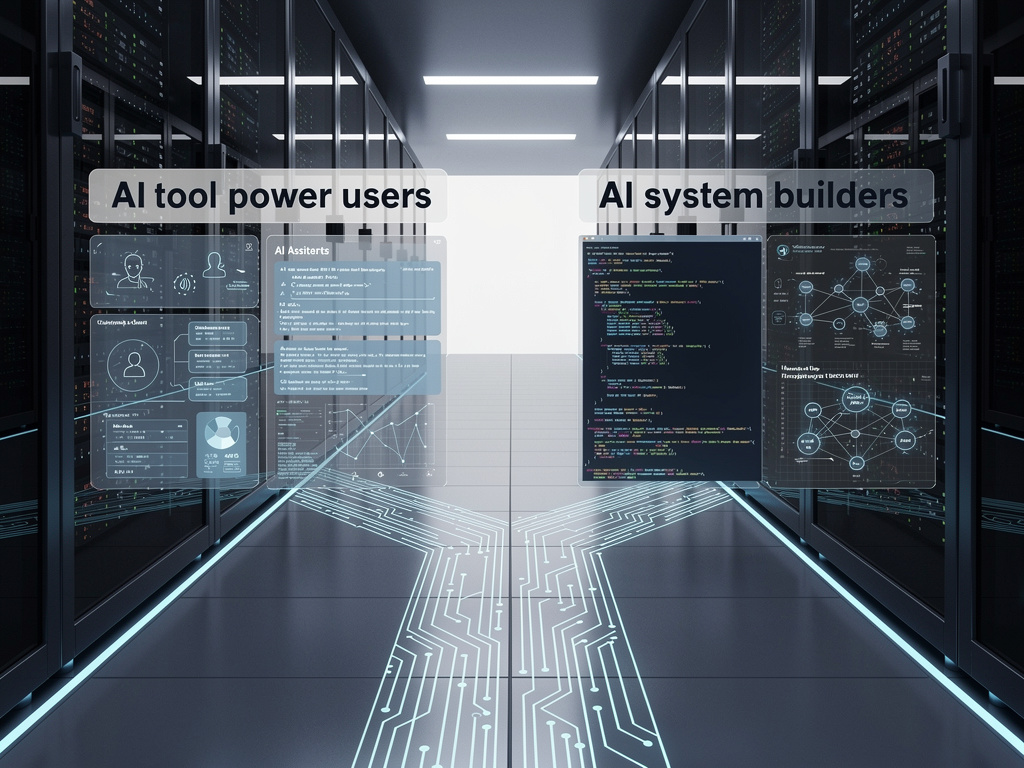
For decades, the path to a successful software engineering career was a well-trodden one: master a programming language, learn a framework, and steadily climb the ladder from junior to senior developer by writing progressively more complex code. That path is now fracturing. Generative artificial intelligence is acting not merely as a new tool, but as a tectonic force, cleaving the profession into two distinct, and increasingly distant, career trajectories. The comfortable middle ground of the journeyman coder, tasked with routine implementation and boilerplate logic, is rapidly eroding, forcing a stark choice upon millions of developers: become a master of AI, or become a master who builds it.
The anxiety in the engineering community is palpable, but the narrative of mass replacement is proving to be a red herring. Instead, what is emerging is a transformation of roles. AI coding assistants like GitHub Copilot are no longer novelties; they are becoming standard issue. These tools excel at the grunt work that once consumed a significant portion of a developer’s day—writing unit tests, generating standard functions, and translating logic from one language to another. This automation of the mundane is creating a productivity boom, but it is also devaluing the very skills that defined entry-level and mid-tier software roles for a generation.
The core of the issue, as detailed in a recent analysis by Digital Trends, is a “great split” in the nature of the work itself. On one side of this divide are the “AI-assisted developers,” a new class of engineer who will leverage AI as a powerful partner to operate at a higher level of abstraction. Their value will no longer be measured in lines of code written, but in the quality of the systems they can design, architect, and orchestrate. This is a fundamental shift from coder to creator, from implementer to strategist.
The Ascendance of the AI Orchestrator
The first path, and the one most current developers will likely tread, is that of the AI orchestrator or power user. In this role, the engineer’s primary function shifts from writing code line-by-line to directing, reviewing, and integrating AI-generated code. Proficiency will depend on the ability to craft sophisticated prompts, critically evaluate the output of a large language model (LLM), and seamlessly weave that output into a larger, coherent application architecture. The skill set becomes less about recalling specific syntax and more about deep domain knowledge and understanding the intricate dependencies of a complex system.
The productivity gains are not theoretical. A randomized controlled trial conducted by researchers at MIT and GitHub found that developers using an AI assistant completed a coding task 55.8% faster than those without. According to a report on the study from MIT News, this acceleration allows engineers to stay “in the flow” longer and feel more fulfilled by their work, as they can focus on more satisfying, higher-order problems. The developer’s role, therefore, evolves into that of a pilot, guiding a powerful machine rather than building the engine by hand.
This evolving dynamic demands a new kind of engineering discipline. The most effective AI-assisted developers will be those who possess exceptional debugging skills and a robust mental model of software architecture. They must be able to quickly identify when an AI has generated suboptimal, insecure, or simply incorrect code. Their expertise will be in seeing the forest, not just the trees, and ensuring that the accelerated pace of development does not come at the expense of quality, security, and maintainability.
The Elite Path of the AI System Builder
On the other side of the chasm lies a far more specialized and demanding role: the AI system builder. These are the engineers who are not using the AI models, but are creating, training, and fine-tuning them. This is the domain of machine learning specialists, data scientists, and research engineers who work directly with neural networks, massive datasets, and the sophisticated infrastructure required to power generative AI. This career path requires a deep, almost academic, understanding of mathematics, statistics, and computer science principles far beyond what is required for typical application development.
The demand for this talent is intense, and the barrier to entry is high. While millions of developers are learning to use AI tools, the pool of individuals who can build the next generation of those tools remains small and highly sought after. These roles involve designing novel model architectures, optimizing algorithms for performance on specialized hardware like GPUs, and curating the vast troves of data necessary to train effective models. This is not about building a web application; it is about advancing the fundamental capabilities of artificial intelligence itself.
Companies are willing to pay a significant premium for this expertise, as owning a proprietary, high-performing AI model can be a powerful market differentiator. The work of an AI system builder is foundational, creating the platforms upon which legions of AI-assisted developers will then operate. This career is less about product features and more about pushing the boundaries of what is computationally possible, making it one of the most intellectually challenging and financially rewarding paths in technology today.
Accelerants on the Horizon and the New Hiring Calculus
The bifurcation is being accelerated by the emergence of even more sophisticated tools that are being marketed as the first “AI software engineers.” A prime example is Devin, an AI agent developed by the startup Cognition, which can reportedly handle entire development projects from a single prompt. As detailed by Bloomberg, such agents aim to autonomously write code, debug it, and deploy the final product, further abstracting the human role. While still in its early stages, this technology points to a future where the AI-assisted developer may manage a team of AI agents rather than just a single co-pilot.
This technological shift is forcing a complete re-evaluation of hiring and team structure within corporations. The emphasis is moving away from language-specific knowledge, which can be easily supplemented by AI, toward core conceptual understanding and problem-solving ability. The 2023 Stack Overflow Developer Survey, which polled over 90,000 developers, revealed a significant trend: 82% of professional developers are either using or plan to use AI tools in their development process within the next year, according to the official survey results. This rapid adoption signals to hiring managers that AI literacy is no longer a bonus but a baseline requirement.
For aspiring and current engineers, the message is clear: standing still is not an option. The industry no longer has room for those who are merely proficient at writing boilerplate code. The future belongs to those who either learn to command AI with expert precision to build remarkable products, or those who possess the rare talent to build the AI itself. The great divide in software development is here, and choosing a side has become the defining career decision for a generation of engineers.


 WebProNews is an iEntry Publication