
When Servers Overheat, Billions Hang in the Balance: Inside the CME Data Center Debacle
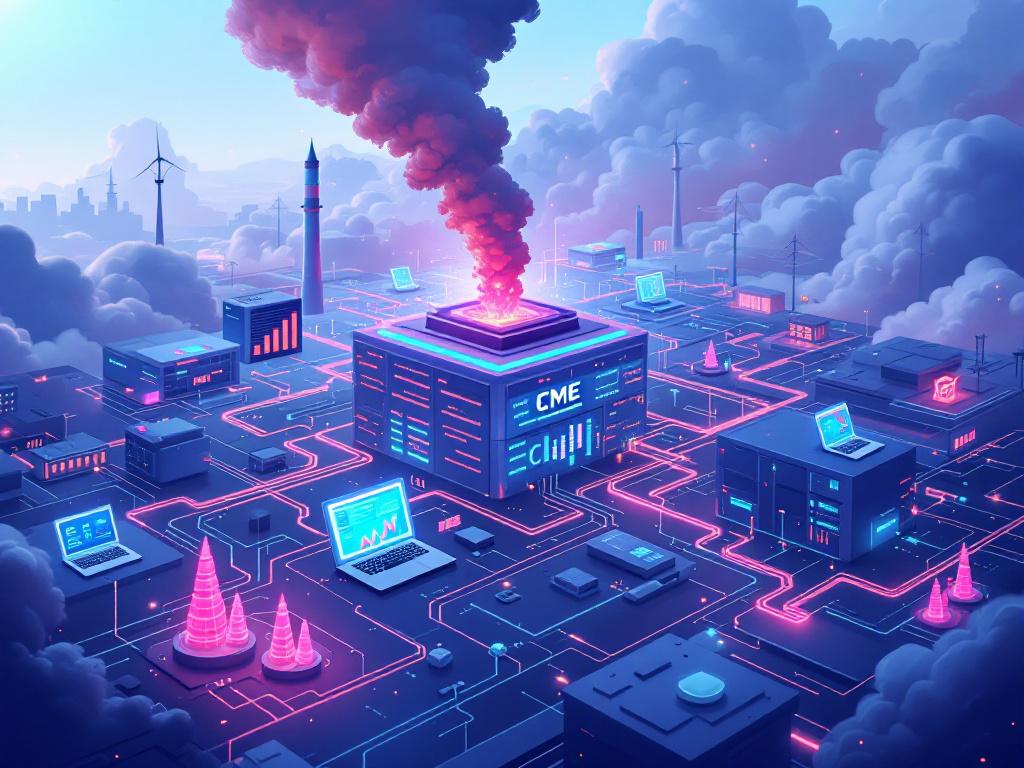
In the predawn hours of a chilly November morning, the financial world’s heartbeat skipped a beat. The CME Group, operator of the globe’s premier derivatives exchange, abruptly halted trading across its vast array of futures and options markets. The culprit wasn’t a cyberattack or a market crash, but something far more mundane: a cooling system failure at its primary data center. This incident, occurring on November 28, 2025, exposed the fragile underbelly of modern financial infrastructure, where trillions in daily transactions rely on the unassuming reliability of air conditioning and refrigeration units.
The shutdown began around 3 a.m. GMT, just as Asian markets were winding down and European traders were gearing up. CME’s platforms, which handle everything from stock index futures to commodity contracts, ground to a halt. Traders in Chicago, London, and beyond stared at frozen screens, unable to execute orders. The exchange, which processes over 20 million contracts daily with a notional value exceeding $1 quadrillion annually, suddenly went silent. Initial reports pointed to a “cooling issue” at the data center managed by CyrusOne, a key provider of colocation services.
As details emerged, it became clear this wasn’t a minor glitch. The failure cascaded through backup systems, leading to a multi-hour outage that disrupted global markets. Stock futures, bond yields, and commodity prices fluctuated wildly in the uncertainty, with ripple effects felt from Wall Street to Kuala Lumpur. According to reports from CNBC, the halt affected foreign exchange, commodities, and equity futures, marking one of the longest disruptions in CME’s recent history.
The Anatomy of a Cooling Catastrophe
At the heart of the incident was CyrusOne’s facility in Aurora, Illinois, a sprawling complex that houses the servers powering CME’s Globex electronic trading platform. Data centers like this one generate immense heat from thousands of servers running 24/7. Cooling systems, often involving chilled water loops, precision air handlers, and redundant backups, are essential to prevent overheating, which can cause hardware failures and data corruption.
Sources indicate the primary cooling system malfunctioned, possibly due to a mechanical breakdown or sensor error, overwhelming the redundancies. Temperatures in the server rooms spiked, triggering automatic shutdowns to protect equipment. This isn’t the first time cooling has tripped up high-stakes operations; similar issues have plagued data centers worldwide, but the scale here was unprecedented for finance. A post on X from a technology analyst highlighted the irony: in an era of AI-driven trading, a basic HVAC failure brought everything to a standstill.
CME’s response was swift but measured. By mid-morning, technicians isolated the problem and began restoring services. Trading resumed in phases, starting with pre-open sessions, but the damage was done. The outage lasted nearly 10 hours, freezing billions in active transactions and forcing market participants to scramble for alternatives like over-the-counter deals or rival exchanges.
Ripples Through Global Markets
The immediate fallout was palpable across continents. In Europe, the UK and EU markets saw delayed openings and heightened volatility as traders adjusted positions without CME’s benchmark prices. Malaysian commodity futures, tied to palm oil and rubber, experienced unusual spreads, as noted in coverage from Tom’s Hardware. The interconnectedness of global finance meant that a problem in suburban Chicago reverberated to trading floors in London and Frankfurt.
In the U.S., the incident coincided with the post-Thanksgiving lull, but that didn’t soften the blow. Hedge funds and proprietary trading firms, reliant on CME for hedging strategies, faced potential losses from unexecuted trades. One industry insider, speaking anonymously, described the chaos: “It’s like the referee blowing the whistle mid-game and everyone just standing there.” Regulatory bodies, including the Commodity Futures Trading Commission, launched reviews to assess compliance with continuity standards.
Beyond immediate disruptions, the event underscored broader vulnerabilities in digital finance. With derivatives markets underpinning everything from agricultural prices to interest rate swaps, a prolonged halt could trigger systemic risks. Analysts pointed to the 2010 Flash Crash as a cautionary tale, where technical glitches amplified market swings. This time, though, the issue was physical infrastructure, not algorithmic trading.
Lessons from Past Outages and Future Safeguards
Historical precedents abound. In 2021, a power outage at a major exchange disrupted trading for hours, and more recently, cloud service failures have taken down swaths of online services. But CME’s debacle stands out for its simplicity—a cooling failure in an age of quantum computing and blockchain. As detailed in a Reuters report, the exchange operator emphasized that support teams worked diligently to resolve the issue, advising clients on resumption timelines.
In the aftermath, CyrusOne announced enhancements to its cooling infrastructure, including additional redundant units and improved monitoring. A statement from the company, covered by Bloomberg, revealed plans to bolster backup capacity to prevent future overheating. This move reflects a growing recognition that as data centers scale to handle AI and high-frequency trading, thermal management becomes a critical bottleneck.
Industry experts are calling for stricter standards. “Redundancy isn’t just about having backups; it’s about testing them under stress,” said a data center consultant with experience in financial services. Posts on X echoed this sentiment, with users sharing stories of similar IT mishaps, from AWS downtimes to regional blackouts, emphasizing the need for diversified hosting.
The Human and Technological Toll
Behind the scenes, the outage highlighted the human element in tech-dependent systems. Engineers at CyrusOne and CME likely pulled all-nighters, troubleshooting in real-time while markets waited. The pressure is immense; a single misstep could exacerbate losses. One X post from a trader captured the frustration: “Billions frozen because the AC broke? Welcome to 2025 finance.”
Technologically, the incident exposes gaps in hybrid infrastructures. Many exchanges now blend on-premises data centers with cloud services for resilience, but CME’s heavy reliance on physical sites proved a weak link. According to TechRepublic, the failure froze over 90% of global derivatives trading, laying bare dependencies on single points of failure.
Looking ahead, innovations in cooling technology could mitigate such risks. Liquid immersion cooling, where servers are submerged in non-conductive fluids, is gaining traction for its efficiency. Companies like those in the HVAC sector saw stock bumps post-incident, as investors bet on increased demand for robust systems.
Economic Implications and Regulatory Responses
Economically, the shutdown’s cost is hard to quantify but significant. Lost trading volumes, opportunity costs, and potential litigation from affected parties could run into millions. A report from Investing.com noted the wide-ranging impact on financial instruments, with crypto-linked futures particularly hard-hit amid ongoing market volatility.
Regulators are stepping in. The SEC and CFTC are expected to probe whether CME’s contingency plans met requirements under Dodd-Frank reforms. This could lead to mandates for more frequent drills or geographic diversification of data centers. International bodies, like the Financial Stability Board, may revisit guidelines for systemically important financial infrastructures.
Meanwhile, competitors like Intercontinental Exchange watched closely, potentially gaining market share during the downtime. The event has sparked discussions on decentralizing exchanges, though traditional players argue that centralized systems offer better oversight.
Toward a More Resilient Financial Backbone
As the dust settles, the CME outage serves as a wake-up call for the industry. With data centers projected to consume up to 8% of global electricity by 2030, driven by AI and crypto demands, cooling challenges will only intensify. Innovations such as edge computing and AI-predictive maintenance could preempt failures, using sensors to forecast issues before they escalate.
Traders and institutions are reassessing their own setups. “We’re doubling down on multi-site redundancies,” said a risk manager at a major bank. X threads buzzed with advice on backup strategies, from cloud mirroring to on-site generators.
Ultimately, this incident reminds us that in the high-stakes world of derivatives, reliability hinges on the seamless integration of cutting-edge tech and basic engineering. While CME has resumed full operations, the memory of that frozen morning will linger, pushing the sector toward greater robustness.
Echoes in the Broader Tech Ecosystem
The ramifications extend beyond finance. Other sectors reliant on data centers—healthcare, transportation, and e-commerce—face similar vulnerabilities. A cooling failure in a hospital’s IT system could be catastrophic, much like in trading. Coverage from Yahoo Finance highlighted how the event exposed systemic risks in modern economies, where a single glitch can cascade globally.
Environmental factors add another layer. Climate change, with rising ambient temperatures, strains cooling systems further. Data centers in warmer regions already battle higher energy costs for air conditioning. This outage could accelerate shifts toward sustainable cooling, like using renewable energy for chillers.
For insiders, the key takeaway is proactive investment. As one X user poignantly noted, “In finance, heat is the silent killer—literal and figurative.” The industry must cool its jets, quite literally, to avoid future meltdowns.
Navigating the Aftermath: Industry Reflections
In boardrooms and trading pits, reflections are underway. CME’s leadership has pledged transparency, with detailed post-mortems expected soon. Lessons from this will inform protocols, perhaps mandating real-time thermal monitoring integrated with trading halts.
The event also spotlights the role of third-party providers like CyrusOne. Contracts will likely include stricter SLAs for uptime, with penalties for breaches. As reported in TradingView, the initial statement from CME pinned the blame on data center cooling, prompting scrutiny of vendor accountability.
Finally, for the derivatives market, this hiccup reinforces the need for agility. While embarrassing, it may catalyze improvements that strengthen the entire system, ensuring that the next time temperatures rise, the markets don’t freeze.


 WebProNews is an iEntry Publication