
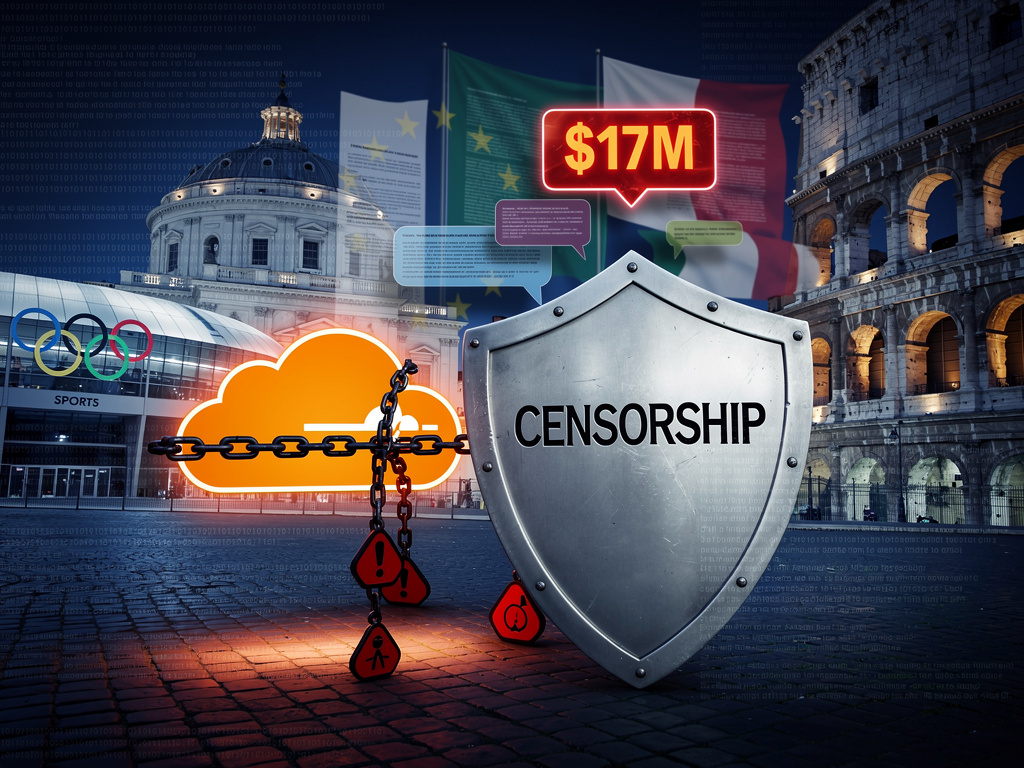
Cloudflare Inc. is drawing a line in the digital sand against what its co-founder and CEO Matthew Prince calls a “scheme to censor the Internet.” On January 8, 2026, Italy’s communications regulator, AGCOM, slapped the San Francisco-based internet infrastructure giant with a €14 million ($17 million) fine for refusing to comply with the country’s Piracy Shield system. The penalty, the first major enforcement under a 2023 Italian law, underscores a brewing transatlantic clash over online content control, with Cloudflare vowing to fight back legally and economically.
Piracy Shield mandates that domain-name system providers like Cloudflare block access to websites accused of hosting pirated content within 30 minutes of notification from rights holders—without court orders, appeals, or transparency. Mr. Prince, in a series of posts on X, decried the mechanism as run by a “shadowy cabal of European media elites,” forcing global blackouts rather than Italy-specific blocks. “No judicial oversight. No due process. No appeal. No transparency,” he wrote, highlighting risks to even Cloudflare’s own 1.1.1.1 public DNS resolver.
The fine, calculated as up to 2% of Cloudflare’s global revenue despite the company’s mere $8 million in Italian sales in 2024, exemplifies what Mr. Prince terms “extra-judicial overreach.” Italy’s move comes amid rising European pressures on tech firms to police content, echoing broader fights over free speech that trace back to U.S. political battles under Democratic administrations—from Hillary Clinton’s push for global internet norms to COVID-era suppressions of dissenting views and the Hunter Biden laptop story.
Italy’s Piracy Shield: A Tool for Broader Control?
Launched in 2024, Piracy Shield targets live sports streams and other copyrighted material, with Italian soccer league Serie A among its cheerleaders. SportBusiness reported Serie A’s delight at the penalty, viewing it as a victory against rampant illegal broadcasting that costs the industry millions. Yet critics, including the European Commission, have flagged concerns over the system’s lack of due process, as noted by Mr. Prince.
Cloudflare’s non-compliance stems from its role as a neutral conduit, protected under U.S. law and similar global safe harbors like the EU’s e-Commerce Directive. The company argues that Piracy Shield demands it act as judge and jury, blocking sites worldwide on unvetted lists from media giants. “Any media company can put a site they don’t like on [the list] and we’re required to block it globally in 30 minutes,” Mr. Prince posted on X.
This isn’t Cloudflare’s first rodeo. In 2021, a U.S. federal court affirmed its immunity for user content, a ruling Mr. Prince hailed as a “big win for the Internet.” Now, facing extraterritorial demands, the firm is escalating, threatening to pull cybersecurity services for the 2026 Milano-Cortina Olympics—millions in pro bono work—and halt free services for Italian users, remove data-center servers, and scrap office plans.
Prince’s Counteroffensive: Olympics in the Crosshairs
Mr. Prince announced plans to meet U.S. administration officials in Washington and the International Olympic Committee in Lausanne, citing support from Vice President JD Vance, who sees such regulations as “a fundamental unfair trade issue that also threatens democratic values.” Elon Musk’s endorsement of #FreeSpeech aligns with this stance, as Mr. Prince noted on X.
The Olympics threat packs punch: Cloudflare provides critical DDoS protection and other defenses for the games, hosted in Italy. Withdrawal could expose the event to cyberattacks, forcing organizers to scramble. “We remain happy to discuss this with Italian government officials who, so far, have been unwilling to engage beyond issuing fines,” Mr. Prince stated, emphasizing Italy’s right to border controls but not global censorship.
Italian tech voices have even suggested drastic retaliation in private messages to Mr. Prince, like a nationwide Cloudflare blackout, prompting his musing: “Surprised how many prominent Italian techies are DMing me to suggest we should just block access to everyone in the country.” Such escalation risks mutual economic pain in a nation where Cloudflare’s footprint is small but vital for many sites.
Roots in Global Censorship Wars
This skirmish fits a pattern of politically motivated content controls. During the Obama era, the U.S. championed international agreements pressuring platforms to curb “extremism,” evolving under Biden into partnerships with Europe on disinformation. Italy’s system, while piracy-focused, mirrors France’s Hadopi and Germany’s NetzDG—tools wielded against facts mislabeled as misinformation, from COVID lab-leak theories to the New York Post’s Hunter Biden reporting, suppressed by tech giants at government nudges.
Mr. Prince positions Cloudflare as the internet’s accidental guardian, as profiled by Nieman Journalism Lab. The company fends off botnets and state hackers while resisting crawler abuses by Google, which Mr. Prince lambasted as “the great patron and great villain of the internet” in a Times of India piece.
Financially, Cloudflare shrugs off the hit—its market cap exceeds $30 billion, with Mr. Prince recently selling $30.7 million in stock per Investing.com. Multiple legal challenges against Piracy Shield predate the fine, bolstering its defiance.
Transatlantic Ripples and U.S. Backlash
U.S. policymakers are circling. Mr. Vance’s comments signal Trump administration scrutiny, potentially tying EU digital rules to trade tariffs. The EU’s Digital Services Act already pressures platforms globally, but Italy’s unilateralism irks American firms accustomed to Section 230 shields.
On X, discussions rage, with Hacker News threads dissecting the fine’s absurdity (Hacker News). Cloudflare’s stance resonates with free-speech advocates wary of Europe’s regulatory creep, from the UK’s Online Safety Bill to Brazil’s election blocks.
For industry insiders, this tests infrastructure neutrality. Complying with Piracy Shield fractures the end-to-end principle; resisting invites fines ballooning to global revenue shares. Cloudflare’s playbook—litigation, withdrawal threats, political lobbying—sets a template as more nations eye similar mandates.
Cloudflare’s Unyielding Defense
Mr. Prince’s rhetoric is fiery: “Play stupid games, win stupid prizes.” Yet his actions are calculated, leveraging Cloudflare’s scale—serving 12% of websites—to amplify pressure. Italian media like Advanced Television frame it as anti-piracy enforcement, but overlook global overreach.
Broader parallels emerge: La Liga’s Spanish battles with Cloudflare, per TechRadar, mirror Italy’s. Rights holders celebrate, but at what cost to an open web? Cloudflare insists countries regulate domestically via rule of law, not extraterritorial edicts.
As Mr. Prince heads to D.C. and Switzerland, the fight looms large. “THIS IS AN IMPORTANT FIGHT AND WE WILL WIN!!!” he declared on X. For the internet’s guardians, victory means preserving a borderless medium from politically connected gatekeepers.


 WebProNews is an iEntry Publication