
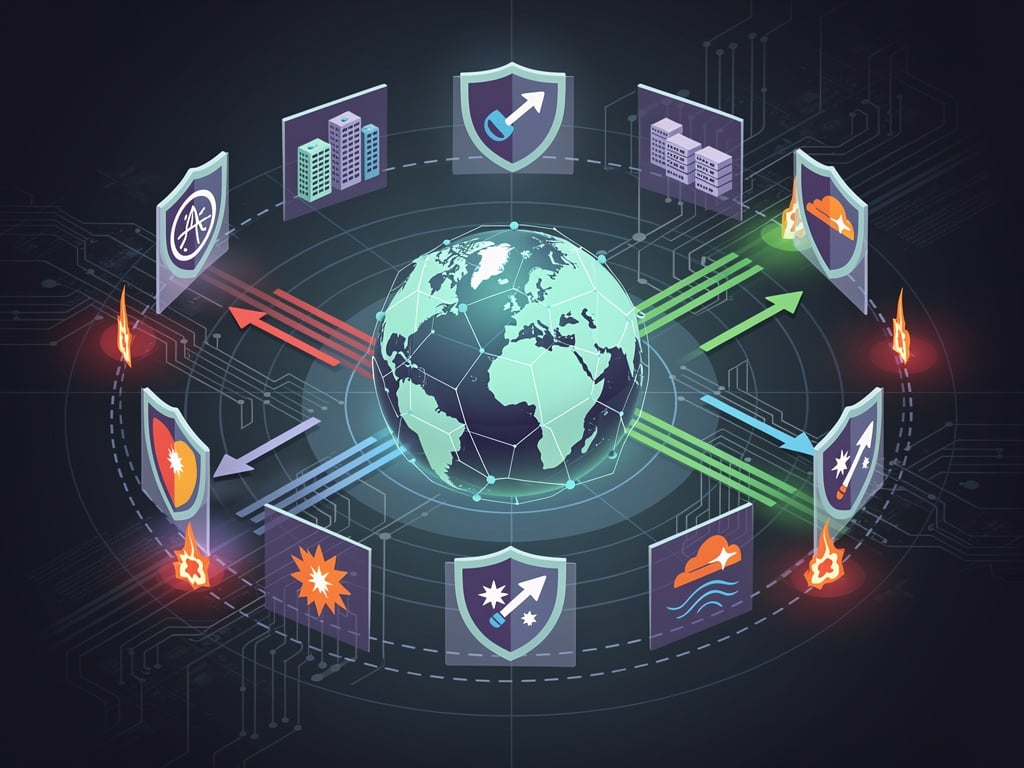
Cloudflare processes staggering volumes of internet traffic every second. At peak, its global network handles 145 million HTTP requests. That scale yields unmatched visibility into attacks as they unfold. Now the company has fused that visibility directly into its Web Application Firewall.
On June 8, 2026, Cloudflare announced a new integration. Security teams can write WAF rules that reference live threat intelligence signals. No more copying IP lists. No more delayed response. The system populates request fields with actor names, target industries, attack types and countries at the earliest stages of processing. Rules then act on them in microseconds.
From Observation to Automatic Defense
The feature builds on Threat Events, a dashboard that already surfaces which IPs attack specific industries or which actors trend worldwide. Previously, analysts saw the data but acted slowly. They built rules by hand. They balanced logging for visibility against blocking for protection. That trade-off disappears here.
Detection now runs always-on. It enriches every request with metadata whether a rule blocks or not. “We believe your intelligence platform shouldn’t just tell you that something is ‘bad’; it should tell you why it’s happening, who is behind it, and automatically prevent it from happening again,” wrote Blake Darché and Alexandra Moraru in a March 2026 post on the Cloudflare blog.
The new fields appear in the WAF rule builder. They support arrays because one IP can link to multiple threat actors or industries. Engineers use the any() function and wildcards to match. Simple expressions now stop known DDoS participants targeting France. Or actors hitting banking. Or traffic from high-risk origin countries.
One example blocks any request where any(cf.intel.ip.target_countries[*] == "FR") and any(cf.intel.ip.datasets[*] == "ddos"). Another targets specific actors against the finance sector. The syntax works in custom rules, rate limiting, Terraform and the API. Deployment feels familiar.
Visibility follows in Security Analytics. Matches log with full context. Analysts see the exact indicator that triggered and create new rules with one click from the Threat Events view. Saved filters turn into production rules without manual transcription. Speed matters here. The datasets compress and distribute to every Cloudflare data center. Lookups run in constant time. Even with millions of indicators the added latency stays negligible.
And the system evaluates all signals for an IP in one pass. Complex intersections do not multiply overhead. That architecture supports the always-on model introduced earlier for attack signature detection. Detection and mitigation stay separate. Teams gain insight even from blocked requests.
The capability requires a Cloudforce One subscription. Essentials provides default datasets and threat hunting. Higher tiers add analyst insights and broader coverage. Initial support focuses on IP-based signals. Future releases plan JA3 fingerprints and domain matching. Attackers rotate IPs. Static fingerprints and command destinations offer more durable signals.
This announcement arrives months after Cloudflare detailed broader evolution of its Threat Intelligence Platform. The March 2026 update moved storage, aggregation and visualization to the edge. GraphQL queries run directly on the network with sub-second latency. Analysts build Sankey diagrams, map attributes and generate rules that deploy via the Firewall API in seconds. The feedback loop tightens. Human insight flows back into automated defenses.
Cloudflare’s WAF already draws on machine learning and network-derived intelligence to stop zero-days and common exploits. It layers managed rules atop OWASP baselines. It scans uploads, checks leaked credentials and applies rate limits. The new intel fields add precision. They let organizations act on patterns observed across millions of other properties before attackers reach their own applications.
Recent coverage reinforces the momentum. A September 2025 Cloudflare report urged organizations to combine WAF protections with real-time intelligence drawn from large cloud networks to counter rising application-layer DDoS. An August 2025 analysis of top WAFs highlighted Cloudflare’s free tier, rapid deployment and global edge as reasons it sets the baseline for startups and mid-size companies. Even four days ago, a June 2026 comparison on Indusface’s site noted Cloudflare’s unmatched scale in sites protected despite competitors’ strengths in specific enterprise segments.
Security teams have long chased tighter loops between discovery and response. Manual processes create gaps. Attackers exploit them within hours. Cloudflare’s approach compresses that window toward zero. Rules reference the same signals analysts review in dashboards. One-click creation turns investigation into enforcement. The data lives at the edge, updated continuously from the traffic Cloudflare sees everywhere.
Challenges remain. False positives still demand tuning. Not every organization holds a Cloudforce One license. IP-based signals lose value as attackers adopt proxies and residential infrastructure. The promised expansion to JA3 and domains will matter. Yet the foundation looks solid. Constant-time lookups. Array-aware matching. Full logging on blocked traffic. Integration with existing IaC workflows.
So the barrier drops. What once required security researchers and custom scripts now fits inside standard WAF expressions. Organizations gain proactive posture drawn from global observations. They block actors before first contact. They filter by victim profile. They respond to campaign velocity instead of isolated incidents.
The change reflects a larger shift. Threat intelligence moves from report to runtime. Data no longer sits in a silo awaiting export. It enriches the request pipeline itself. For security engineers and SOC leads, that represents concrete progress. Less copying. Fewer delays. Faster decisions grounded in fresh, distributed intelligence.
Cloudflare continues to ship enhancements at pace. The June 8 announcement follows March’s platform evolution and earlier managed list expansions. Each step tightens the connection between seeing threats and stopping them. Industry watchers expect further extensions to non-IP signals and deeper automation. For now, the immediate value sits in the dashboard and rule builder. Teams can start today.


 WebProNews is an iEntry Publication