
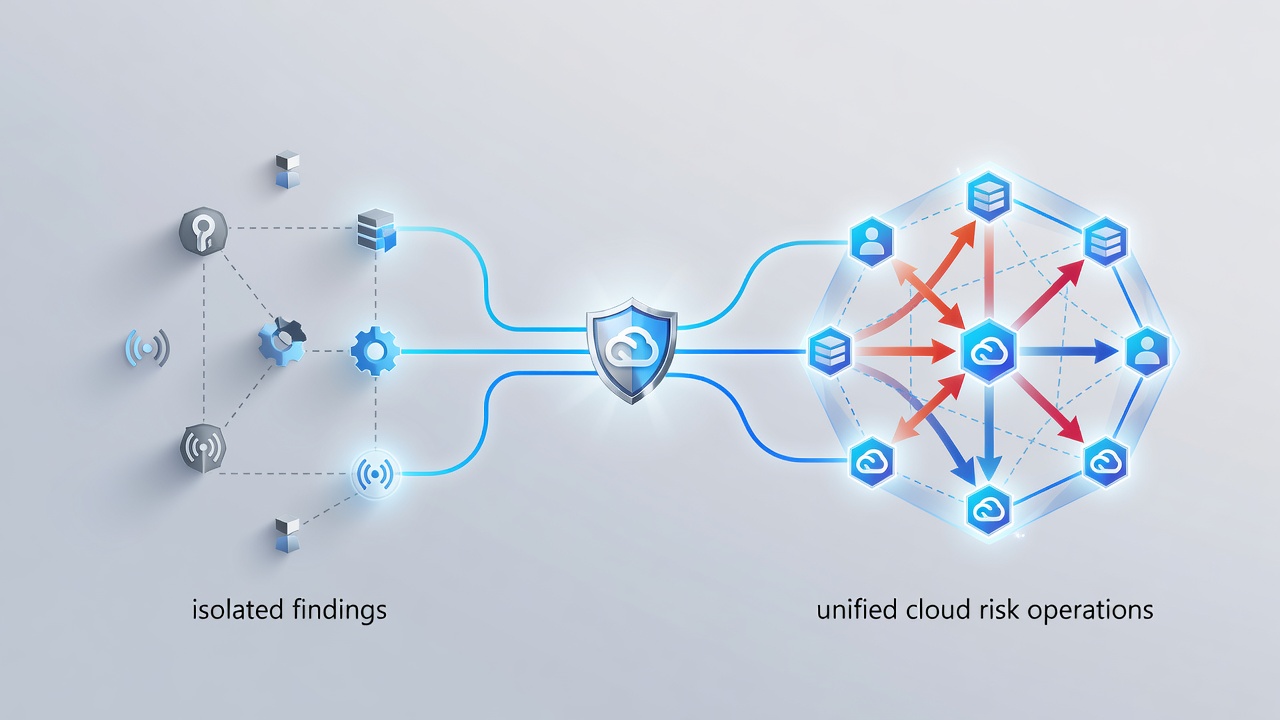
Cloud security teams face a familiar problem that has grown sharper. They collect thousands of posture findings, runtime alerts, and identity signals every day. Most of those findings sit in separate tools. Few of them reveal which combinations actually open a path to real damage.
Microsoft Security addressed that gap directly in a June 24 post. The company described how Cloud-Native Application Protection Platforms, or CNAPPs, are moving beyond visibility toward continuous, context-driven risk reduction. Microsoft Security Blog cited Frost & Sullivan’s 2026 Frost Radar for CNAPP as evidence of the shift. The analyst report positions Microsoft among leading vendors because its Defender for Cloud correlates posture findings with identity, data, runtime behavior, and SOC workflows.
The change matters. Earlier CNAPP tools scanned for misconfigurations and listed vulnerabilities. They produced long inventories that security analysts had to sort manually. Frost & Sullivan’s analysis, summarized by Microsoft, states that leading platforms now treat CNAPP as a unified cloud risk operations layer. That layer links code scanning, cloud posture, runtime protection, identity entitlements, data sensitivity, and active threat detection into one operating model.
Defender for Cloud demonstrates the approach in practice. A misconfigured storage account by itself may score low priority. The same account paired with overly broad permissions and sensitive customer data becomes an exploitable path. Microsoft’s platform surfaces the combined exposure rather than isolated issues. Security teams then focus remediation on the paths most likely to be used.
Code-to-cloud traceability forms another pillar. A vulnerability flagged in infrastructure-as-code before deployment can be tracked forward. At runtime the platform validates whether the issue actually exists in production and whether it appears in security operations data. This closed loop replaces the old handoff between development and operations teams.
Fragmented tool stacks create their own friction. Organizations juggle CSPM scanners, workload protection agents, identity tools, and separate SIEM consoles. Microsoft integrates these functions inside a single console that spans Azure, AWS, Google Cloud, and on-premises resources. Analysts investigate one incident across its full chain instead of jumping between dashboards.
Market data supports the direction. Frost & Sullivan’s 2026 report notes that the CNAPP market reached $7.37 billion in 2025 revenue with 30.8 percent year-over-year growth. The forecast calls for a 25 percent compound annual growth rate through 2030. Demand now centers on runtime-validated risk reduction and SOC integration rather than static compliance reports alone.
Competitors move in parallel. CrowdStrike introduced adversary-informed risk prioritization in March 2026 for its Falcon Cloud Security platform. The feature maps cloud exposures against known attacker tradecraft drawn from the company’s threat intelligence. CrowdStrike Blog described how the engine identifies which exposures align with observed adversary behavior and supplies root-cause timelines for faster remediation.
Independent evaluations reflect the same emphasis. The Forrester Wave for Cloud Native Application Protection Solutions, Q1 2026, named several vendors leaders, including Wiz, Qualys, and Sysdig. These reports evaluate integration depth, risk prioritization accuracy, and operational efficiency across multicloud estates. Microsoft participates in the broader CNAPP conversation through its positioning in the Frost Radar.
AI workloads add fresh variables. The Frost report notes that AI security posture management remains adjacent for now but will tighten integration with core CNAPP capabilities in coming years. Microsoft Defender for Cloud already includes protections for generative AI workloads alongside traditional cloud resources.
Security leaders evaluating platforms now ask sharper questions. Does the solution correlate identity, data, and runtime signals? Does it span code through production and into SOC response? Can it rank exposures by actual exploitability instead of generic severity scores? Does it reduce tool sprawl while scaling across multiple clouds?
The answer determines whether a platform reduces noise or simply adds more of it. Microsoft’s recent alignment with the Frost Radar framing shows one path: connect the signals that matter, surface the attack paths that count, and keep risk reduction continuous rather than episodic.
Windows Forum summarized the practical outcome two days after Microsoft’s post. CNAPP evolves from posture visibility into a model that ranks exposures by exploitability and impact. The category becomes less about protecting cloud-native applications in isolation and more about feeding accurate context into enterprise decision-making. Windows Forum
That operational focus replaces the old inventory mindset. Teams stop drowning in findings. They start closing the exposures that adversaries would actually use.


 WebProNews is an iEntry Publication