
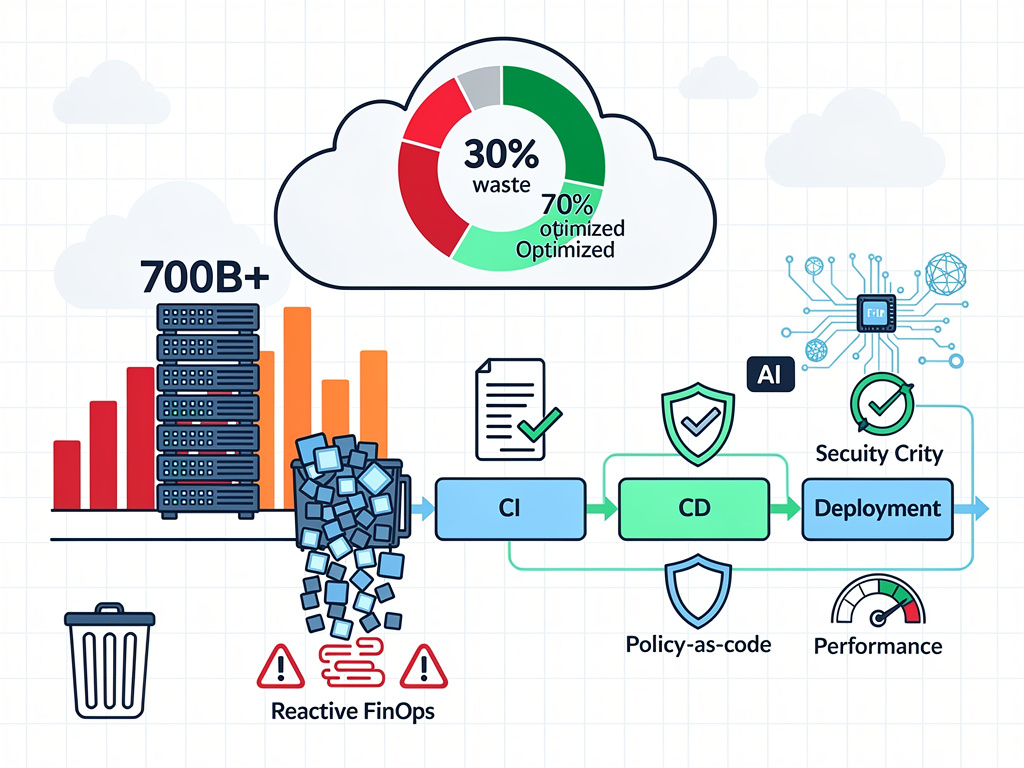
Cloud spending surges past $700 billion annually, yet organizations waste over 30% on idle resources and overprovisioning, according to the FinOps Foundation’s latest reports. Monthly bill shocks trigger finance-led scrambles, but reactive fixes fail. As Vicki Walker notes in The New Stack, “Trying to control cloud spending after you get the bill never works. The solution is shifting optimization left into design and deployment.”
This engineering-first approach embeds cost controls, security and governance into CI/CD pipelines, preventing waste at the source. Traditional FinOps, focused on post-deployment audits, leaves architectural decisions unchecked, leading to persistent overspend. Harness FinOps specialists Ben Linares and Patrick Brogan emphasize in a recent webinar that true cloud value balances efficiency, reliability, security and developer speed—optimizing one at others’ expense creates hidden debt.
Organizations ignoring this shift face escalating costs amid AI-driven workloads and multi-cloud complexity. Engineers, not accountants, hold the keys to sustainable spending through proactive design.
Reactive FinOps’ Persistent Failures
Finance teams storm engineering departments when bills spike, demanding urgent cuts to overprovisioned instances or idle Kubernetes clusters. Despite efforts to shutter unused workloads, costs climb month-over-month. Walker explains, “Most organizations try to solve cloud overspending backward: They wait until the bill comes in before looking for savings.” Manual audits and disconnected governance ignore root causes in code and pipelines.
FinOps practices mature, but the State of FinOps reveals workload optimization remains the top priority for 50% of practitioners. Cloud spending hit $723.4 billion in 2025, with 32% wasted, per DEV Community analysis. Reactive tools catch symptoms, not the engineering decisions deploying excess capacity.
Cloud engineers like Akhilesh Mishra warn on X, “Your manager: ‘Why is our AWS bill $47,000 this month?’ You: ‘Uh… the application is running?’ This conversation ends careers.” Cost awareness must start in architecture, not invoices.
Shifting Left: Engineering at the Core
Reframing optimization as an engineering duty means integrating it into design, pull requests and pipelines. “The earlier optimization and governance are introduced—design, pull requests (PRs) and pipelines—the less rework, firefighting and spend remediation are required later,” states The New Stack. IaC templates now include cost guardrails, with CI/CD providing previews of deployment impacts, as detailed in ManageEngine CloudSpend.
This “FinDevOps” prevents violations upfront. Harness automates CI/CD with machine learning to align Kubernetes clusters continuously, combating drift between intent and runtime. Zero-drift practices keep environments optimized without slowing developers.
Policy as code enforces standards automatically: humans review intent, systems handle outcomes. ManageEngine predicts, “Infrastructure as Code (IaC) templates are now designed with built-in cost guardrails, pull requests are automatically evaluated for potential cost risks.”
Kubernetes Drift and Continuous Alignment
Kubernetes environments inevitably drift, with declared resources diverging from runtime reality. Without automation, clusters bloat with unused pods and oversized nodes. The New Stack webinar highlights, “Kubernetes needs continuous alignment: Drift between declared intent and runtime reality is inevitable without automation.” Tools like Harness ensure compliance and predictability over time.
Recent trends show percentile-based rightsizing (P95, P90) and container-level visibility as priorities, per Amnic. Autoscaling and node overprovisioning drive unexpected bills, but engineering-led automation applies the 4Rs: retain, rightsize, repurchase, relocate.
Platform engineers evaluate Kubernetes-native tools like Cast AI for spot instance maximization and autonomous scaling, reducing waste by 30%, according to Platform Engineering.org.
AI-Driven Tools Reshape Optimization
2026 brings AI agents that detect anomalies, forecast spend and execute optimizations autonomously. ManageEngine reports, “Cloud cost platforms are increasingly coming with built-in ML models that automatically detect anomalies, forecast future spend, and surface opportunities to cut waste.” FinOps Hub 2.0 from Google Cloud uses Gemini for waste insights and Kubernetes recommendations.
Vantage and Finout unify multi-cloud and SaaS into “MegaBills,” integrating into CI/CD for real-time previews, as listed in Ringover. Sedai and nOps automate rightsizing and idle shutdowns, attributing savings directly.
CloudZero pioneers unit economics like cost-per-deployment, empowering engineers with business-context data beyond finance reports.
Multi-Cloud and 2026 Trends
Multi-cloud adoption amplifies challenges, demanding unified governance. CloudKeeper forecasts FinOps as foundational, uniting finance, engineering and business for value per dollar. AI workloads push serverless dominance, with autoscaling demanding predictive controls.
GreenOps integrates sustainability metrics, per Platform Engineering.org. AWS Cost Optimization Hub, Azure enhancements and GCP’s GKE allocation export to BigQuery enable precise attribution, as in FinOps Weekly.
Enterprises achieving 75% FinOps automation by 2026 outperform, per DataStackHub statistics, breaking silos for real-time accountability.
Building Cost-Aware Engineering Culture
Promotion goes to engineers mastering cost implications: multi-AZ vs. single, reserved vs. on-demand, per Mishra’s X thread. Training embeds FinOps in CI/CD, with chargebacks fostering ownership.
Arpit Bhayani notes on X, “Leadership expects AI to cut time-to-ship in half… The real drag is non-tech stuff.” Optimization demands process evolution alongside tools.
Addy Osmani adds, “The best engineers… shape ambiguous problems into actionable intent.” In cloud, this means cost-efficient architectures from inception.
Practical Steps for Implementation
Start with visibility: tag resources, export to BigQuery or equivalent. Integrate scanning into pipelines for fast feedback. Automate rightsizing, scheduling and commitments via tools like Harness or Sedai.
Conduct DR tests isolating costs, multi-tenant K8s with quotas. As Glory Yusuf shares on X, “Cost awareness was part of the process… production systems need cost management from day one.”
Progress through FinOps phases: Crawl (visibility), Walk (automation), Run (culture), per DEV Community roadmap, yielding 30% cuts while accelerating innovation.


 WebProNews is an iEntry Publication