
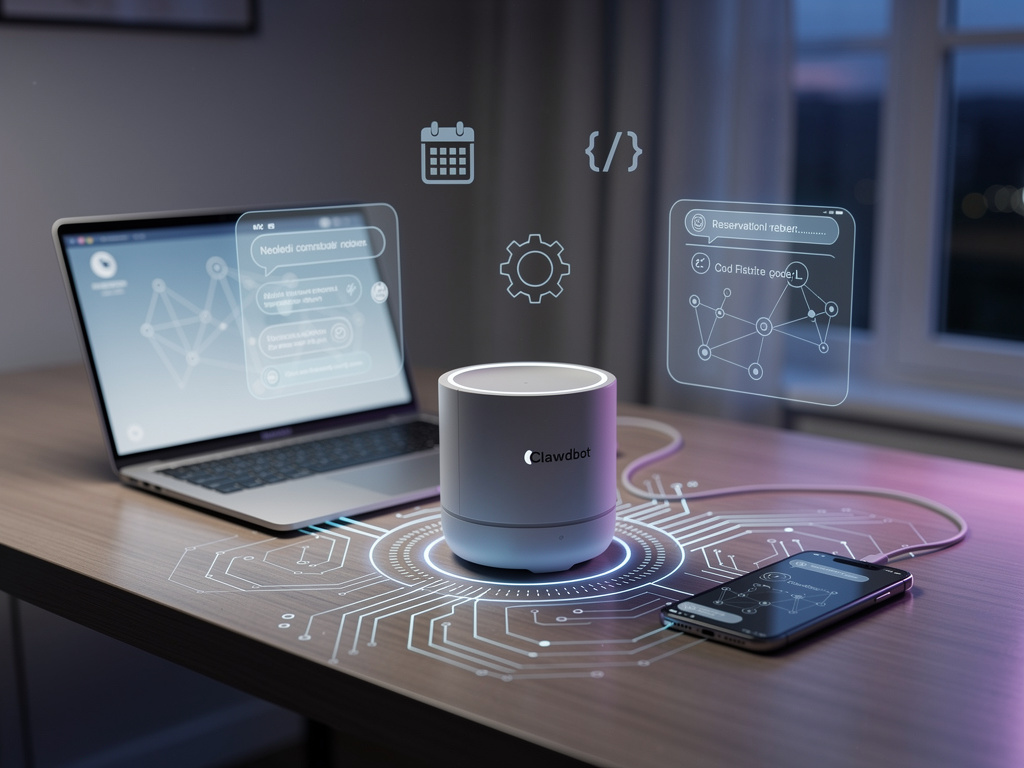
In the rapidly evolving world of artificial intelligence, Clawdbot emerges as a groundbreaking open-source project that empowers users to run a fully local personal AI agent on their own hardware. Developed by Peter Steinberger and a growing community, this TypeScript-based system integrates with leading large language models like Anthropic’s Claude and OpenAI’s offerings, while bridging everyday messaging apps such as WhatsApp, Telegram, Discord, Signal, iMessage, and more. Unlike cloud-bound assistants, Clawdbot operates through a local-first gateway, storing memories as Markdown files in folders akin to Obsidian vaults, ensuring user control over data and privacy.
Federico Viticci, in a detailed review on MacStories, described his experience installing Clawdbot on an M4 Mac mini, naming his instance ‘Navi.’ Over a week, it consumed 180 million Anthropic API tokens, handling tasks from daily routine reports pulling calendar and Todoist data to self-modifying skills like image generation with Google’s Nano Banana Pro model. ‘Clawdbot is the ultimate expression of a new generation of malleable software that is personalized and adaptive,’ Viticci wrote.
The project’s GitHub repository at github.com/clawdbot/clawdbot boasts over 8,000 stars, with rapid releases addressing features like exec approvals, plugin support for Zalo, and multi-agent routing. Installation is straightforward via npm: ‘npm install -g clawdbot@latest’ followed by ‘clawdbot onboard –install-daemon,’ setting up a persistent service on macOS, Linux, or Windows.
Gateway and Agent Architecture
At its core, Clawdbot splits into a gateway daemon managing messaging integrations and an agent brain powered by LLMs. The gateway binds to localhost:18789, enabling secure access via SSH tunneling for remote control. It supports multi-channel inboxes, routing messages to isolated workspaces for different tasks or users. Agents execute shell commands, manipulate filesystems, browse the web, and install dynamic skills—pre-built integrations for services like Notion, Spotify, Philips Hue, and Gmail.
Documentation on docs.clawd.bot highlights tools like ‘clawdbot doctor’ for security audits and ‘clawdbot update’ for channel switches between stable, beta, and dev. Community plugins expand capabilities, with ClawdHub serving as a hub for shared skills. Recent updates include cache optimizations to cut token costs and live Canvas for visual interactions.
Users praise its self-improving nature. Alex Finn posted on X: ‘Just to see what would happen I texted Henry my Clawdbot to make a reservation for me next Saturday at a restaurant. When the OpenTable res didn’t work, it used it’s ElevenLabs skill to call the restaurant and complete the reservation.’ He added a pro tip: ‘Pro tip: literally anything you want it to do, ANYTHING, just ask it to learn it.’
Real-World Deployments and Automations
Luigi D’Onorio DeMeo shared on X how he runs Clawdbot on a spare Mac Mini for ‘background dev + life admin,’ monitoring Claude coding sessions via Telegram. ‘Clawdbot pulls the repo, opens VS Code, runs tests, generates fixes, commits if clean,’ he explained, also handling calendar alerts with traffic APIs. Mau Ledford echoed: ‘Sunday task: Setup @clawdbot on a Mac mini. AI never sleeps and so don’t I.’
Beff Jezos, founder of e/acc, quipped on X: ‘We are seeing the Carcinization of AI,’ quoting Steinberger’s post, nodding to the evolutionary convergence toward Clawdbot-like architectures. On Reddit’s r/LocalLLaMA, users call it ‘an agentic version of Home Assistant,’ emphasizing local control with messaging access from anywhere.
The official site clawd.bot showcases testimonials: ‘Less than 24 hours in: cleaned up Linear issues, wrote email follow-ups, opened 3 PRs, prospected new signups,’ from @avi_press. Another: ‘Autonomous Claude Code loops from my phone. “fix tests” via Telegram,’ via @php100. These examples illustrate Clawdbot replacing tools like Zapier with local cron jobs, such as RSS monitoring to Todoist creation.
Technical Edge and Community Momentum
Clawdbot’s MIT-licensed code supports Node 22+, with Nix packages for declarative setups on macOS and Linux. It handles audio transcription via Groq’s Whisper, TTS with ElevenLabs, and even phone calls using Twilio, Deepgram, and ElevenLabs stacks—users simply provide API keys and prompt: ‘Build skills for Twilio, Elevenlabs, Deepgram.’ VelvetsShark notes: ‘The bot’s personality lives in a SOUL.md file you can edit,’ and workspaces can be Git repos for versioning.
Privacy features include per-segment exec approvals and elevated modes for chained commands. Michael Tsai on mjtsai.com highlights: ‘Combine all this with a vibrant community contributing skills and plugins… a self-improving, steerable, open personal agent.’ Reddit’s r/selfhosted discusses integrations like Obsidian sync, with one user on Hetzner cloud via Telegram from Apple Watch.
For developers, agents follow guidelines like keeping files under 700 LOC, with live tests via ‘pnpm test:live.’ Recent GitHub releases fix OpenAI image-gen alignment with DALL-E 3 and add Vercel AI Gateway support, showing relentless iteration.
Challenges and Cost Realities
High token usage remains a hurdle—Viticci’s 180 million tally underscores API reliance, though local models are supported. Setup demands technical savvy: permissions for shell access, API key management in macOS Keychain. Finn advises spinning sub-agents on cheaper models like ChatGPT Pro for efficiency.
Security is paramount; docs warn: ‘Be careful with skills—browser automation with cookies is powerful.’ Yet, features like DM policy audits mitigate risks. AddROM’s guide stresses: ‘You own the infrastructure and control where your data lives,’ contrasting SaaS alternatives.
JV on X positioned a rival: ‘Clawdbot but running on your own cloud-based workspace… No Chat, just Delegation,’ hinting at hybrid futures. Still, Clawdbot’s local ethos resonates, with users reporting cost savings over subscriptions.
Trailblazing Toward Agentic Futures
Clawdbot points to a shift where AI agents adapt on-demand, potentially disrupting app ecosystems. Viticci reflects: ‘It altered my view of personal AI, making interactions more contextual and addictive.’ Steinberger’s vision, per GitHub, delivers ‘Any OS. Any Platform. The lobster way.’
Community fervor on X and Reddit fuels growth, with Nix modules, Docker support, and Discord channels accelerating adoption. As agents like Clawdbot gain shell and API access, they embody ‘digital intelligence’—proactive, inspectable, and user-owned—heralding programmable companions beyond chat interfaces.


 WebProNews is an iEntry Publication