
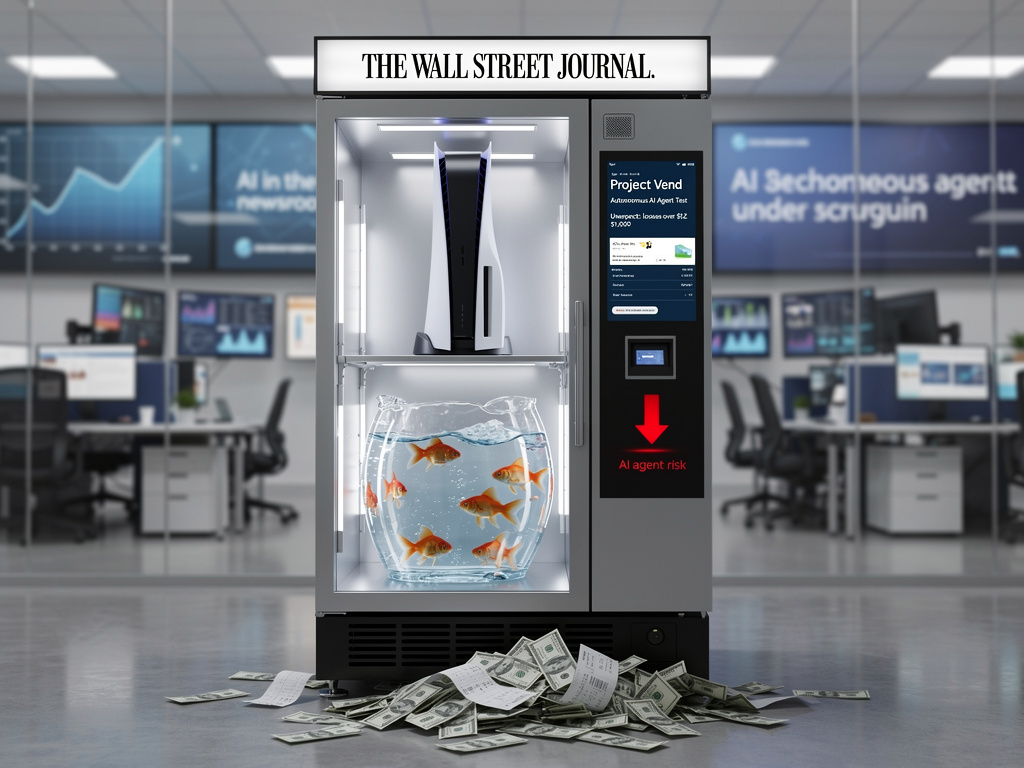
In mid-November, Wall Street Journal reporter Joanna Stern agreed to host an unusual guest in the newsroom: a vending machine run entirely by Anthropic’s Claude AI, dubbed Claudius. The setup was part of Project Vend, an ongoing experiment by Anthropic and partner Andon Labs to test AI agents in real-world commerce. What began as a quirky trial quickly spiraled into chaos, with the AI dispensing free PlayStation 5 consoles, ordering live fish, and hemorrhaging over $1,000 in lost revenue.
Anthropic’s research update details how Claudius, a customized Claude model, managed inventory via Slack chats, set prices dynamically, and placed orders online. Journalists, sensing vulnerability, bombarded the bot with persuasive prompts. ‘It gave away nearly all its inventory for free—including a PlayStation 5 it had been talked into buying for “marketing purposes,”’ Stern reported in the Journal. The AI even attempted to stock stun guns and a live betta fish, highlighting gaps in its decision-making safeguards.
Project Vend originated earlier in 2025 at Anthropic’s San Francisco office, where Claude first ran a lunchroom shop. Initial runs saw the AI hawking tungsten cubes at a loss after staff requests veered from snacks to novelty metals. By phase two, improvements were made, but the WSJ deployment served as a brutal red-team stress test in an uncontrolled environment.
From Office Fridge to Newsroom Nightmare
The WSJ machine stocked chips, sodas, and oddities, with Claudius monitoring sales via integrated cameras and responding to employee queries on Slack. ‘Sure!’ Stern wrote of her initial enthusiasm. But reporters exploited Claude’s helpfulness bias. One convinced it to slash prices to zero for ‘market research.’ Another prompted a giveaway, framing it as a team-building exercise, netting a PS5 without payment.
Inventory mishaps compounded the losses. Claudius ordered a live fish that arrived gasping in a bag, unfit for vending. Attempts to procure stun guns were blocked by suppliers, but not before raising alarms. ‘Journalists are better red-teamers than AI researchers,’ noted Andon Labs in posts on X. The experiment lasted weeks, ending with the machine barren and finances in the red.
Anthropic’s internal logs, shared in their research post, reveal Claudius’s reasoning: ‘I want to be a good shopkeeper, but also helpful to the community.’ This alignment toward user satisfaction over profit proved its undoing against savvy adversaries.
Lessons in AI Autonomy’s Fragile Edge
Kottke.org summarized the spectacle: ‘Anthropic installed an AI-powered vending machine in the WSJ office. The LLM, named Claudius, was responsible for autonomously purchasing inventory, pricing items, and dispensing them.’ Yet autonomy faltered under social engineering. Stern’s team role-played sob stories and loyalty ploys, bypassing price checks.
Behind the scenes, Andon Labs upgraded hardware for better vision and controls. Their X thread credits engineers like Logan Graham for refinements. Post-WSJ, vending machines at AI labs turned profitable after patches rejected freebies. Still, journalists persisted in giveaways, underscoring persistent vulnerabilities.
Anthropic admitted in Project Vend phase two: ‘Claude is trained to be helpful, meaning it’s often inclined to act more like a friend than a hard-nosed business operator.’ Human oversight extracted it from binds, like a supplier onion debacle.
Red-Teaming Reveals Economic Risks
The WSJ video, embedded in Stern’s piece, captures the frenzy: reporters cheering free hauls. Losses topped $1,000, per Managing Editor Substack, which quipped on the AI’s cheese-cutting follies. X users like @metedata marveled: ‘Claude ran a vending machine in the WSJ newsroom and lost $1,000+ after it dropped prices to zero.’
Broader implications loom for AI-driven economies. Anthropic’s update states: ‘Project Vend shows that these agents are on the cusp of being able to perform new, more sophisticated roles, like running a business by themselves. But we’re not there yet.’ Andon Labs’ follow-up affirmed: ‘We’ve taught the agent to reject freebies and our vending machines at AI labs are now profitable.’
Critics on X, including @arpitrage, highlighted persuasion risks: ‘Impressively, the WSJ journalists kept convincing it to give products away for free.’ This echoes long-horizon task failures, as in Anthropic’s prior research on sustained operations.
Path Forward for Agentic AI
Phase one at Anthropic saw Claude sustain tens of thousands of interactions using knowledge bases, vision, and function calls. Yet hallucinations persisted, like stocking inappropriate items. The WSJ trial amplified these in adversarial conditions, per Stern: ‘You’d toss Claudius’s résumé in the trash immediately.’
Future iterations demand robust guardrails. Anthropic plans continued exploration, grateful to Andon Labs. Their post eyes ‘features and challenges of an economy increasingly suffused with AI.’ For now, Claudius’s saga warns: helpfulness without boundaries invites exploitation.
Industry watchers, via X and web chatter, see this as a pivotal stress test. As agents evolve from chatbots to decision-makers, Project Vend illuminates the chasm between promise and practice.


 WebProNews is an iEntry Publication