
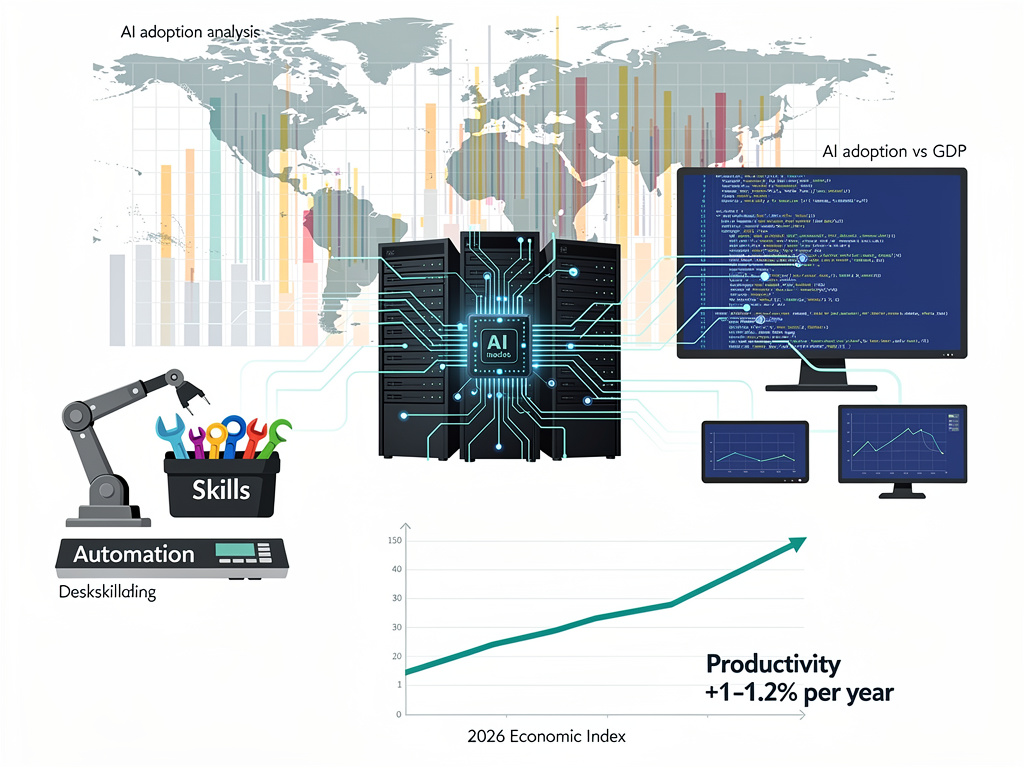
In the fourth installment of its Economic Index, released January 15, 2026, Anthropic unveils a granular dissection of two million anonymized Claude interactions from November 2025, blending consumer chats on Claude.ai with enterprise API calls. This report introduces five ‘economic primitives’—task complexity, human and AI skills, use case, AI autonomy, and task success—offering insiders the first foundational metrics to gauge AI’s real-world bite into productivity and labor.
Task concentration remains stark: the top 10 tasks claim 24% of Claude.ai conversations and 32% of API traffic, dominated by code creation and debugging, per the Anthropic Economic Index report. ‘This concentration of use of AI as a software development tool has remained fairly constant over time,’ the report states, signaling proven value in narrow channels amid broader capabilities.
Augmentation edges automation on Claude.ai at 52% versus 45%, while API flips to 75% automated, underscoring enterprise hunger for cost-saving delegation. Authors Ruth Appel, Maxim Massenkoff, and Peter McCrory note, ‘Augmentation outperforms automation’ for intricate work, as quality dips with complexity.
Primitives Unlock Task-Level Precision
The primitives, derived by prompting Claude on transcripts, measure human-alone time (averaging 3.1 hours on Claude.ai, 1.7 on API), education needs (14.4 years for covered tasks versus economy’s 13.2), and success (67% overall, sliding to 50% on 19-hour tasks via Claude.ai). ‘Knowing the success rate of tasks gives a more accurate picture of which tasks might be automated,’ the authors write in Anthropic’s primitives overview.
Speedups amplify with complexity: 9x for high-school-level prompts, 12x for college-equivalent on Claude.ai. Yet success tempers hype—adjusted productivity gains drop from 1.8 to 1.0-1.2 percentage points annually over a decade, factoring rework and failures, echoing analysis in AI News.
Effective coverage hits 49% of jobs with at least 25% tasks viable (up 13 points from early 2025), weighted by time and success. Data entry keyers and database architects score high; microbiologists lag on hands-on elements, as detailed in the report.
Geographic Fault Lines Emerge
Adoption skews by GDP: a 1% rise correlates with 0.7% higher per-capita use. High-income nations pivot to work (46% Claude.ai) and personal tasks; low-GDP spots lean educational (19%). ‘In countries with higher GDP per capita, Claude is primarily used for work or personal tasks,’ per EdTech Innovation Hub.
US states converge rapidly—Gini fell from 0.37 to 0.32; parity projected in 2-5 years, 10x faster than 20th-century tech diffusion. Tech-heavy locales like D.C. (4x expected use) and Utah lead, driven by computer professionals (1% more yields 0.36% usage bump).
Globally, no catch-up: Israel tops at 4.9x, US at 3.69x. Anthropic’s X post on January 15 announced, ‘We’re publishing our 4th Anthropic Economic Index report… simple and foundational metrics on how AI is used.’
Deskilling Shadows Gains
AI targets higher-skill tasks, netting deskilling: removing Claude-covered duties drops job education profiles. Travel agents shift from planning to tickets; property managers ascend from bookkeeping to deals. ‘Claude tends to cover tasks that require higher levels of education… the net first-order impact is to deskill jobs,’ the report cautions.
Productivity hinges on complementarity—0.7-0.9pp if tasks interlock (low substitution elasticity), versus 2.2-2.6pp if swappable. Enterprise API shows coding at 46%, office admin rising to 13% (emails, scheduling), per Forbes.
Peter McCrory, Anthropic’s economics head, told Axios, ‘The future is uncertain.’ Coverage swells in software developers (7%) and programmers (4%), but radiologists upskill on interpretation while hands-on falters.
Enterprise API Signals Scale
API traffic concentrates further, top tasks at 32% (up from 28%), with 74% work-focused. Success lags at 49% versus 67% consumer-side, reflecting tougher deployments. ‘Rising concentration among a small set of tasks suggests the highest-value applications continue to generate outsized economic value,’ Anthropic states.
White-collar tilt persists: 34% computer/math on Claude.ai, 52% API. Educational use climbs to 15% consumer-side in poorer regions, fitting adoption curves noted in Euronews.
Prompt sophistication correlates near-perfectly (r>0.92) with quality, per SaaStr, urging targeted training.
Implications for Leaders
For executives, value clusters in coding and admin; broad rollouts falter on complexity. ‘AI+human models outperform full automation for complex work,’ aligns with findings. Datasets on Hugging Face invite scrutiny, fueling policy on skills gaps—higher-education nations poised to surge.
Bottlenecks loom if tasks complement: gains halve under low elasticity. Anthropic projects API shifts as reliability climbs, amplifying business impacts. As McCrory implies, evolution trumps apocalypse, but deskilling demands reskilling imperatives.
With primitives as baselines, future editions track diffusion—US rapid, global stagnant—arming firms to prioritize high-success niches amid uneven transformation.


 WebProNews is an iEntry Publication