
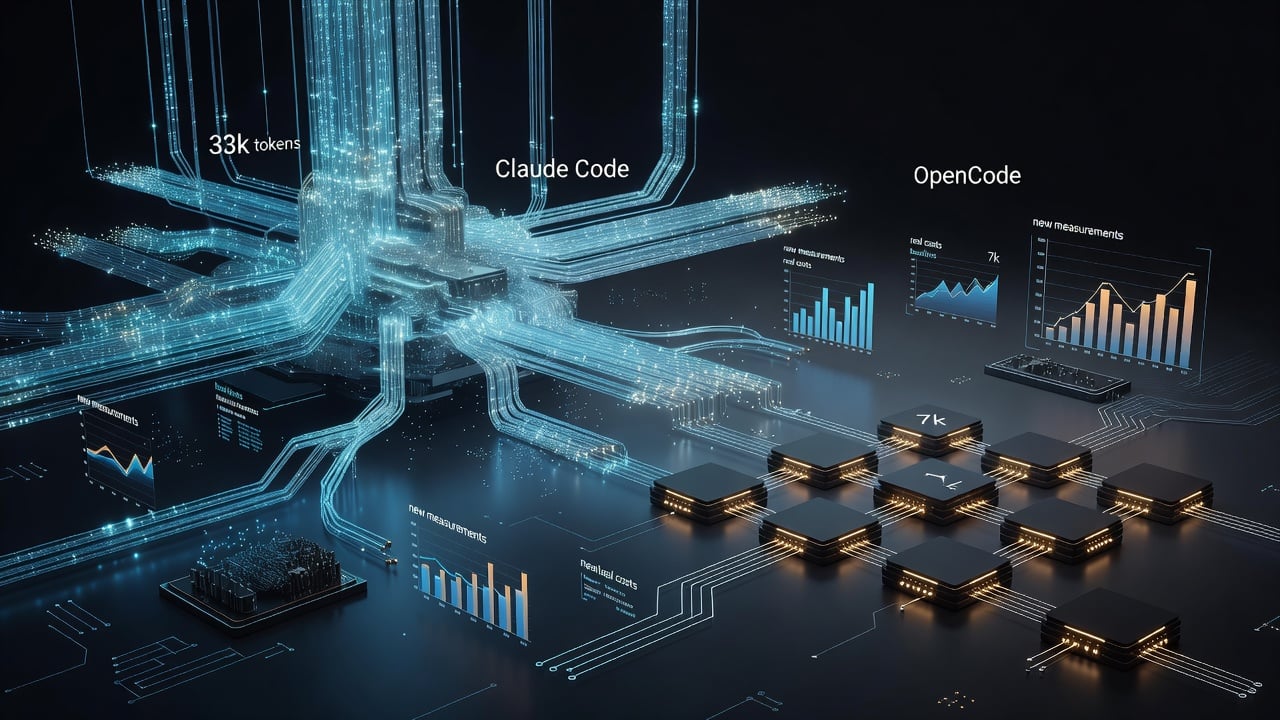
Developers chasing faster code face a hidden bill. One tool sends 33,000 tokens before it reads the first word of a prompt. Its open-source rival clocks in at 7,000. That gap, measured at the API boundary, changes the math on everything from simple queries to marathon agent sessions.
The comparison pits Anthropic’s polished Claude Code against OpenCode, an MIT-licensed alternative that lets teams swap models or run locally. A fresh analysis from Systima lays out the numbers in stark relief. Researchers routed both tools through a logging proxy, captured exact JSON payloads, and read the usage blocks returned by the model endpoint. Same machine. Same tasks. Same underlying model, pinned to Claude Sonnet 4.5 in July 2026.
Results surprised even the testers. For a one-line reply of “OK,” Claude Code shipped roughly 32,800 tokens in its opening payload. OpenCode needed about 6,900. Tool schemas drove most of the difference. Claude Code defined 27 tools, including orchestration primitives for background agents, worktree management, and notifications. OpenCode stuck to 10 core coding tools. Strip the tools entirely and the gap narrowed but persisted. Claude Code’s system prompt alone weighed 6,500 tokens. OpenCode’s came in at 2,000.
Real work multiplies these floors. Attach a 72-kilobyte AGENTS.md instruction file from a production repo and both tools add more than 20,000 tokens per request. Five modest Model Context Protocol servers tack on another 5,000 to 7,000. Suddenly a fresh workspace sits at 75,000 to 85,000 tokens deep before any user input. Builder.io saw similar bloat. Seven active servers consumed 25 percent of a 200,000-token window before the prompt arrived.
Yet totals don’t always favor the lighter tool. On a multi-step write-run-test-fix loop, Claude Code completed the job in three model requests by batching parallel tool calls. OpenCode issued nine separate turns, one tool per cycle. Cumulative input tokens converged near 121,000 for Claude Code and 132,000 for OpenCode. The bigger baseline, paid fewer times, sometimes wins. But fan the task to two subagents and costs explode. Claude Code hit 513,000 tokens. Each subagent carried its own bootstrap prompt plus most of the tool set. The parent then ingested every transcript. OpenCode’s subagent design proved leaner on paper, with smaller prompts and fewer tools, though gateway limitations kept its full totals out of the test.
Prompt caching helps but doesn’t erase the problem. Both tools set cache breakpoints. The first write carries a premium. Subsequent reads drop to one-tenth the input price. Still, three expenses survive. The initial cache write recurs after any pause longer than the time-to-live window. Context-window occupancy counts against the model regardless of cache status. And every new configuration layer, instruction file, or server schema, gets re-evaluated on each turn.
These mechanics matter more now than six months ago. Anthropic’s Claude 4 family, announced in May 2025, pushed state-of-the-art scores on SWE-bench. Opus 4 reached 72.5 percent. Sonnet 4 hit 72.7 percent. Both models support million-token contexts and long-running agentic work. Yet higher capability arrives alongside tighter economics. Subscription plans that once masked per-token reality now face scrutiny as usage scales. A LinkedIn test by Matthieu Napoli, using Opus 4.5 on identical plans, found Claude Code finished in 14 minutes and 191,000 tokens. OpenCode took 27 minutes and 278,000 tokens. Quality stayed close. Claude edged ahead slightly. Speed and cost favored the native tool.
Enterprise teams feel the pressure differently. A Substack post titled “Escaping the Token Tax” from Data Engineering Central, published this week, charts the shift from flat-rate subsidies to usage-based billing. Both GitHub Copilot and Anthropic have moved in that direction. Developers report surprise bills when autonomous agents chew through long sessions. One analysis showed baseline loads of 20,000 to 30,000 tokens before typing even begins. Another recent piece from Zylon notes token efficiency now drives workflow choices. Teams track governance, integrations, and exact token flows to stay under budget.
OpenCode counters with flexibility. It supports more than 75 providers, including local models through Ollama. Teams bring their own keys and avoid vendor lock-in. Its client-server architecture runs persistent workspaces in Docker and allows declarative MCP configuration via glob patterns to load only needed tools. Claude Code stays tied to Anthropic models. It offers tighter integration, a polished interface, and autonomous features such as goal-driven loops and an agent fleet dashboard. A January 2026 comparison by Alice Moore at Builder.io showed Claude Code completing four tasks in 9 minutes 9 seconds against OpenCode’s 16 minutes 20 seconds. OpenCode generated 94 tests to Claude’s 73 and caught an extra bug during a refactor. Speed went to the proprietary option. Thoroughness leaned the other way.
Recent X discussions echo the tension. One post from today noted Claude Code burns 33,000 tokens before reading the prompt while OpenCode stays at 7,000. Another highlighted Grok 4.5 from xAI as a cheaper alternative with strong coding benchmarks and better token efficiency than some Claude variants. A third called out speed and verification gaps that GPT models appear to close more effectively in practice.
Configuration choices amplify every difference. MorphLLM’s July 2026 overview lists Claude Code’s core system prompt at 2,896 tokens with more than 20 built-in tool descriptions and specialized subagent prompts that add hundreds of tokens each. OpenCode relies on modular markdown files with YAML frontmatter for per-agent settings, keeping only configured tools in context. Lazy loading in newer Claude Code versions can drop MCP overhead from 134,000 tokens to around 5,000. Yet the default behavior still favors richer, heavier payloads.
Cost implications hit different users at different scales. A $200 monthly Max plan buys headroom that covers unpredictable spikes. Pay-per-token via OpenCode or direct API can undercut that for disciplined teams who track usage and avoid idle time. But one long session with multiple subagents can erase those savings fast. Systima found the meter starts higher for Claude Code but the session flow decides the final tally. Batch aggressively and the heavier tool can finish cheaper. Serialize every action and the lighter baseline pulls ahead.
Regulatory angles add another layer. The EU AI Act requires logging and understanding of system behavior in production. Knowing exactly what an agent sends matters. Both harnesses inject reminders, skill catalogs, and context that grow with conversation length. Claude Code added extra system-reminder blocks as turns progressed. OpenCode’s marginal per-turn additions stayed smaller, mostly conversation history.
Developers have responded with workarounds. Custom instruction files that prune redundant context. Frameworks that compress templates. Techniques shared on Reddit and Hacker News that cut output tokens by more than 60 percent through careful prompting. One GitHub repository offers a “universal Claude.md” designed to minimize waste. Yet these fixes treat symptoms. The harness itself sets the floor.
So the choice narrows to priorities. Need maximum autonomy, native Anthropic performance, and the fastest path to working code? Claude Code delivers. Want model freedom, lower baselines, and the ability to run sensitive workloads locally? OpenCode wins. Hybrid approaches have emerged. Some teams use Claude Code for interactive sessions and route heavy batch jobs through OpenCode with cheaper providers or open-weight models.
Numbers alone don’t tell the full story. Quality, speed, and developer experience still dominate many evaluations. But as agentic coding moves from experiment to daily production, token accounting stops being an afterthought. It becomes table stakes. Teams that measure at the boundary, understand their multipliers, and align harness choice to workflow will spend less and ship more. Everyone else risks watching their context window and budget disappear before the first line of generated code appears.
That reality has already changed buying patterns. CTOs now ask not just which model performs best on benchmarks but which entire stack keeps the meter under control across hundreds of sessions. The Systima measurements, the MorphLLM breakdown, the Builder.io head-to-head tests, and fresh commentary from this week all point the same direction. Overhead matters. Measure it. Then decide.


 WebProNews is an iEntry Publication