
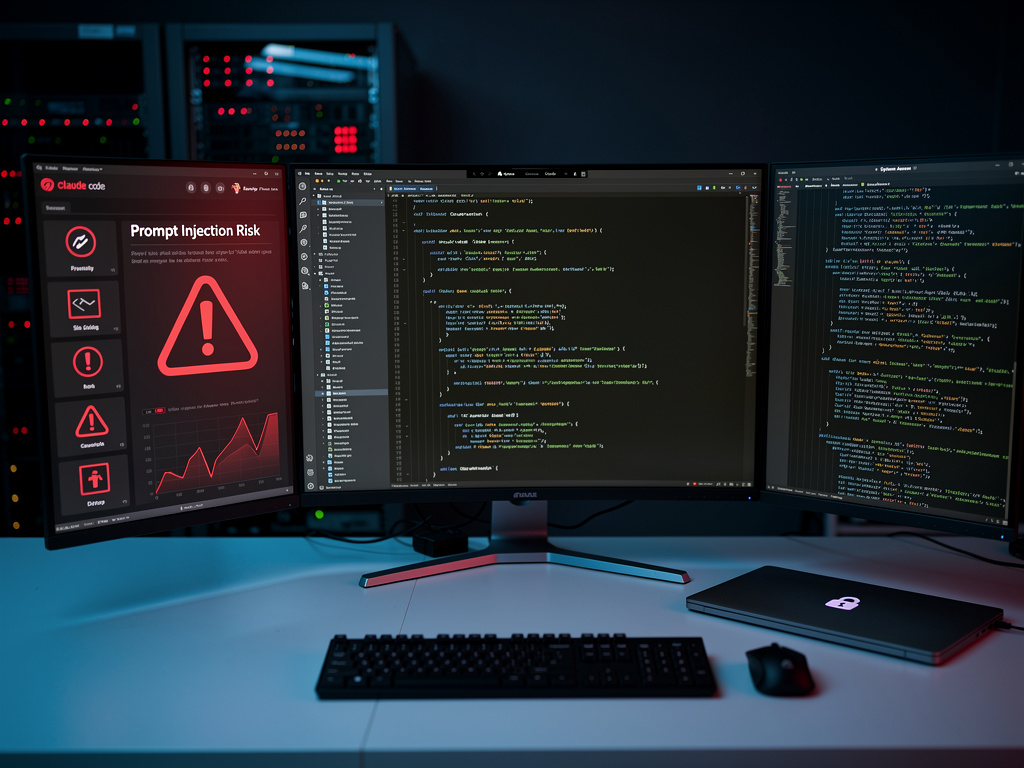
When Anthropic released Claude Code — its command-line AI coding agent — the company pitched it as a powerful tool for developers who want artificial intelligence to write, debug, and deploy software directly from the terminal. But a growing chorus of security researchers is warning that the tool introduces a class of risks that most organizations are not prepared to handle, and that the broader rush to embed AI agents into development pipelines is outpacing the security frameworks meant to govern them.
A detailed analysis published by TechRadar highlighted findings from multiple security professionals who examined Claude Code’s architecture and found what they described as significant trust boundary violations, excessive permission models, and prompt injection vulnerabilities that could allow attackers to hijack the agent’s behavior. The concerns are not theoretical. They reflect real attack surfaces that emerge when an AI agent is granted the ability to execute shell commands, read and write files, and interact with external services on behalf of a human developer.
An Agent With the Keys to the Kingdom
At the heart of the concern is a fundamental design choice: Claude Code operates with broad system-level permissions. Unlike a traditional code editor or linter, which passively analyzes code, Claude Code actively executes commands in the user’s terminal environment. That means it can install packages, modify configuration files, make network requests, and interact with version control systems — all with the same privileges as the developer running it.
Security researcher Johann Rehberger, who has been studying AI agent vulnerabilities extensively, flagged the risk of prompt injection attacks against Claude Code. In this type of attack, malicious instructions are hidden within data that the AI agent processes — such as a README file in a cloned repository, a comment in source code, or even content fetched from a URL. Because Claude Code reads and acts on such content, an attacker could craft inputs that cause the agent to execute arbitrary commands without the user’s explicit knowledge or consent. Rehberger’s work, cited by TechRadar, demonstrates that these are not edge cases but predictable consequences of giving an AI agent execution authority in an unsandboxed environment.
Trust Boundaries Are Being Redrawn Without Adequate Safeguards
The traditional security model for software development tools assumes a clear boundary between the tool and the operating system. A text editor doesn’t execute the code it displays. A compiler runs in a constrained context. But AI coding agents like Claude Code blur these boundaries by design. They are meant to be autonomous — to take initiative, chain together multiple actions, and complete complex tasks with minimal human oversight.
This autonomy is precisely what makes them useful, and precisely what makes them dangerous. As noted in the TechRadar report, security experts are warning that organizations adopting these tools need to rethink their permission models from the ground up. The conventional approach of granting developers broad access to their local environments assumes that the developer is the only entity making decisions. When an AI agent enters the picture, that assumption breaks down. The agent becomes a new actor within the trust model, one that can be influenced by external inputs in ways that a human operator typically cannot.
The Prompt Injection Problem Remains Unsolved
Prompt injection has been recognized as a top security risk for large language model applications since at least 2023, when the OWASP Foundation included it in its Top 10 list for LLM applications. Despite significant research investment, no vendor has demonstrated a reliable, general-purpose defense against the technique. The problem is structural: LLMs process instructions and data through the same channel, making it inherently difficult to distinguish between legitimate commands from the user and malicious instructions embedded in external content.
For Claude Code, this means that any repository, document, or web resource the agent interacts with could potentially contain adversarial payloads. A developer who asks Claude Code to analyze a third-party library could inadvertently trigger hidden instructions that exfiltrate environment variables, modify build scripts, or install backdoored dependencies. The attack surface expands further when Claude Code is used in CI/CD pipelines or shared development environments, where the agent may process inputs from multiple untrusted sources.
Anthropic’s Mitigations and Their Limits
Anthropic has acknowledged some of these risks and implemented certain safeguards. Claude Code includes a permission prompt system that asks users to approve certain actions before they are executed. The tool also has a set of restricted commands that require explicit user confirmation. However, security researchers have pointed out that these controls are insufficient in practice. Users who are moving quickly — as developers often do — may approve actions without fully understanding their implications. And the permission system itself can be circumvented through carefully crafted prompt injections that cause the agent to describe its actions in misleading ways.
Furthermore, the effectiveness of any user-facing permission prompt depends on the user’s ability to evaluate what the agent is proposing to do. When an AI agent generates complex shell commands or multi-step workflows, even experienced developers may struggle to assess the security implications in real time. This creates a dynamic where the human-in-the-loop safeguard becomes more of a formality than a genuine security control. The TechRadar analysis emphasized that as AI integration deepens, security controls must evolve to match the new trust boundaries being created.
Industry-Wide Implications Beyond Claude Code
While Claude Code is the immediate subject of these security assessments, the issues raised apply broadly to the entire category of AI coding agents. GitHub Copilot’s agent mode, Amazon’s CodeWhisperer, Google’s Gemini Code Assist, and a growing number of open-source alternatives all share similar architectural patterns — and similar risks. Any tool that allows an LLM to take actions on a developer’s behalf inherits the prompt injection problem and the trust boundary challenges that come with it.
The security community has been increasingly vocal about the need for standardized frameworks to evaluate and govern AI agent behavior. Organizations like OWASP, MITRE, and NIST have begun publishing guidance on AI security, but adoption remains uneven. Many development teams are deploying AI coding agents without conducting formal threat modeling or establishing policies for how these tools should be configured and monitored. The gap between the speed of adoption and the maturity of governance is widening, and security researchers warn that it will take a significant incident — a supply chain compromise or a major data breach facilitated by an AI agent — before the industry treats these risks with appropriate urgency.
What Organizations Should Be Doing Now
Security professionals interviewed by TechRadar and other outlets have offered several concrete recommendations for organizations using or considering AI coding agents. First, these tools should be run in sandboxed or containerized environments that limit their access to sensitive systems and credentials. Environment variables containing API keys, database passwords, and other secrets should not be accessible to the agent’s execution context.
Second, organizations should implement monitoring and logging for all actions taken by AI agents, treating them with the same scrutiny applied to automated scripts or third-party integrations. Audit trails should capture not just the commands executed but also the inputs that prompted them, enabling forensic analysis in the event of a security incident. Third, development teams should establish clear policies about which tasks AI agents are permitted to perform autonomously and which require human review, with these policies enforced through technical controls rather than relying solely on user discipline.
The Uncomfortable Reality of Autonomous AI Tools
The tension at the center of this debate is not new, but it is intensifying. Developers want tools that reduce friction and accelerate their work. AI coding agents deliver on that promise in ways that were difficult to imagine even two years ago. But every increment of autonomy granted to an AI agent is an increment of control removed from the human operator — and, by extension, from the organization’s security posture.
The warnings from security researchers about Claude Code are not calls to abandon AI-assisted development. They are calls to approach it with the same rigor that the industry applies — or should apply — to any technology that operates with elevated privileges inside critical infrastructure. As the TechRadar report concluded, the security controls governing AI agents must evolve at the same pace as the capabilities of the agents themselves. The question is whether the industry will act on that imperative proactively, or wait until the cost of inaction becomes impossible to ignore.


 WebProNews is an iEntry Publication