
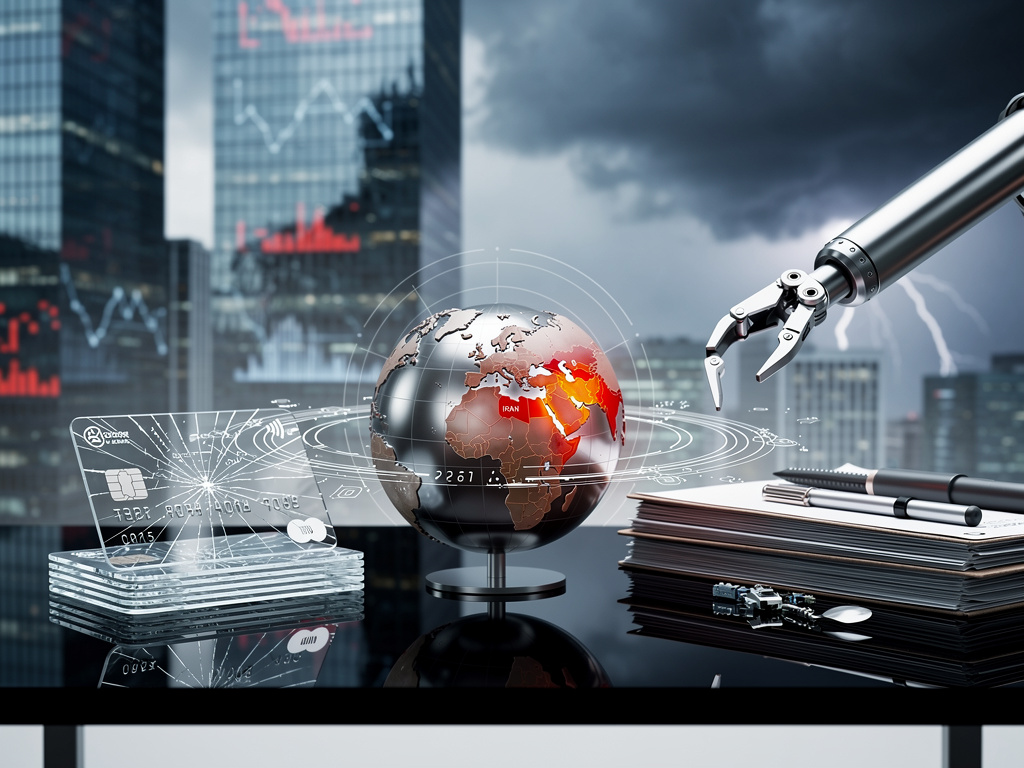
Jane Fraser isn’t sugarcoating anything. The Citi CEO laid out a blunt assessment of the risks facing global finance in 2026, touching on private credit’s ballooning growth, the threat of a wider conflict involving Iran, and AI’s accelerating impact on banking jobs. Her remarks, reported by Business Insider, amount to a candid warning shot for an industry that’s been riding a wave of post-pandemic optimism.
Private credit is the big one. The asset class has exploded past $1.7 trillion globally, and Fraser made clear she sees systemic risk building beneath the surface. Her concern isn’t that private credit exists — it’s that the market has grown so fast, with so little transparency, that nobody fully understands the interconnections. Traditional banks have offloaded risk to private lenders, but those lenders are now deeply intertwined with insurance companies, pension funds, and retail investors through interval funds and other vehicles. If a recession hits and defaults spike, the pain won’t stay contained.
This isn’t a fringe view anymore. The IMF, the Federal Reserve, and the Bank of England have all flagged private credit concentration as a potential source of instability. But Fraser’s comments carry particular weight because Citi sits at the intersection of traditional banking and capital markets — the firm sees both sides of the ledger. She’s essentially saying: we helped create this, and we’re worried about where it’s going.
Then there’s geopolitics. Fraser highlighted the risk of escalation involving Iran as one of the most underpriced threats in markets today. A broader Middle Eastern conflict could send energy prices surging, disrupt shipping lanes, and trigger inflationary shocks that central banks thought they’d already tamed. She didn’t predict war. But she made the point that markets are pricing in a remarkably benign outcome given how many flashpoints exist — Iran’s nuclear program, proxy conflicts across the region, and the fragile state of diplomatic channels.
For financial professionals, this matters because geopolitical risk has a way of arriving all at once. One day it’s background noise. The next day it’s repricing every asset class simultaneously.
On AI, Fraser was direct about what’s coming for Citi’s own workforce. She acknowledged that artificial intelligence will eliminate certain categories of jobs at the bank — not in some distant future, but soon. Coding, data analysis, compliance monitoring, and parts of customer service are all areas where automation is already making inroads. Fraser framed this not as a cost-cutting exercise but as an inevitability that the bank needs to manage responsibly, including retraining and redeploying affected employees.
That framing is important. Most bank CEOs talk about AI in vague, aspirational terms — efficiency gains, better client experiences, innovation. Fraser went further by naming the downside. Jobs will go away. The question is whether banks handle the transition with some degree of planning or let it happen chaotically.
Citi has been investing heavily in AI infrastructure. The bank has deployed large language models internally for tasks like summarizing regulatory documents and generating code. According to Reuters, Citi allocated significant resources to its AI and automation programs in 2025, and Fraser has positioned the technology as central to the bank’s ongoing transformation — a multiyear restructuring effort that has already involved thousands of layoffs and a simplification of Citi’s corporate structure.
So what’s the takeaway for the industry? Fraser is painting a picture where three major forces — opaque credit markets, geopolitical instability, and technological displacement — converge in ways that could amplify each other. A geopolitical shock triggers a credit event in private markets, which exposes vulnerabilities that AI-driven risk models didn’t anticipate because they were trained on a decade of low-volatility data. That’s not a prediction. It’s a scenario. And it’s the kind of scenario that risk managers should be stress-testing right now.
Fraser’s willingness to speak plainly about these risks is notable in itself. Bank CEOs tend to project confidence. They talk about opportunity, growth, client momentum. Fraser did some of that too — Citi’s stock has recovered meaningfully since she took the helm, and the restructuring is showing results. But the tone of her remarks suggests she’s more concerned about tail risks than the market currently reflects.
Private credit firms will push back, arguing their underwriting standards are strong and their portfolios are diversified. They have a point — many of the largest players, like Apollo, Ares, and Blackstone Credit, have built sophisticated operations. But Fraser’s critique isn’t about any single firm. It’s about the system. When $1.7 trillion sits in a market with limited mark-to-market discipline and no centralized clearing, the potential for correlated losses is real.
And the Iran risk? It’s the kind of thing that gets ignored until it can’t be. Energy markets remain the transmission mechanism. A disruption in the Strait of Hormuz alone could spike oil prices by $20 to $30 per barrel almost overnight, according to estimates from S&P Global Commodity Insights.
Fraser’s message boils down to something simple: don’t confuse calm markets with safe markets. The risks are accumulating. Whether they materialize in 2026 or later, the time to prepare is now — not after the first domino falls.


 WebProNews is an iEntry Publication