
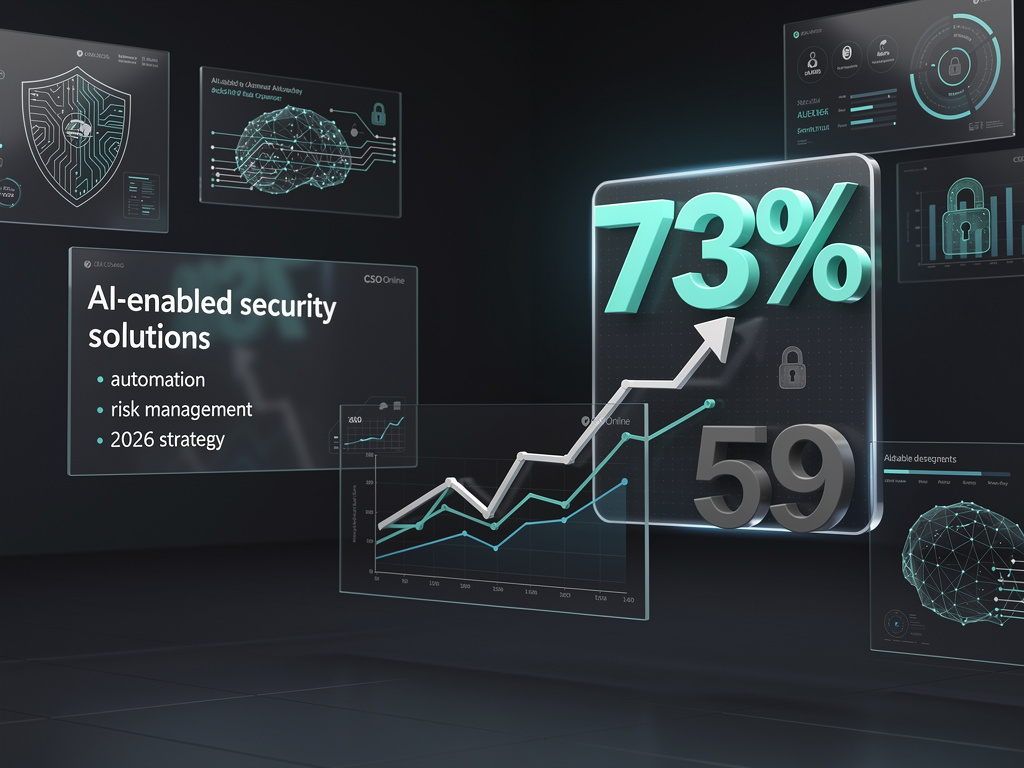
In the high-stakes arena of corporate defense, chief information security officers are accelerating their embrace of artificial intelligence, with 73% now more inclined to deploy AI-powered security solutions compared to last year. This marks a sharp rise from 59%, according to a recent CSO Online report drawing from Foundry’s survey of 200 U.S. CISOs. The shift reflects mounting pressures from sophisticated attacks and stretched teams, positioning AI as a force multiplier in threat detection and response.
Executives cite AI’s prowess in automating routine tasks and sifting through vast data volumes for anomalies humans might miss. ‘AI-enabled solutions are becoming table stakes for staying ahead,’ notes one CISO surveyed. Yet, this enthusiasm tempers with caution: 68% express worries over AI’s own vulnerabilities, including model poisoning and adversarial inputs that could undermine defenses.
From Hesitation to Acceleration
The data underscores a pivotal evolution. Last year, adoption hovered lower amid pilot programs and proof-of-concepts. Now, with generative AI infiltrating both offensive and defensive playbooks, CISOs report heightened urgency. Foundry’s findings align with broader trends, as CSO Online highlights AI topping 2026 priority lists alongside resiliency and third-party risks.
Posts on X echo this momentum. Industry watchers like CSOonline amplified the 73% statistic, while users such as Chuck Brooks shared the CSO link, signaling real-time buzz among professionals. Cisco’s 2025 Cybersecurity Readiness Index, available here, reveals flat overall readiness despite AI’s transformative role, pushing leaders toward intelligent automation.
AI’s Dual-Edged Promise in Threat Hunting
At the core, AI excels in predictive analytics and behavioral analysis. Tools now scan petabytes of logs in seconds, flagging zero-day exploits with machine learning models trained on global threat feeds. A CSO Online study on security priorities notes CISOs piloting AI to stretch budgets, enlisting partners for advanced capabilities.
Google Cloud’s blog on cloud CISO perspectives for 2025 emphasizes securing AI itself alongside defenses, with AI agents handling alert triage. Harvard Business Review’s sponsored content from Palo Alto Networks predicts autonomous AI agents dominating SOCs by 2026, delegating tasks like financial modeling—extending to cyber triage.
Budget Pressures Fueling the Shift
Budgets remain tight, yet threats escalate. The Foundry survey reveals 75% of CISOs facing stagnant funding despite rising incidents. AI promises efficiency: 62% anticipate workload reductions of 30% or more. CSO Online’s piece on top CISO challenges lists AI threats and scaling budgets as paramount.
Enterprise adoption stats from X posts, like Inference Labs noting AI in 38% of cybersecurity tools and 70% of workflows, highlight integration depth. Dr. Khulood Almani on X forecasts AI-driven autonomous defense for 2026, with agents detecting and mitigating in real time.
Risks and the Governance Imperative
Enthusiasm doesn’t eclipse risks. Hallucinations in large language models could generate false positives, overwhelming teams. Supply chain attacks targeting AI vendors loom large. 40% of CISOs in the Foundry poll demand robust vendor audits before deployment.
CSO Online warns of AI, cloud, and interconnectivity pitfalls for 2026. Tech.co’s roundup of expert predictions flags data surges and AI malware. Crest Data’s trends piece details agentic AI outpacing humans, urging automation boundaries.
Case Studies Lighting the Path
Real-world wins abound. Organizations using AI SIEM platforms report 50% faster mean-time-to-response. ET Edge Insights discusses AI-assisted SIEM 4.0 as a 2026 mandate amid AI threats and talent shortages.
CSO Online’s 2026 projects list features AI for penetration testing and risk assessments—27% of CISOs see takeover here, per X sentiment from Cantina. WebProNews signals CIOs tracking unsupervised AI decisions and agent sprawl.
Regulatory Headwinds and Compliance
New rules like the EU AI Act classify security AI as high-risk, mandating transparency. U.S. executives brace for similar scrutiny. Foundry data shows 55% prioritizing compliant AI tools.
Integration challenges persist: legacy systems resist AI overlays. Training gaps affect 48% of teams. Yet, 81% plan investments within 12 months, per CSO surveys.
Strategic Roadmaps for 2026
CISOs craft hybrid models blending AI with human oversight. Priorities include explainable AI for audit trails and federated learning to safeguard data. Partnerships with hyperscalers accelerate deployment.
X chatter from Stephanie Link cites Palo Alto: 78% embrace AI, but 94% lack security—mirroring Foundry gaps. Cisco Umbrella’s SASE stats project 60% enterprise adoption by 2025, now extending to AI security stacks.
Quantifying ROI and Metrics
Success metrics evolve: beyond breach reductions, focus on automation rates and analyst productivity. Early adopters log 40% false positive drops. Gartner echoes via proxies, stressing measurable outcomes.
As 2026 unfolds, the 73% figure likely climbs, propelled by competitive edges. Foundry’s CISO voices affirm: AI isn’t optional—it’s the new operational core.


 WebProNews is an iEntry Publication