
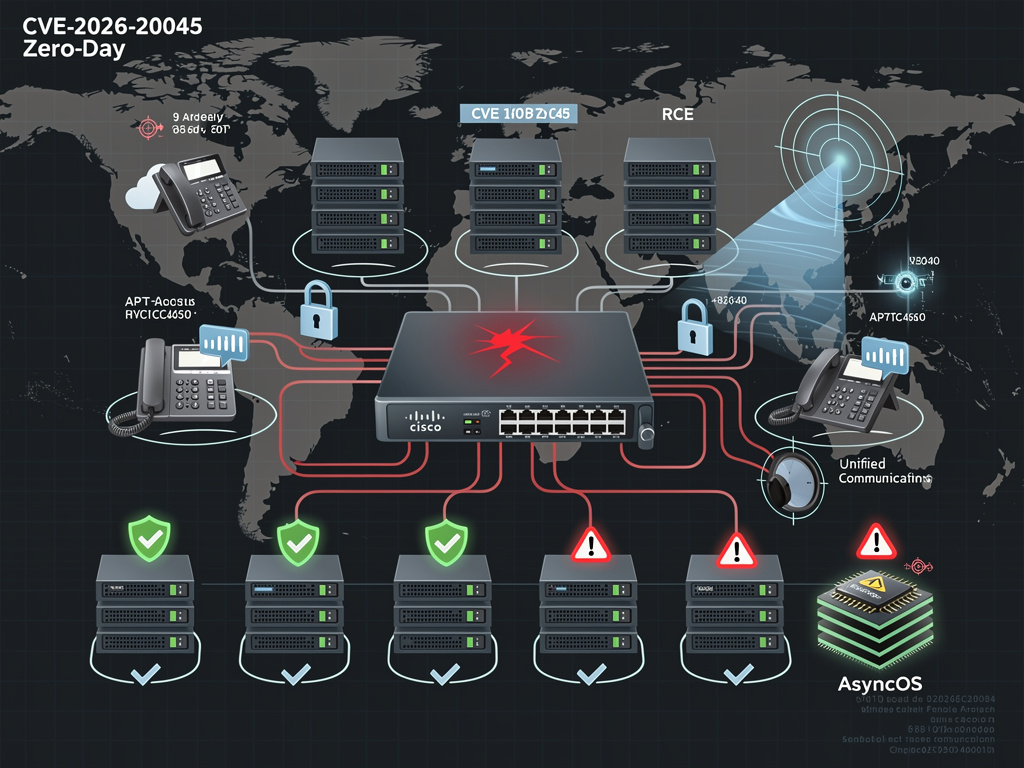
In a stark reminder of enterprise vulnerabilities, Cisco Systems Inc. has rushed out fixes for a critical remote code execution (RCE) flaw in its Unified Communications suite, confirming active exploitation in the wild. Tracked as CVE-2026-20045, the bug allows attackers to seize root-level control without user interaction, prompting immediate version-specific patches for affected products like Unified Communications Manager and Webex Calling.
The vulnerability, rated critical with a CVSS score of 9.8, stems from improper input validation in a system component, enabling unauthenticated remote attackers to execute arbitrary code. Cisco’s advisory, released January 22, 2026, details exploitation evidence gathered from customer reports and threat intelligence, urging organizations to apply tailored updates based on their exact software versions.
Exploitation Tactics Emerge in the Shadows
Attackers have been observed scanning for vulnerable instances and deploying exploits that bypass authentication entirely. According to CSO Online, the RCE flaw lets remote foes gain root on affected systems with no user interaction, a scenario that has already led to compromises in production environments.
Security firm SOC Prime, in its analysis of CVE-2026-20045, notes that the flaw affects multiple Cisco UC products, with proof-of-concept code circulating on underground forums accelerating the threat. “This is a textbook zero-day under active attack,” the firm stated, highlighting the need for precise patching sequences.
Version-Specific Fixes Demand Precision
Cisco’s patching guidance is granular, listing fixed releases for Unified CM versions 14SU3, 15SU5, and others, with no single upgrade path applicable universally. Organizations running unpatched 12.5 or 14 releases face the highest risk, as exploits target specific endpoints exposed to the internet.
BleepingComputer reports that Cisco confirmed zero-day attacks prior to disclosure, with indicators of compromise including unusual root processes and network anomalies. “Patch immediately if you’re on affected versions,” Cisco urged in its advisory.
Broader Cisco Vulnerability Wave
This UC incident follows closely on the heels of another zero-day in Cisco’s AsyncOS, CVE-2025-20393, a CVSS 10.0 RCE exploited by a China-linked APT group targeting Secure Email Gateways. The Hacker News detailed how attackers leveraged the flaw for root access via email appliances, drawing parallels to the UC bug’s mechanics.
Posts on X from accounts like @CiscoSecurity emphasize the urgency, with users reporting scans against their UC infrastructure. The Register described it as “another week, another emergency patch,” in its coverage, noting the critical rating leaves unpatched systems open to full takeover.
Attack Surface and Mitigation Strategies
Cisco UC deployments, integral to call centers and hybrid work setups, often expose management interfaces online, amplifying risks. The Center for Internet Security advisory on the flaw recommends isolating UC managers behind firewalls and monitoring for exploit attempts using signatures for CVE-2026-20045.
Dark Web Informer highlighted active probing of Cisco enterprise comms products, with attackers shifting focus post-patch release. Industry insiders stress validating patches in staging environments to avoid service disruptions in voice and video systems.
Threat Actor Attribution and Patterns
While Cisco has not publicly attributed the UC exploits, patterns mirror state-sponsored campaigns seen in prior AsyncOS attacks. SOC Prime’s blog on related flaws points to UAT-9686, a China-backed APT, suggesting possible overlaps in tooling and infrastructure.
Exploitation involves crafted packets triggering the input flaw, leading to shell access. Cybersecurity News covered similar ASA RCE zero-days, underscoring Cisco’s recurring exposure in firewall and comms stacks.
Enterprise Response Imperatives
For CISOs, this underscores the perils of delayed patching in voice comms, where downtime equals revenue loss. Cisco’s Software Checker tool aids in verifying fixed status, but manual review of release notes is essential given version variances.
Posts found on X reveal enterprise panic, with admins sharing IOCs like suspicious logins from Asia-Pacific IPs. Thehackernews.com noted no widespread breaches yet, but urged segmentation and IDS rules.
Long-Term Resilience Lessons
Beyond patches, experts advocate zero-trust architectures for UC, minimizing exposed surfaces. Field Effect’s blog on AsyncOS exploits warns of persistent threats to Cisco ecosystems, calling for continuous monitoring.
As 2026 unfolds, this cluster of zero-days signals heightened scrutiny on Cisco’s secure development lifecycle. Organizations must prioritize vulnerability management, treating UC as a crown jewel against RCE threats.


 WebProNews is an iEntry Publication