
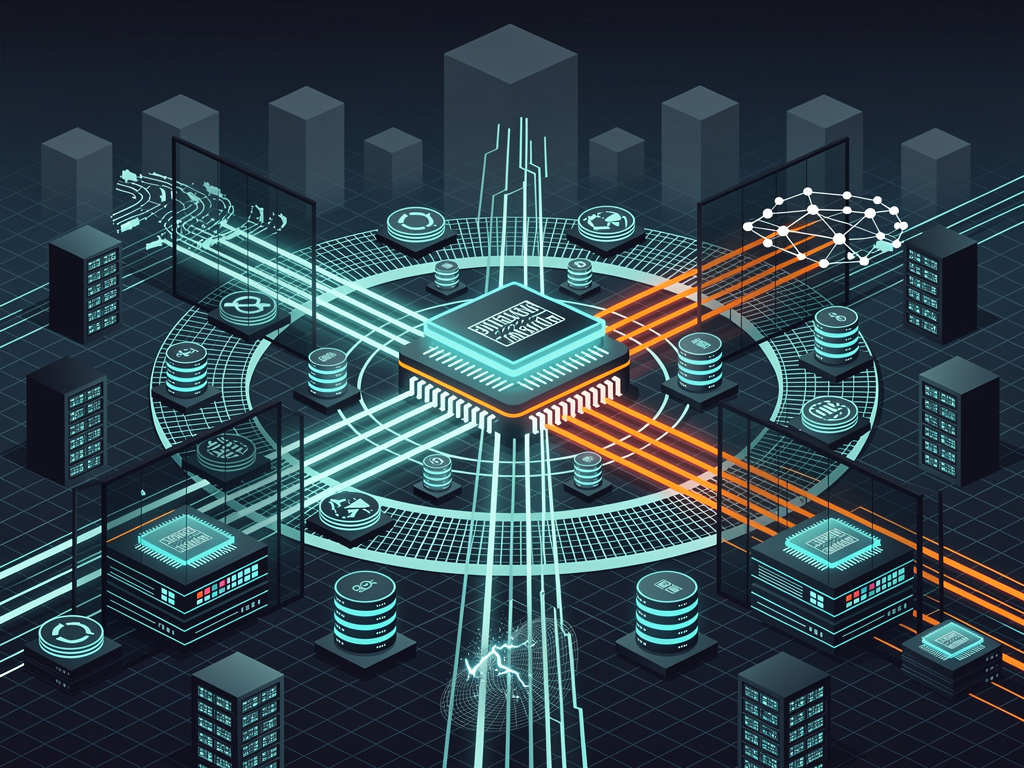
Chuck Robbins doesn’t sugarcoat things. In a wide-ranging interview on The Verge’s Decoder podcast, the Cisco CEO laid out a vision of the next decade in technology infrastructure that is equal parts ambitious and sobering. The networking giant that once defined the internet era is now positioning itself at the center of the largest buildout of computing infrastructure the world has ever seen — the AI data center explosion. And Robbins wants everyone to understand that the plumbing underneath all of it is where the real bottlenecks, and the real money, will be.
The conversation, hosted by Nilay Patel, covered everything from Cisco’s $28 billion acquisition of Splunk to the geopolitics of Elon Musk’s Starlink to the physics of cooling thousands of GPUs packed into warehouse-scale facilities. But the through line was unmistakable: the AI gold rush is creating demand for networking infrastructure at a pace and scale that the industry hasn’t confronted before, and Cisco is betting its future on being the company that connects it all.
Start with the numbers. Hyperscale data center construction is accelerating at a rate that has surprised even the companies building them. Microsoft, Google, Amazon, and Meta have collectively committed hundreds of billions of dollars to new facilities. Robbins told The Verge that the current wave of capital expenditure announcements represents something qualitatively different from previous cycles. These aren’t incremental expansions. They are massive, purpose-built AI training clusters requiring networking bandwidth that dwarfs what traditional cloud workloads demanded.
“The amount of east-west traffic inside these data centers is just enormous,” Robbins said, referring to the server-to-server communication patterns that define distributed AI training. In a traditional data center, most traffic flows north-south — from users to servers and back. AI training flips that model. GPUs need to constantly synchronize with each other, exchanging gradient updates across thousands of nodes. The networking fabric connecting those GPUs becomes the single most important determinant of training efficiency. A slow network doesn’t just add minutes. It can add weeks.
This is Cisco’s pitch. Not the GPUs. Not the models. The pipes.
Robbins was characteristically direct about where Cisco sits in the competitive stack. Nvidia dominates GPU hardware and has built its own networking business through the Mellanox acquisition, selling InfiniBand switches that currently handle much of the highest-performance AI cluster interconnect work. Cisco’s counter-argument is that Ethernet — the protocol it has dominated for decades — is catching up fast, and that as AI workloads move from training into inference and deployment, Ethernet’s flexibility and cost advantages will win out. He pointed to Cisco’s Silicon One chip architecture and the company’s work with the Ultra Ethernet Consortium as evidence that the open-standards approach will ultimately prevail over proprietary alternatives.
It’s a familiar pattern in tech. Proprietary solutions win the early high-performance market. Open standards eventually commoditize the space. Robbins is betting history repeats itself.
But there’s a more immediate and tangible dimension to Cisco’s AI infrastructure play: the Splunk acquisition, which closed in March 2024. Robbins framed the $28 billion deal not as a pivot but as a recognition that networking hardware alone won’t be enough. As data centers scale to hundreds of thousands of GPUs, the observability and security challenges multiply. Splunk gives Cisco a data analytics platform that can ingest machine data at enormous scale — logs, metrics, traces — and turn it into actionable intelligence about what’s happening across sprawling infrastructure. Robbins told The Verge that integrating Splunk’s capabilities with Cisco’s networking telemetry is already yielding products that can detect anomalies, security threats, and performance degradation in real time across hybrid environments.
The integration is still early. Cisco reported in its most recent earnings that Splunk contributed meaningfully to recurring revenue, but analysts have questioned whether the premium paid will ultimately be justified. Robbins seemed unfazed. “When you’re sitting on the network and you can see every packet, and you combine that with the ability to analyze every log, you have a view of the enterprise that nobody else has,” he said.
Then there’s the question of where these data centers are actually going to go. Power. That’s the constraint everyone in the industry is talking about, and Robbins didn’t shy away from it. New AI data centers can consume hundreds of megawatts each. Finding locations with sufficient grid capacity, water for cooling, and permitting flexibility has become a fierce competition among hyperscalers. Robbins acknowledged that nuclear power — including the small modular reactors being pursued by companies like Oklo and NuScale — is part of the long-term answer, but he was realistic about timelines. Those reactors are years away from commercial deployment at scale.
In the meantime, the power crunch is forcing creative solutions. Some companies are building in Nordic countries where cold climates reduce cooling costs. Others are exploring direct liquid cooling systems that can handle the thermal density of next-generation GPU racks. Cisco itself has been working on networking equipment designed for these denser, hotter environments — switches and optics that can operate reliably in conditions that would have been considered extreme just a few years ago.
Robbins also waded into geopolitics, specifically the role of Elon Musk’s Starlink in global connectivity. The Cisco CEO was notably measured in his assessment. He acknowledged that Starlink has achieved something remarkable in deploying a low-earth-orbit satellite constellation that provides broadband to underserved areas. But he also raised questions about the concentration of critical communications infrastructure in the hands of a single private actor. “There’s a question of governance,” Robbins said, noting that governments around the world are grappling with how to regulate satellite-based internet services that don’t respect traditional jurisdictional boundaries.
This isn’t abstract for Cisco. The company sells heavily to governments, telecom operators, and enterprises that have historically relied on terrestrial networking infrastructure. Starlink represents both a potential partner and a potential disruptor. Robbins seemed to be threading the needle — praising the technology while subtly arguing that the existing terrestrial infrastructure, much of it running on Cisco gear, remains indispensable for the kind of high-reliability, low-latency connectivity that enterprises and governments require.
The space angle goes further. Cisco has been quietly building relationships with satellite operators and defense agencies interested in networking constellations of satellites together. Robbins hinted at work in this area without providing specifics, but the implication was clear: if the next frontier of networking extends into orbit, Cisco intends to be there.
Back on Earth, the competitive dynamics are intensifying. Arista Networks has been gaining share in data center switching, particularly among the hyperscalers. Juniper Networks, now being acquired by Hewlett Packard Enterprise in a $14 billion deal, represents another shifting piece on the board. And Nvidia’s networking ambitions — through its Spectrum-X Ethernet platform and continued InfiniBand dominance — mean that Cisco faces competition from a company with extraordinary momentum and market capitalization advantages.
Robbins addressed the Arista competition directly. He argued that Cisco’s breadth — spanning campus networking, wide-area networking, security, collaboration, and now observability through Splunk — gives it an integrated value proposition that pure-play data center switching companies can’t match. Whether enterprise CIOs buy that argument as AI workloads increasingly dictate infrastructure purchasing decisions remains an open question.
One thing Robbins was emphatic about: the AI infrastructure buildout is not a bubble. He pushed back hard against comparisons to the late-1990s telecom and dot-com spending spree that ended in spectacular overcapacity and write-downs. His argument rests on the nature of the demand. In the late ’90s, companies were building fiber networks based on projected internet traffic growth that didn’t materialize on the expected timeline. Today, he contended, the demand for AI compute is real, measurable, and accelerating. Every major enterprise is either deploying AI models or planning to. The inference workloads alone — running trained models in production — will require sustained and growing infrastructure investment for years.
“This is not speculative,” Robbins said. “The workloads exist today.”
Still, there are skeptics. Some analysts have pointed to the gap between hyperscaler capital expenditure and the actual revenue being generated by AI services. The return on investment for much of this spending remains unclear, particularly for enterprise AI applications that are still in pilot phases. If the ROI doesn’t materialize, capital spending could decelerate, and infrastructure vendors like Cisco would feel the impact.
Robbins conceded that not every AI investment will pay off, but he drew a distinction between individual company bets and the macro trend. “Some companies will overspend. Some projects will fail. But the aggregate demand for AI infrastructure is going in one direction,” he said. It’s the kind of statement that sounds obvious now but will be tested over the next two to three years as enterprises move from experimentation to demanding measurable returns.
The interview also touched on Cisco’s internal use of AI. Robbins described how the company is deploying AI across its own operations — in customer support, software development, and network management. He framed this as both a competitive necessity and a proof point for customers. If Cisco can demonstrate efficiency gains from AI in its own business, the argument for AI-optimized infrastructure becomes more concrete.
And then there’s the workforce question. Robbins acknowledged that AI will displace some jobs while creating others, but he was more focused on the near-term skills gap. Finding engineers who understand both networking and AI workloads is extraordinarily difficult. Cisco has been investing in training programs and partnerships with universities, but Robbins admitted the demand for talent far outstrips supply. This constraint, he suggested, could be as significant as power availability in determining how fast AI infrastructure scales.
Recent reporting reinforces many of Robbins’ themes. Reuters reported that Cisco’s latest quarterly revenue forecast exceeded Wall Street estimates, driven in part by demand for AI networking equipment. The company’s infrastructure platforms segment showed particular strength, suggesting that the AI data center buildout is translating into real orders. Cisco’s stock has responded accordingly, recovering from a period of underperformance as investors begin to price in the AI infrastructure tailwind.
Meanwhile, the broader data center construction boom shows no signs of slowing. According to recent reporting from CNBC, the power demands of AI data centers are reshaping energy markets, with utilities scrambling to add generation capacity and grid connections. Some projects are being delayed not by lack of capital but by lack of electricity. It’s a constraint that validates Robbins’ point about the physical limits of the buildout — and one that networking vendors like Cisco must account for in their own product roadmaps.
The picture that emerges from Robbins’ interview is of a CEO who sees a once-in-a-generation opportunity and is determined not to let Cisco miss it. The company fumbled the cloud transition a decade ago, ceding ground to nimbler competitors as hyperscalers built their own networking stacks. Robbins has spent his tenure trying to reposition Cisco as a software and subscription company while defending its hardware franchise. The AI moment gives him a chance to do both simultaneously — selling high-performance networking hardware for AI clusters while layering on software-based observability, security, and management tools.
Whether it works depends on execution. Cisco is a $55 billion revenue company with over 80,000 employees. Moving an organization that size quickly enough to capture a fast-evolving market is the central leadership challenge. Robbins knows this. He’s restructured the company multiple times, most recently cutting thousands of jobs to reallocate resources toward AI-related product development.
The hard part, as Robbins himself acknowledged, hasn’t even started. Building the data centers is one thing. Making them work — reliably, efficiently, securely, at scale — is another. That’s where networking lives. And that’s the bet Cisco is making.
Not on the models. Not on the chips. On the invisible infrastructure that connects everything together. It’s the same bet Cisco made in the 1990s when the internet was new. The difference now is that the stakes are measured in trillions, the competition is fiercer, and the margin for error is thinner than ever.
Chuck Robbins seems comfortable with that. Whether Cisco’s shareholders should be is the question that will define the next chapter of one of Silicon Valley’s most enduring companies.


 WebProNews is an iEntry Publication