
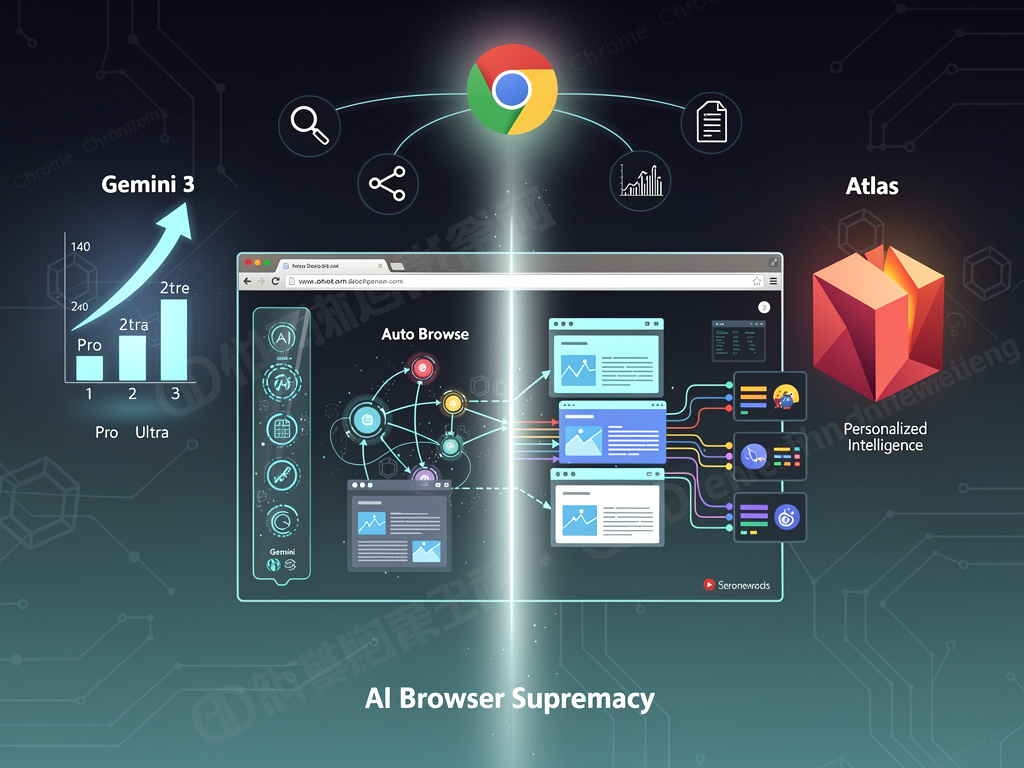
Google is embedding deeper artificial intelligence capabilities into its dominant Chrome browser, introducing agentic tools that autonomously handle web tasks amid intensifying competition from AI-native rivals. On January 28, 2026, the company unveiled updates powered by its Gemini 3 model, including a persistent side panel for the Gemini chatbot, image generation via Nano Banana, Personal Intelligence for tailored responses, and Auto Browse for executing multi-step commands across sites.
These enhancements arrive as Chrome, with over 65% global market share, faces pressure from OpenAI’s Atlas browser launched in October 2025, which integrates ChatGPT and triggered a 2% drop in Alphabet shares, according to CNBC. Google Chrome Vice President Parisa Tabriz wrote in a blog post, “Chrome will remember context from past conversations so you get uniquely tailored answers to whatever you’re looking for across the web and you can already add specific instructions to Gemini to get more tailored responses.”
The side panel redesign keeps Gemini accessible without disrupting workflows on MacOS, Windows, and Chromebook Plus devices in the U.S., enabling users to query content across tabs, summarize videos, or compare options seamlessly, as detailed in Google’s official blog at blog.google.
Agentic Dawn with Auto Browse
Central to the rollout is Auto Browse, an agentic feature exclusive to Google AI Pro and Ultra subscribers in the U.S., allowing Gemini to navigate sites, filter results, and perform actions like “Go through my favorited apartments on Redfin and remove any that are not pet friendly,” per the CNBC report. In a demo, Product Lead Charmaine D’Silva tasked Gemini with planning a family vacation by cross-referencing travel sites, school calendars, and schedules, as covered by CNET.
Built on Gemini 3, released late last year, Auto Browse supports Google’s Universal Commerce Protocol (UCP), co-developed with Shopify, Etsy, Wayfair, and Target, to enable seamless agentic commerce. This positions Chrome as a proactive platform, evolving from passive browsing, according to SiliconANGLE.
Personalization via Connected Intelligence
Personal Intelligence, first launched in the Gemini app earlier in January 2026, extends to Chrome soon, linking data from Gmail, Google Photos, Calendar, YouTube, Maps, and more for hyper-personalized assistance. Users can instruct Gemini on preferences, such as dietary needs for recipes, without repeated explanations, enhancing continuity across sessions.
Nano Banana brings on-demand image generation and editing directly in the browser—no uploads required. While viewing an image, users prompt Gemini via the side panel to transform it, streamlining creative workflows, as noted by Engadget.
Strategic Push Amid Monopoly Scrutiny
These moves follow a September 2025 U.S. district court ruling deeming Google’s search practices monopolistic, though it avoided mandating Chrome divestiture—a decision Google appealed in January 2026. Post-ruling, Chrome integrated deeper Google app access in September 2025, per CNBC.
Google DeepMind CEO Demis Hassabis envisions a “universal assistant” that plans and acts across devices, a goal these features advance. Chrome now recalls browsing history, suggests prompts via AI Mode in the address bar, and bolsters security with Gemini Nano detecting scams, fake alerts, and auto-updating compromised passwords on sites like Coursera and Spotify.
Browser Wars Heat Up
OpenAI’s Atlas and Anthropic’s Claude tools challenge Chrome, but Google’s scale—over 3 billion users—amplifies reach. Unlike cloud-reliant rivals, Gemini Nano enables on-device processing for privacy-sensitive tasks. Gemini in Chrome rolled out broadly in September 2025 without subscriptions, expanding to iOS and ChromeOS 144 by January 2026, as reported by 9to5Google and TechRepublic.
Enterprise focus includes Google Workspace integrations with data controls, rolling out to businesses soon. On mobile, Android users access via power button; iOS gets tab-aware queries. Features remain optional, preserving user control over data and history deletion.
Road Ahead for AI-Driven Browsing
Future updates promise fuller agentic capabilities, like automated grocery reorders or bookings, teased since September 2025 blogs. Parisa Tabriz emphasized in a press conference, “We live our lives on the web,” framing Auto Browse for “digital laundry,” via ZDNet.
While previews limit access, broad rollout eyes all users, balancing innovation with trust amid AI hallucination risks. Google’s Chrome evolution underscores its bet on embedded AI to retain dominance in an era where browsers become intelligent operatives.


 WebProNews is an iEntry Publication