
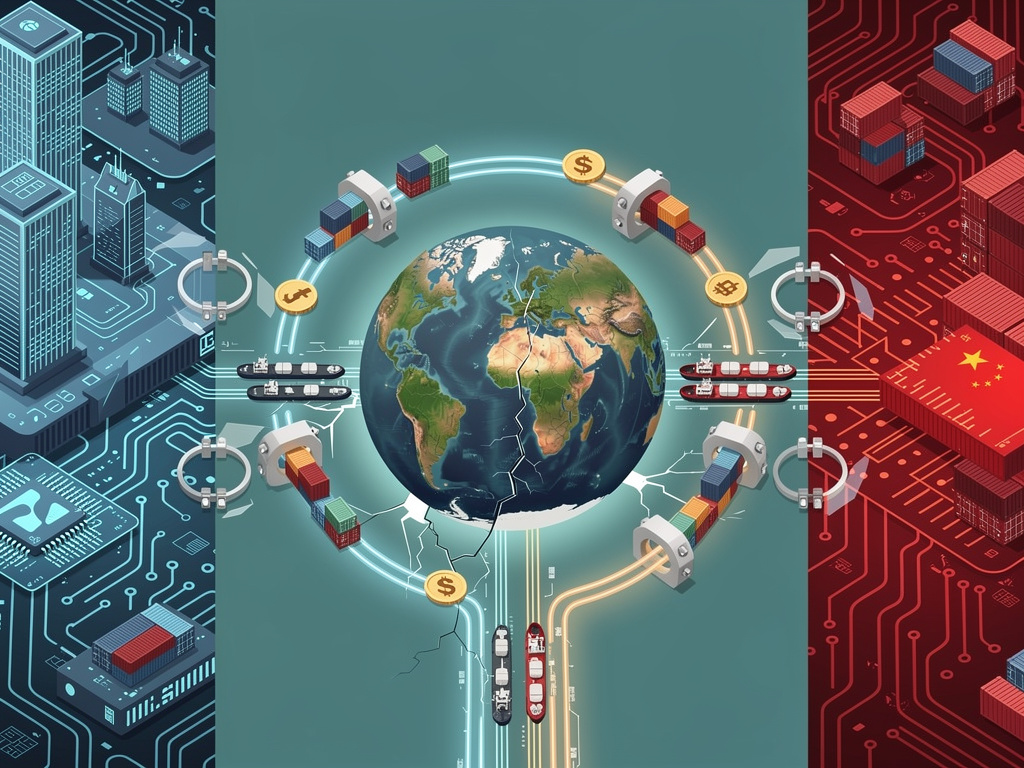
JPMorgan analysts spotted something new in the contest between Washington and Beijing. The narrow passages that once let one side squeeze the other have flipped. Pressure points now cut in both directions. Both governments grasp this reality. The task becomes containing those pressures before they spiral.
This shift marks a departure from earlier decades. China once stood more exposed. Its export machine relied on open sea lanes. Its tech sector drank from American semiconductors and software. Today the dependencies feel more balanced. Or at least more contested. A note from the bank lays out five forces quietly tilting the equilibrium. The piece, published by Yahoo Finance, captures the analysts’ core warning.
Trade routes first. The Strait of Hormuz, Bab el-Mandeb, Suez, Malacca, Panama. These passages carry the lifeblood of global commerce. Recent closures and attacks have shown their fragility. When Iran halted shipping through Hormuz in 2026, roughly 20 percent of global crude and LNG flows faced immediate risk. Rerouting flooded secondary passages. The Panama Canal absorbed extra pressure. So did Malacca. Congestion spread. S&P Global reported in April 2026 that supply chain risk had grown geographically diffuse. Simple detours no longer sufficed. Network effects took over.
Yet the same geography constrains China. Its factories ship goods through those same straits. Its energy imports travel them daily. Beijing cannot close them without harming itself. That mutual exposure creates a strange stability. Neither side wants full rupture. But each probes the other’s tolerance.
Technology forms another front. Semiconductors sit at the heart. The United States controls advanced chip design and manufacturing equipment. China pours billions into catching up. Progress comes. Yet gaps remain in extreme ultraviolet lithography and certain design tools. Washington tightened export controls. Beijing responded with its own restrictions on rare earths and processing. The chokepoint works both ways. One side limits high-end chips. The other can throttle materials essential for magnets, batteries, and defense systems.
Finance adds tension. The dollar’s dominance gives Washington sanction power. Chinese firms felt the sting when cut off from SWIFT or correspondent banking. Beijing builds alternatives. Cross-Border Interbank Payment System. Digital yuan experiments. Yuan-denominated oil trades with Russia and others. These efforts erode the monopoly slowly. They have not replaced it. Still, the trajectory worries American officials. A less dollar-centric system would blunt one of Washington’s sharpest tools.
Energy security tells a parallel story. China imports most of its oil. Much passes through Hormuz and Malacca. Diversification efforts include pipelines from Russia and Central Asia. Strategic reserves. Renewables push. The United States, now a net exporter, holds different cards. LNG terminals. Shale flexibility. But American allies in Europe and Asia still need stable flows. Disruptions anywhere ripple everywhere. A Nature study from 2025 quantified the damage. Expected annual trade disruption at chokepoints reached $192 billion. Economic losses from delays, rerouting, and higher insurance hit $10.7 billion yearly. Suez, Bab el-Mandeb, and Malacca drove most of the total. The paper appeared in Nature Communications.
Recent events bring these calculations into sharp focus. The Hormuz closure earlier this year forced shipping lines to reroute around Africa or through congested alternatives. Insurance premiums spiked. Freight rates jumped. Factories adjusted inventories. Some shifted sourcing. The episode, analyzed in depth by ION Analytics in May 2026, showed how one chokepoint event redefines risk models across entire networks. James Gabor, the author, noted that geography and economics still bind players to these passages despite efforts to avoid them.
UNCTAD’s Review of Maritime Transport painted a similar picture. The 2024 edition, updated with fresh data, highlighted how climate events at Panama combined with Red Sea conflict to slow container growth to 0.3 percent in 2023. Recovery projections remain modest. Overcapacity in shipping could return if routes normalize. The report from UNCTAD warned that maritime trade’s resilience faces repeated tests.
Corporate boardrooms feel the change. Executives once viewed supply chains through a cost and efficiency lens. Geopolitics now dominates scenario planning. Companies map exposure to each major strait. They track supplier dependencies on Chinese inputs and American technology. Diversification accelerates. Nearshoring. Friendshoring. Inventory buffers. Yet complete separation proves impossible. Costs soar. Innovation slows. Customers pay.
Policy makers on both sides study the same maps. American strategy blends export controls, investment screening, and alliance building. The CHIPS Act. Export restrictions on advanced nodes. Quad and AUKUS partnerships. China counters with Made in China 2025 successors, dual-circulation policies, and Belt and Road infrastructure. Each move seeks to reduce vulnerability while increasing the other’s.
The five forces JPMorgan identified capture this dynamic. They include technological decoupling pressures, financial weaponization risks, energy transit dependencies, trade route vulnerabilities, and industrial policy competition. The analysts argue that awareness of mutual chokepoints may prevent escalation. Knowing the pressure points allows calibration. A tariff here. An export license delay there. Rare earth quotas. Chip equipment licenses. Small moves that signal without shattering.
But risks accumulate. Miscalculation remains possible. A naval incident in the Taiwan Strait. A blockade threat. Cyber attack on port systems. Any could cascade. The Nature analysis found geopolitical tensions at Taiwan Strait and Suez carried the highest expected trade disruption values. Drought at Panama and piracy at Malacca added layers. No single actor controls all variables.
Investors watch closely. Equity markets price in volatility around these themes. Commodity traders adjust positions on news from the Gulf. Shipping stocks swing with rerouting announcements. Bond markets price sovereign risk differently when chokepoint exposure rises. JPMorgan’s note served as much for clients as for policy thinkers.
Longer term, the balance may evolve further. New technologies could ease some pressures. Alternative routes. Arctic passages if ice melts. Synthetic biology reducing material needs. Quantum computing altering encryption and design advantages. None arrive soon. Physical geography still rules. Narrow straits. Limited deep-water ports. Fixed pipeline routes.
So the contest continues. Each side probes. Each side fortifies. Both understand that full decoupling would damage their own economies as much as the rival’s. The chokepoints run both ways. That knowledge shapes restraint. It also fuels quiet preparation for when restraint fails. Companies and governments alike now build assumptions around persistent tension rather than open cooperation. The old globalization model bends. A new, more guarded version takes shape.
Recent coverage reinforces the point. A US-China Economic and Security Review Commission hearing in June 2025 examined supply chain chokepoints eroding American security. Witnesses discussed China’s dominance in certain materials and processing. The USCC record detailed vectors for potential coercion. Similar themes echo across think tank reports and corporate risk assessments released this year.
The result is a world where supply chain architecture doubles as strategy. Boards review maps once reserved for admirals. Finance teams model sanctions scenarios alongside interest rate paths. Procurement chiefs visit alternative suppliers in Vietnam, Mexico, Eastern Europe. The mutual awareness JPMorgan described has not eliminated conflict. It has changed its character. From outright dominance to managed friction. From one-sided leverage to reciprocal pressure. The narrow passages that connect the global economy now also define its fault lines.


 WebProNews is an iEntry Publication