
Jason Kidd scans the room. Three or four Chipotle crew members sit across from him at a local restaurant table. The conversation flows easily over burritos and chips. Yet every comment, every gesture, every question gets logged. The chief operating officer of the $46 billion chain isn’t simply sharing a meal. He hunts for signals that separate future managers from the pack.
Every week Kidd visits roughly a dozen stores spread across different markets. He pulls small groups aside for 90-minute dinners. The ritual builds rapport. It sharpens operational insights. Most of all it surfaces talent ready for promotion. “We’re constantly identifying internal talent during these visits, seeing how people show up and see how they react,” Kidd told Business Insider.
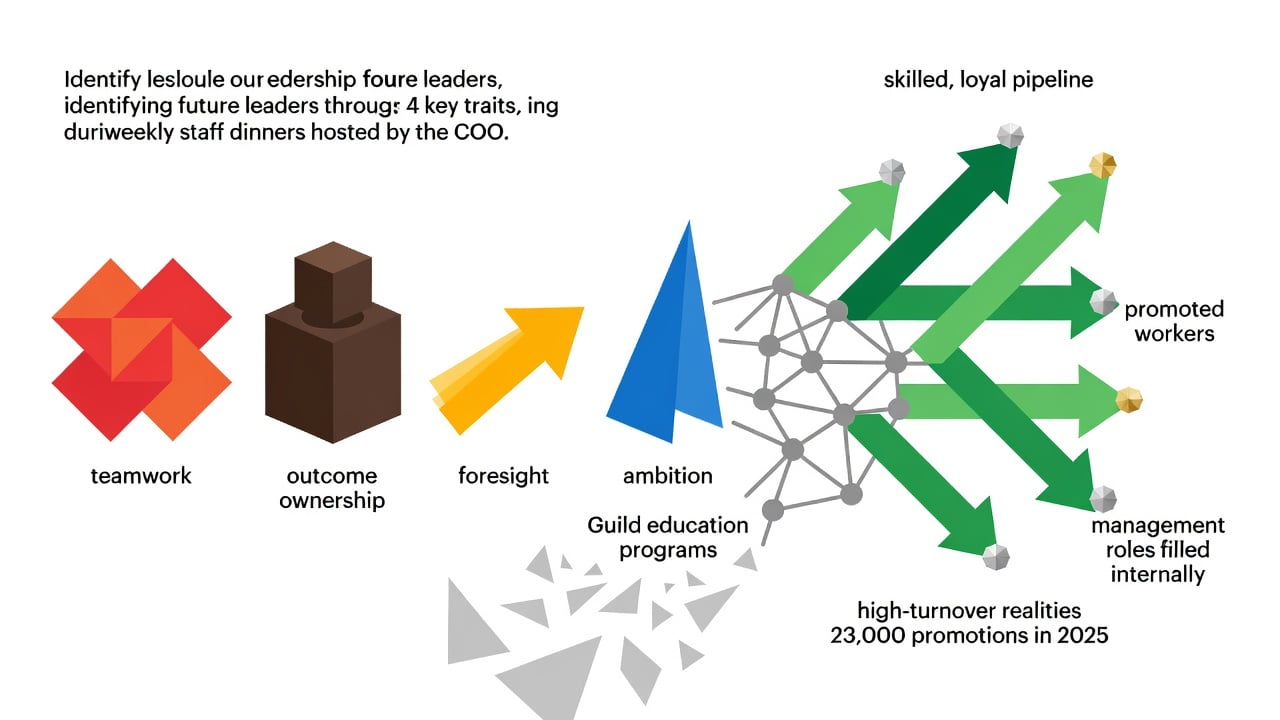
The approach matters. Chipotle promoted 23,000 employees in 2025. That figure represents a huge slice of its 135,000-person workforce across more than 4,100 locations worldwide. Internal candidates filled 100 percent of regional vice president roles, 85 percent of general manager positions, and 83 percent of field leadership spots that year, the company told Yahoo Finance. Such numbers stand out in an industry where turnover routinely exceeds 100 percent annually.
Kidd’s Four Traits Separate Future Leaders From the Rest
During those dinners Kidd watches for four specific qualities. Team players come first. People who support colleagues and collaborate without drama earn notice. “At the end of the day, we run a people business,” Kidd said in the Business Insider interview. “So you need to make sure you take care of your people.”
Next comes ownership. Kidd wants straight talk about results, good or bad. Excuses raise red flags. Those who accept responsibility and learn from setbacks demonstrate leadership material. “If somebody can own the outcome of what they’re doing, they’re likely to be a good leader,” he explained.
Foresight ranks third. Crew members who spot problems before they explode impress him. Reactive fixes help today. Anticipation protects tomorrow’s operations and margins. The final trait centers on genuine career ambition. Kidd looks for staffers who engage deeply because they see a future at Chipotle, not merely a paycheck.
These dinners reveal more than resumes ever could. They expose how someone behaves outside the rush of a lunch line. They test emotional intelligence under casual pressure. And they let Kidd gauge cultural fit in real time. The meals have become a quiet engine behind the company’s internal promotion machine.
But dinners alone cannot solve the broader labor challenge. Restaurant chains have battled chronic turnover for years. Chipotle once hovered near 50 percent retention in its early tenure cohorts. High churn meant constant retraining. Performance suffered. Growth plans risked stalling.
Enter a more systematic fix. The company partnered with Guild, an education technology provider, to overhaul its tuition assistance model. Traditional reimbursement programs require workers to pay upfront then wait for repayment. That barrier excludes many frontline employees living paycheck to paycheck. Guild helped redesign the benefit so assistance flows first. Workers gain immediate access to courses without cash strain.
Results followed quickly. Employees engaged with the program showed retention rates twice as high as non-participants, according to a Guild case study. Average tenure stretched from 2.5 years to more than five. Internal promotions climbed. By 2025 the chain needed 10,000 new hires to staff over 300 fresh restaurants, yet its existing workforce supplied most leadership openings.
Ilene Eskenazi, Chipotle’s chief human resources officer, described the dual focus at Fortune’s Workplace Innovation Summit. “We often have high turnover, so we were solving for two things,” she said in the Fortune report. “In the restaurants that have higher turnover, where we’re constantly having to train and retrain new employees, performance is not as high as teams that have longer tenure.”
The program expanded beyond business and technology classes. It now covers roughly 100 different degrees. Career paths appear clearly mapped so employees see exactly how new skills translate into higher roles and pay. Stories circulate among crew members. One immigrant who started as a line worker now holds a six-figure leadership post, bought a home, and sent a child to college. Such accounts spread virally. They build belief.
Bijal Shah, Guild’s CEO, highlighted another benefit. Enrollment itself flags ambition. “Seeing who enrolls in it is a really good indicator of who’s motivated, who’s excited, who’s inspired, who wants to invest in themselves,” Shah told Fortune. The company gains a ready pipeline of proven talent.
Kidd’s dinner circuit complements these structural changes. One identifies hunger for growth. The other equips that hunger with skills. Together they attack turnover at both cultural and practical levels. Crew members sense real opportunity. They stay longer. They advance. The chain retains knowledge, sharpens execution, and controls labor costs.
Recent coverage shows the strategy continues to gain traction. A May 2025 Fortune analysis noted that five of 11 regional vice presidents began as frontline workers. Field leaders promoted internally now oversee territories averaging $24 million in annual sales. These figures underscore how education access plus personalized talent spotting can reshape a workforce.
Challenges remain. The restaurant sector still wrestles with wage pressure, shifting consumer habits, and generational expectations. Yet Chipotle’s blend of personal attention and scalable development offers a template. Kidd keeps scheduling those dinners. He keeps watching. And the company keeps filling its leadership benches from within. The approach doesn’t rely on slogans. It rests on consistent, observable behavior and measurable investment in people. That combination proves hard to copy and even harder to beat.


 WebProNews is an iEntry Publication