
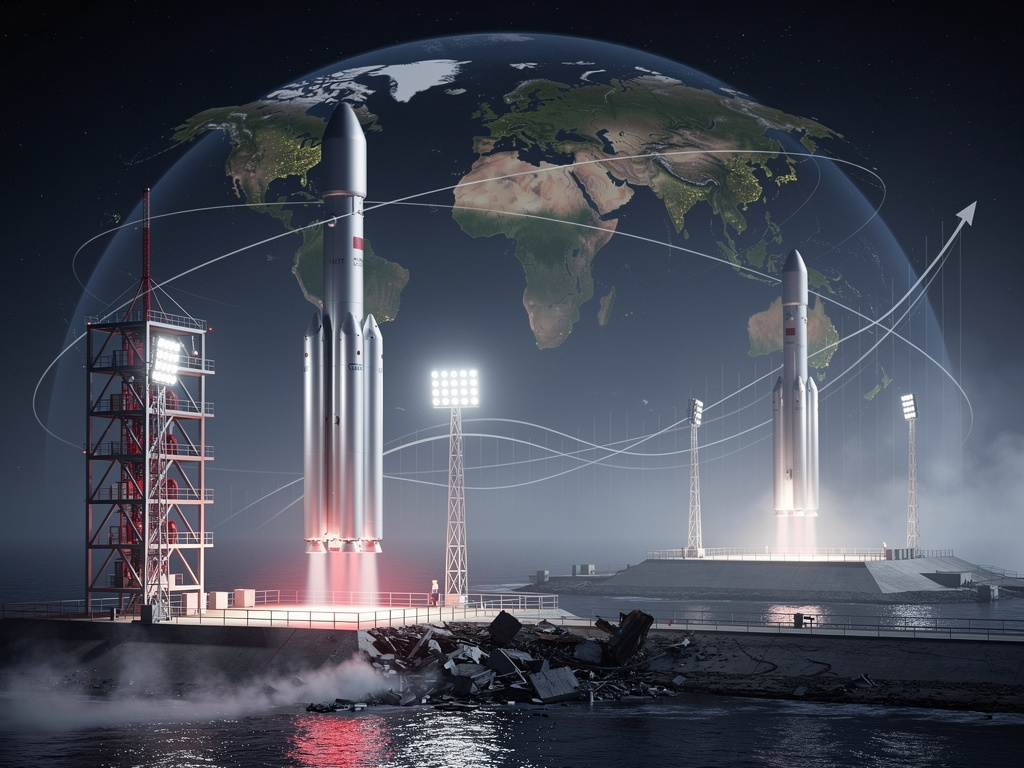
China’s Rocket Challenger Emerges: LandSpace’s Bid to Disrupt SpaceX’s Dominance
In the high-stakes arena of commercial spaceflight, a Beijing-based startup is positioning itself as a formidable rival to Elon Musk’s SpaceX. LandSpace Technology Corp., often dubbed China’s closest equivalent to the American giant, is accelerating its efforts to capture a slice of the global launch market. Recent developments, including plans for an initial public offering and advancements in reusable rocket technology, signal a potential shift in the competitive dynamics of orbital access. Drawing inspiration from SpaceX’s reusable Falcon 9, LandSpace is betting on its Zhuque-3 rocket to lower costs and increase launch frequency, challenging the status quo dominated by U.S. firms.
The company’s journey began in 2015, coinciding with China’s decision to open segments of its space sector to private investment. This policy shift has fueled a surge in domestic innovation, with LandSpace emerging as a leader among private rocket developers. According to reports from Reuters, LandSpace has invested heavily in methane-liquid oxygen propulsion systems, a technology that mirrors SpaceX’s approach and promises greater efficiency over traditional fuels. This focus has allowed the firm to conduct multiple test flights, building a foundation for commercial operations.
However, the path hasn’t been without setbacks. A maiden test of the Zhuque-3 in early December 2025 ended in failure, preventing LandSpace from joining the elite club of companies like SpaceX and Blue Origin that have successfully demonstrated reusable spacecraft. Despite this, executives remain optimistic, targeting a successful booster recovery by mid-2026. This ambition underscores a broader trend in China’s space industry, where private entities are rapidly iterating on designs to close the gap with Western counterparts.
Pushing Boundaries in Reusability and Market Entry
LandSpace’s strategy hinges on reusability, a cornerstone of SpaceX’s success that has dramatically reduced launch costs and enabled frequent missions. The Zhuque-3 is designed to be partially reusable, with plans to recover and refurbish its first stage, potentially slashing expenses by up to 80%. Industry observers note that this could position LandSpace to offer competitive pricing in the small-to-medium payload market, where demand for satellite deployments is exploding due to constellations like Starlink and emerging competitors.
Financially, the company is gearing up for expansion through an IPO on Shanghai’s STAR market. Recent regulatory changes in China have eased listing requirements for firms developing reusable rockets, providing a “fast lane” for such innovators. As detailed in a Reuters article, this exemption from certain financial hurdles is tailored to support high-tech ventures like LandSpace, which could raise billions to fund further R&D and production scaling. The move comes at a pivotal time, as global investors eye the burgeoning commercial space sector amid projections of a trillion-dollar valuation for leaders like SpaceX.
On social media platform X, sentiment reflects growing excitement and caution. Posts from users highlight LandSpace’s progress, with some drawing parallels to SpaceX’s early days, while others warn of the technological and geopolitical challenges ahead. For instance, discussions emphasize how reusable rockets could democratize access to space, potentially pressuring U.S. dominance in launch services. These online conversations, often amplified by space enthusiasts and analysts, underscore the firm’s rising profile in international circles.
Geopolitical Undercurrents and Technological Parallels
The rivalry extends beyond engineering feats into the realm of international relations. China’s push for space autonomy is part of a larger national strategy to rival U.S. leadership in critical technologies. LandSpace’s advancements are bolstered by state support, including access to talent from government programs, which has accelerated its timeline. A piece from The Hindu BusinessLine notes that the company is openly inspired by SpaceX, adopting similar iterative testing methods to refine its vehicles.
Comparisons to SpaceX are inevitable, given the latter’s market share. In 2025, SpaceX achieved over 170 orbital launches, dwarfing China’s total of around 78, as per posts on X analyzing global launch data. LandSpace aims to chip away at this lead by targeting underserved markets, such as rapid-response launches for constellations or scientific payloads. Elon Musk himself has acknowledged the threat, reportedly commenting on the potential of Chinese competitors to match Falcon 9 capabilities within years.
Yet, challenges loom large. The failed Zhuque-3 test highlighted issues with landing precision and engine reliability, areas where SpaceX has invested billions over a decade. LandSpace must also navigate export controls and sanctions that limit technology transfers, forcing it to innovate domestically. Insights from Modern Diplomacy suggest that while the firm is closing the gap, achieving full reusability will require overcoming significant engineering hurdles, including advanced materials and autonomous flight systems.
Funding the Future: IPO Prospects and Investor Interest
The impending IPO represents a critical milestone for LandSpace, potentially valuing the company in the billions and attracting global capital. This follows a trend where Chinese space startups are leveraging domestic markets to fuel growth, with venture funding already pouring in. According to The International Institute for Strategic Studies, China’s commercial space sector has proliferated thanks to political backing and private investment, positioning firms like LandSpace as key players in Beijing’s ambition to surpass U.S. space prowess.
Investors are drawn to the promise of high returns in a sector projected to grow exponentially. LandSpace’s reusable ambitions could enable it to compete in the lucrative satellite launch market, where costs per kilogram to orbit are a decisive factor. Recent web searches reveal analyst predictions that a successful IPO could fund the development of even larger rockets, akin to SpaceX’s Starship, by 2030. This aligns with posts on X speculating about a “new space race,” where Chinese firms challenge American hegemony through cost-effective innovations.
Moreover, the company’s progress is intertwined with broader industry shifts. As reusable technology matures, launch prices are stabilizing, with new entrants like Blue Origin adding pressure. LandSpace’s entry could further compress margins, benefiting satellite operators but intensifying competition. Executives have signaled readiness to partner internationally, though geopolitical tensions may limit such collaborations.
Innovation Ecosystem and Workforce Dynamics
Behind LandSpace’s rise is a robust ecosystem of talent and resources. The firm employs hundreds of engineers, many drawn from China’s state-run space agencies, fostering a culture of rapid prototyping. This mirrors SpaceX’s agile approach, where failures are viewed as learning opportunities. A report from Technology.org highlights how the partial success of recent tests has bolstered confidence, with Musk reportedly noting that Zhuque-3 could rival Falcon 9 in performance.
Workforce dynamics play a crucial role, with LandSpace attracting top graduates through competitive salaries and the allure of groundbreaking projects. In contrast to SpaceX’s Silicon Valley vibe, LandSpace operates in Beijing’s tech hubs, benefiting from proximity to suppliers and research institutions. This localized advantage has enabled quicker iterations, as evidenced by the company’s pivot from expendable to reusable designs in under a decade.
Looking ahead, LandSpace’s roadmap includes expanding to heavier payloads and possibly crewed missions, though reusability remains the immediate focus. Industry insiders speculate that success in 2026 could catalyze a wave of Chinese launches, potentially capturing 20-30% of the global market by 2030. Posts on X from space investors emphasize this potential, drawing comparisons to how SpaceX disrupted traditional aerospace giants like United Launch Alliance.
Strategic Implications for Global Space Commerce
The implications of LandSpace’s emergence extend to global supply chains and satellite economies. By offering affordable launches, the company could empower emerging markets to deploy their own constellations, reducing reliance on U.S. providers. This democratization of space access is a double-edged sword, raising concerns about orbital congestion and debris management, areas where international regulations are still evolving.
Geopolitically, LandSpace’s progress fuels debates on technology transfer and national security. Western governments have imposed restrictions on dealings with Chinese space firms, yet the allure of cost savings may tempt commercial partnerships. A blog post from Meyka warns of price pressures on U.S. markets, suggesting that LandSpace’s IPO could heighten risks for American satellite operators.
Furthermore, the firm’s innovations contribute to China’s lunar and Mars ambitions, integrating commercial capabilities with national goals. As LandSpace refines its technology, it may collaborate with state entities like the China National Space Administration, blending private agility with public resources. This hybrid model could prove more resilient than purely commercial ventures, offering a blueprint for other nations.
Overcoming Hurdles Toward Orbital Parity
Despite optimism, LandSpace faces steep obstacles in achieving parity with SpaceX. Scaling production to match the latter’s cadence of dozens of launches per year requires massive infrastructure investments, from launch pads to recovery ships. The 2025 test failure, while informative, delayed timelines and highlighted the need for more robust simulation tools.
Financially, the IPO’s success hinges on demonstrating viable reusability. Investors will scrutinize metrics like turnaround time between flights, a metric where SpaceX excels with its Falcon fleet. Web-based analyses indicate that LandSpace’s mid-2026 target for recovery is ambitious but feasible, given China’s track record in rapid technological leaps.
In the broader context, this competition fosters innovation across the board. As LandSpace pushes forward, it may inspire countermeasures from SpaceX, such as accelerated Starship deployments. Ultimately, the duel between these titans could lower barriers to space, enabling new applications in communications, earth observation, and beyond.
Evolving Dynamics in Private Space Ventures
The private space sector is witnessing a renaissance, with firms like LandSpace exemplifying how non-traditional players can disrupt incumbents. By focusing on cost-effective reusability, the company is not just competing but redefining market norms. Insights from MSN detail how LandSpace is preparing to enter the commercial launch fray, with executives eyeing international clients despite trade barriers.
Talent migration and knowledge sharing are accelerating this evolution. Engineers with experience from global projects are bolstering LandSpace’s teams, infusing diverse perspectives. This cross-pollination, evident in X discussions, suggests a future where space technology transcends borders, even amid rivalries.
As 2026 approaches, all eyes will be on LandSpace’s recovery attempts. Success could mark a turning point, validating China’s private sector as a global force. Regardless, the firm’s trajectory illustrates the relentless pace of innovation in space exploration, promising a more competitive and accessible cosmos for all.


 WebProNews is an iEntry Publication