
Illuminating AI Horizons: China’s Photonic Leap Over Nvidia’s Silicon Giants
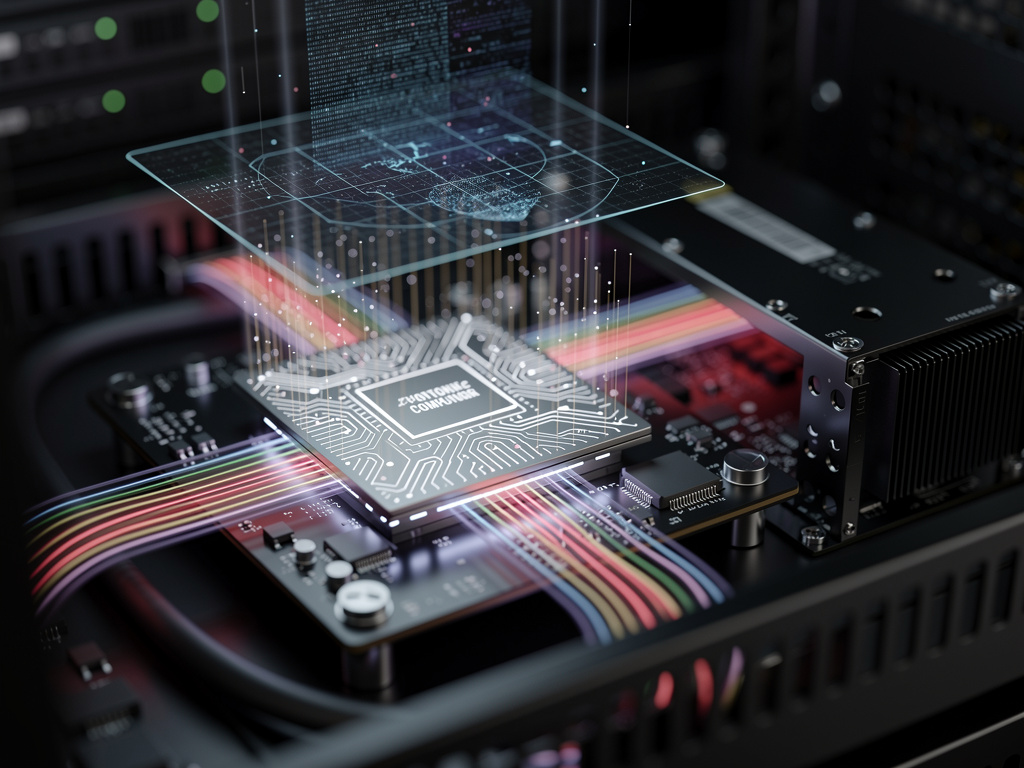
In the relentless pursuit of computational supremacy, a team of Chinese researchers has unveiled an optical AI chip that promises to redefine performance benchmarks in artificial intelligence processing. Dubbed LightGen, this innovation harnesses the speed of light to execute complex generative tasks, reportedly outperforming Nvidia’s A100 GPU by a staggering 100 times in speed and energy efficiency. Developed by scientists from Shanghai Jiao Tong University and Tsinghua University, the chip represents a bold foray into photonic computing, where light pulses replace traditional electronic signals for data processing.
The breakthrough, detailed in a recent paper published in the journal Science, showcases LightGen’s ability to handle AI workloads such as image and video synthesis with unprecedented efficiency. Unlike conventional silicon-based chips that rely on electrons, which are hampered by heat dissipation and energy loss, optical chips like LightGen use photons to carry information, enabling faster data transmission and lower power consumption. This shift could address one of the most pressing challenges in AI development: the escalating energy demands of training and running large models.
Industry experts are buzzing about the implications, particularly amid U.S.-China tech tensions and restrictions on advanced semiconductor exports. The chip’s design incorporates 3D-stacked photonic neurons, allowing for parallel processing that mimics neural networks but at optical speeds. Early tests indicate that LightGen achieves 35,700 trillion operations per second (TOPS) and 664 TOPS per watt, metrics that dwarf the A100’s capabilities in specific scenarios.
Photonic Computing’s Core Advantages
To understand LightGen’s edge, it’s essential to delve into the fundamentals of optical computing. Photons travel at the speed of light, unencumbered by resistance that plagues electron-based systems. This inherent property allows for massive parallelism, where multiple light beams can process data simultaneously without interference. The researchers claim their chip excels in matrix multiplications, a cornerstone of AI algorithms, performing them up to 100 times faster than the A100 in lab-controlled generative tasks.
Sources like the South China Morning Post have reported on the chip’s potential to revolutionize energy-intensive AI applications. By integrating diffractive optical neural networks, LightGen minimizes the need for digital-to-analog conversions, which are power hogs in traditional setups. This all-optical approach not only boosts speed but also slashes energy use, making it ideal for edge computing and data centers striving for sustainability.
However, skepticism abounds regarding real-world applicability. Critics point out that while LightGen shines in narrowly defined tasks, it may struggle with broader AI workloads that require versatile programming. Nvidia’s A100, a workhorse in data centers worldwide, benefits from mature ecosystems and software support, elements that photonic chips are still developing.
Comparative Performance Metrics
Benchmarking LightGen against the A100 reveals stark contrasts. The A100, launched in 2020, delivers around 312 teraflops in tensor performance, but LightGen’s optical architecture purportedly achieves equivalent computations in fractions of the time for vision-based AI models. According to details from Interesting Engineering, the chip’s efficiency stems from its ability to process data in the optical domain, avoiding the bottlenecks of electronic interconnects.
In generative AI tasks, such as creating high-resolution images or videos, LightGen demonstrated a 100-fold speedup, as highlighted in reports from Singularity Hub. This is particularly relevant for applications in autonomous driving, medical imaging, and content creation, where rapid processing can translate to real-time innovations. Yet, the chip’s current prototype status means scalability remains a question mark, with yields and manufacturing challenges noted in industry analyses.
Broader comparisons extend to other Chinese advancements. For instance, a startup founded by a former Google engineer has claimed a custom ASIC that’s 1.5 times faster than the A100, per Tom’s Hardware. These developments signal a concerted effort in China to circumvent U.S. export controls by pioneering alternative technologies like photonics.
Geopolitical and Market Implications
The emergence of LightGen intensifies the U.S.-China tech rivalry, especially as Washington tightens restrictions on AI hardware exports. Chinese firms, facing barriers to acquiring Nvidia’s latest GPUs, are pivoting to homegrown solutions. Posts on X, formerly Twitter, reflect a mix of excitement and caution, with users speculating on how photonic chips could alter global AI dynamics. One recent post from TechRadar echoed lab tests showing extreme efficiency in generative workloads, underscoring the chip’s potential to challenge established players.
Nvidia, not one to rest on laurels, is investing in optical technologies itself, as mentioned in coverage from Tom’s Hardware on a separate optical quantum chip. This indicates that the industry recognizes photonics as a viable path forward, potentially leading to hybrid systems that combine silicon and optical elements for optimal performance.
For investors and tech executives, LightGen’s advent raises questions about supply chain diversification. With China producing an estimated 12,000 wafers annually for similar optical chips, as reported in various outlets, the scale-up could disrupt Nvidia’s market share, which currently dominates AI accelerators.
Technical Hurdles and Future Prospects
Despite the hype, photonic computing faces significant obstacles. Integrating optical components with existing silicon infrastructure requires breakthroughs in materials science, such as developing reliable photonic-electronic interfaces. The LightGen team acknowledges these challenges, noting in their Science paper that while the chip excels in analog computations, digital precision tasks might still favor traditional GPUs.
Energy efficiency is another focal point. Reports from South China Morning Post on an analogue AI chip suggest up to 1,000 times faster operation with less power, aligning with LightGen’s claims. This could be a game-changer for hyperscale data centers, where electricity costs are soaring amid AI’s voracious appetite.
Looking ahead, collaborations between academia and industry will be crucial. Tsinghua University’s involvement hints at state-backed support, potentially accelerating commercialization. Industry insiders speculate that within five years, photonic accelerators could become standard in specialized AI applications, complementing rather than replacing silicon giants.
Innovation Ecosystem and Global Response
China’s push into optical AI isn’t isolated. A Reddit thread on r/Futurology, with thousands of upvotes, discusses the 100x speedup, fostering debates on technological sovereignty. Such online sentiments highlight growing awareness of how photonics could democratize AI access, especially in regions constrained by export bans.
Globally, competitors are responding. European and U.S. firms are ramping up R&D in light-based computing, with initiatives like the U.S. CHIPS Act funding similar explorations. Nvidia’s own forays into optical interconnects, as covered in tech media, suggest a convergence toward hybrid architectures that leverage the best of both worlds.
For enterprises, adopting photonic tech means rethinking software stacks. LightGen’s architecture demands new programming paradigms, potentially creating opportunities for startups specializing in optical AI frameworks. As one X post from a tech analyst noted, this could reshape competitive dynamics in AI hardware, pushing innovation beyond Moore’s Law limitations.
Real-World Applications and Case Studies
Envisioning LightGen in action, consider autonomous vehicles. Real-time image processing for object detection could benefit from the chip’s speed, reducing latency in critical decisions. In healthcare, faster generative models for drug discovery or medical imaging analysis could accelerate research timelines, as suggested by efficiency gains reported in NewsBytes.
Case studies from early adopters, though sparse, point to pilot programs in Chinese data centers testing optical accelerators for video synthesis. These trials, detailed in recent web articles, show promise in reducing carbon footprints, aligning with global sustainability goals.
However, integration challenges persist. Compatibility with existing CUDA ecosystems, Nvidia’s stronghold, means photonic chips must prove interoperability to gain traction. Analysts predict that initial deployments will target niche markets, gradually expanding as the technology matures.
Economic Ramifications and Investment Trends
Economically, LightGen could bolster China’s semiconductor self-sufficiency, mitigating the impact of sanctions. Investment in photonic startups has surged, with venture capital flowing into firms developing similar tech. A post on X from an economic forecaster highlighted potential stock impacts on Nvidia, urging caution amid these developments.
For Wall Street, this signals volatility in tech sectors. Nvidia’s shares have fluctuated with news of Chinese breakthroughs, as investors weigh the threat to its monopoly. Broader market trends show increasing bets on alternative computing paradigms, from quantum to optical, diversifying portfolios beyond traditional silicon.
In the long term, if LightGen scales, it could lower barriers to AI adoption, enabling smaller players to compete. This democratization might spur innovation across industries, from entertainment to finance, where fast, efficient AI processing becomes a competitive edge.
Expert Perspectives and Forward Outlook
Industry voices, including those from TechDator, emphasize the chip’s role in pushing AI boundaries. Experts like those quoted in WebProNews praise its 100x efficiency for generative tasks, but caution that widespread adoption hinges on overcoming fabrication hurdles.
Forward-looking, the fusion of photonics with AI could lead to exascale computing without exorbitant energy costs. As global data demands explode, innovations like LightGen offer a pathway to sustainable progress, challenging incumbents to evolve.
Ultimately, while LightGen isn’t an immediate Nvidia killer, it illuminates a future where light powers the next era of intelligence, urging the industry to adapt or risk obsolescence. With ongoing advancements, the race for AI supremacy is brighter than ever.


 WebProNews is an iEntry Publication