
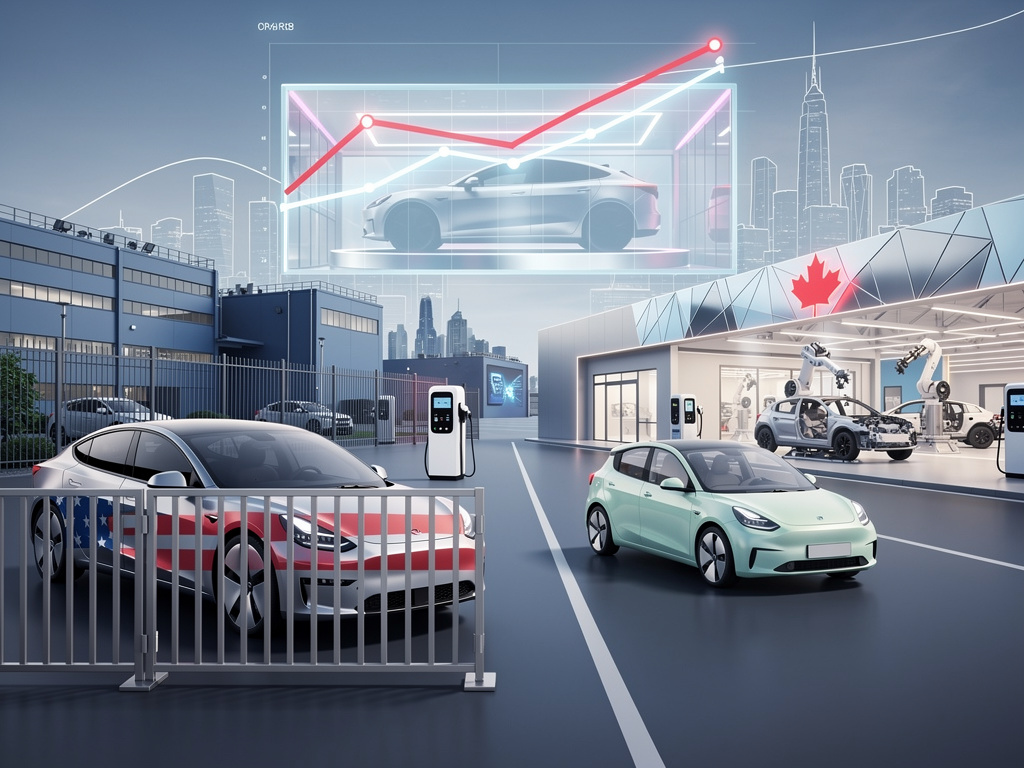
Two decades ago, Tesla Motors ignited the electric vehicle revolution, dominating global sales under Elon Musk’s leadership. Last year, however, BYD claimed the top spot as the world’s largest EV seller, propelled by models like the Seagull, priced at $8,000 in China. These affordable, tech-packed vehicles now capture nearly 10% of new-car sales in Europe and 20% in Mexico, undercutting rivals from Volkswagen and Renault by thousands of dollars, according to The Atlantic.
U.S. policies have held firm against this tide. The Biden administration slapped 100% tariffs on Chinese EVs and effectively banned them over national security fears, including data transmission risks to Beijing, as outlined in a U.S. Embassy fact sheet. The Trump administration maintained these barriers while rolling back fuel economy rules to favor American gas vehicles, per Reuters.
Yet fissures are appearing. President Trump, speaking at the Detroit Economic Club, signaled openness to Chinese firms building U.S. plants: “If they want to come in and build the plant and hire you and hire your friends and your neighbors, that’s great,” he posted on Truth Social (Truth Social).
Canada’s Tariff Reversal Sparks Alarm
Canada’s move has accelerated the shift. Prime Minister Mark Carney announced a deal allowing up to 49,000 Chinese EVs annually at a 6.1% tariff—down from 100%—in exchange for China cutting duties on Canadian canola from 85% to 15%, as reported by Reuters and Al Jazeera. U.S. Transportation Secretary Sean Duffy warned, “I think they’ll look back at this decision and surely regret it to bring Chinese cars into their market,” speaking at a Ford factory in Ohio.
U.S. Commerce Under Secretary Howard Greer called the decision “problematic,” emphasizing tariffs protect American workers: “There’s a reason why we don’t sell a lot of Chinese cars in the United States. It’s because we have tariffs to protect American auto workers and Americans from those vehicles,” he told CNBC, cited in Reuters.
White House spokesperson Kush Desai downplayed a related personnel change: “The personnel change ‘should not be read that deeply into as reflective of broader Administration thinking or decision-making,’” after Reuters reported the ousting of the Commerce official behind the Chinese vehicle ban (Reuters).
Geely’s U.S. Ambitions Gain Traction
Geely Auto previewed SUVs at CES, resembling the Ford Explorer, with a spokesperson stating the company “continues to monitor market opportunities in North America,” per InsideEVs. Analysts predict a U.S. debut in two to three years, mirroring strategies to bypass tariffs via local production.
Dan Hearsch of AlixPartners told The Atlantic, “It’s the first step. It’s an inevitability that Americans will buy Chinese cars.” He likened it to Toyota and Honda’s past success: Chinese firms could create jobs and elevate quality through competition.
The TikTok spinoff, finalized January 22, offers a blueprint: Chinese-designed EVs could be built in Michigan or Ohio with U.S. parts to address cybersecurity, as detailed in Bloomberg.
U.S. Automakers Face Pricing Pressures
Average U.S. new-car prices hover at $50,000, per The Atlantic. Chinese EVs won’t hit $8,000 stateside due to labor costs but remain cheaper via efficient manufacturing, notes another Atlantic piece.
Ford CEO Jim Farley acknowledged, “They’re really impressive companies, as I have said many times publicly,” in an interview with The Atlantic. Ford plans a $30,000 electric pickup, while GM discontinues its $30,000 Bolt EV for gas crossovers.
Historical precedents abound: Volkswagen, Toyota, Honda, Hyundai, and Kia entered via affordability. GM, once the world’s largest private employer, has shrunk dramatically, per Applied Geographic, and Ford dominates only pickups and SUVs, according to CarScoops.
Global Ripples and Security Hurdles
Mexico hiked tariffs to 50%, yet Chinese models hold 20% share, with BYD manufacturing locally to evade duties, as noted by Forbes. Europe battles with duties, but Chinese brands push hybrids and micro-cars tailored to markets.
January 2025 rules bar connected Chinese vehicles, a major barrier. TechCrunch reports Geely eyes U.S. entry despite 100% tariffs (TechCrunch). InsideEVs highlights affordability anxiety at the 2026 Detroit Auto Show (InsideEVs).
Hearsch predicts Chinese brands at 30% global share by 2030. As barriers erode, U.S. consumers may gain cheaper options, but Detroit braces for upheaval.


 WebProNews is an iEntry Publication