
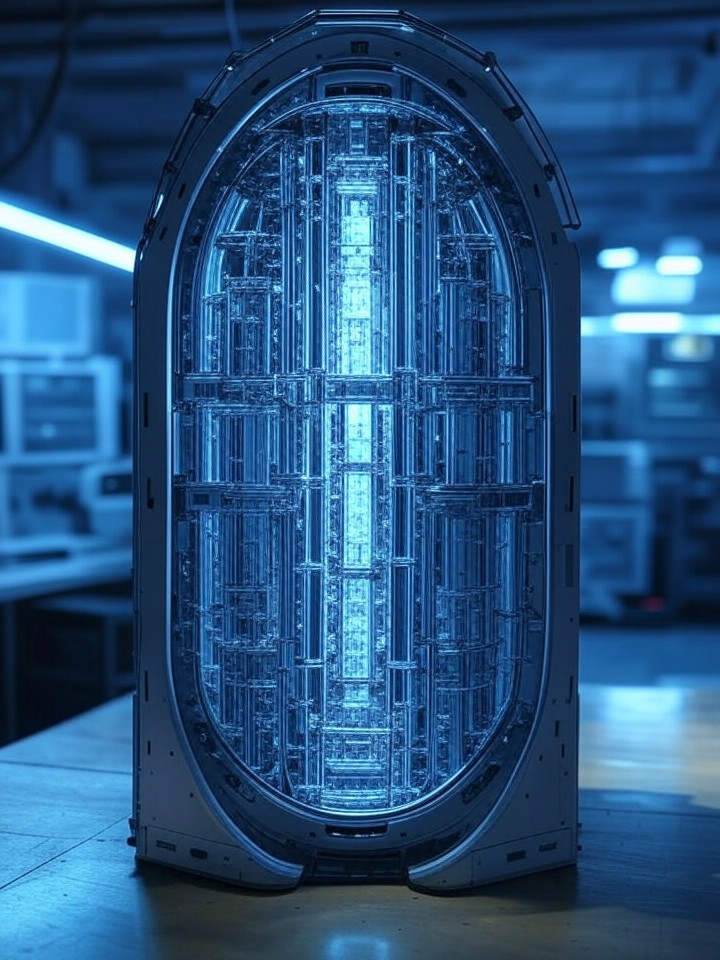
Shattering Fusion’s Invisible Barrier: China’s Tokamak Triumph Redefines Energy Horizons
In the relentless pursuit of harnessing the power of the stars, a team of physicists in China has achieved what many in the field long considered impossible. Operating the Experimental Advanced Superconducting Tokamak (EAST), researchers have pushed plasma densities beyond the infamous Greenwald limit, a theoretical ceiling that has constrained fusion experiments for decades. This breakthrough, detailed in recent reports, signals a potential paradigm shift in how we approach controlled nuclear fusion, the holy grail of clean, abundant energy.
The Greenwald limit, named after physicist Martin Greenwald, posits that plasma density in a tokamak—a doughnut-shaped reactor that uses magnetic fields to confine superheated plasma—cannot exceed a certain threshold without causing instability. Exceeding this limit typically leads to plasma disruptions, where the ionized gas escapes confinement, potentially damaging reactor components. For years, this boundary has been a stubborn roadblock, forcing engineers to balance density with stability in their quest for sustained fusion reactions.
Now, experiments at EAST have demonstrated a “density-free regime,” where plasma remains stable even at densities far above the Greenwald threshold. By carefully managing the interaction between the plasma and the reactor walls, the team achieved this stability, opening doors to higher power outputs in future fusion devices. This isn’t just incremental progress; it’s a fundamental rethinking of plasma behavior in confined environments.
Unlocking the Secrets of Plasma Stability
The EAST reactor, often dubbed China’s “artificial sun,” has been at the forefront of fusion research since its inception. In these latest trials, physicists injected additional particles into the plasma while employing advanced control techniques to mitigate edge instabilities. According to a report from ScienceAlert, the experiments successfully circumvented the density cap by optimizing the plasma’s boundary conditions, preventing the usual cascade of turbulence that leads to collapse.
This achievement builds on decades of theoretical work. The Greenwald limit, empirically derived from data across multiple tokamaks, suggests density is proportional to the plasma current divided by the square of the minor radius. But the Chinese team found that under specific conditions—such as enhanced magnetic shear and reduced wall interactions—the plasma could tolerate much higher densities without destabilizing. It’s a testament to the evolving sophistication of fusion engineering.
Industry experts are buzzing about the implications. “This could be the key to making fusion reactors more efficient,” notes one physicist involved in international collaborations. By packing more fuel into the plasma, reactors could achieve ignition—the point where fusion reactions produce more energy than they consume—with less input power, accelerating the timeline for commercial viability.
Historical Context and Global Race
Fusion research has always been a global endeavor, with major players like the International Thermonuclear Experimental Reactor (ITER) in France aiming for similar milestones. Yet China’s EAST has consistently pushed boundaries, holding records for plasma temperature and duration. This density breakthrough comes on the heels of other advancements, such as sustained high-temperature operations exceeding 100 million degrees Celsius.
Drawing from web sources, a post on The Debrief highlights how the team exceeded the plasma-density limit in tokamak experiments, marking a new milestone. This isn’t isolated; it’s part of a pattern where Chinese researchers are leveraging superconducting magnets to explore regimes inaccessible to older machines.
Comparatively, Western efforts like those at the Joint European Torus (JET) in the UK have approached but not surpassed the Greenwald limit in similar ways. The difference lies in EAST’s fully superconducting design, which allows for stronger, more stable magnetic fields. This hardware edge has enabled the precise control needed to enter the density-free zone.
Technical Deep Dive: How They Did It
At the heart of the breakthrough is the management of plasma-wall interactions. In traditional setups, as density increases, particles bombard the reactor walls, eroding materials and injecting impurities that cool the plasma. The EAST team mitigated this by using tungsten divertors—components that exhaust heat and particles—and optimizing the plasma shape to minimize contact.
Further details from ScienceDaily explain that the experiment confirmed plasma stability at extreme densities through careful control of these interactions. By adjusting the magnetic topology, researchers created a buffer zone that shielded the core plasma from edge perturbations, allowing densities up to twice the Greenwald limit without disruption.
This regime, theorized but rarely accessed, relies on a phenomenon called “pedestal optimization.” Here, the plasma edge forms a steep pressure gradient that enhances confinement, effectively creating a self-regulating system. Simulations backed by supercomputers predicted this possibility, but EAST provided the empirical proof.
Implications for Commercial Fusion
The ripple effects extend far beyond the lab. For fusion startups like Commonwealth Fusion Systems in the US, which are racing to build compact reactors, this density advancement could inform designs that prioritize high-density operations. Higher densities mean more fusion events per unit volume, potentially reducing the size and cost of reactors.
Economic analysts project that viable fusion could disrupt energy markets, providing baseload power without carbon emissions or long-lived nuclear waste. According to insights from Live Science, this step brings humanity closer to near-limitless clean energy, with EAST shattering a major fusion limit.
However, challenges remain. Scaling this to larger devices like ITER will require verifying the technique under different conditions. Material science must advance to handle the increased heat fluxes, and control systems need to be robust enough for continuous operation.
Voices from the Field and Broader Impacts
Sentiment on platforms like X reflects excitement, with posts describing the breakthrough as a game-changer for fusion power plants. Users highlight how this “density-free regime” enables denser fuel without instability, echoing reports from scientific communities.
In academia, physicists are re-evaluating models. A discussion on Phys.org notes that EAST achieved stable operation at densities well beyond conventional limits, offering a new approach to fusion ignition. This could accelerate research timelines, potentially bringing net-positive fusion within a decade.
Globally, this fuels the fusion arms race. While China leads in certain metrics, collaborations remain vital. The US Department of Energy’s recent investments in tokamak research aim to match these strides, fostering innovation through shared knowledge.
Challenges Ahead in Fusion’s Path
Despite the optimism, skeptics point out that density is just one piece of the puzzle. Achieving sustained ignition requires balancing temperature, density, and confinement time—the so-called triple product. EAST’s success improves density, but integrating it with other parameters is the next hurdle.
Engineering hurdles include developing materials that withstand neutron bombardment over years of operation. Fusion neutrons, unlike those in fission, are highly energetic, demanding alloys that don’t degrade quickly.
Regulatory frameworks also lag. As fusion edges toward commercialization, governments must establish safety standards and incentives. In the US, the Nuclear Regulatory Commission is adapting rules, but international harmonization is needed for a global rollout.
Future Visions: From Lab to Grid
Looking ahead, this breakthrough could influence designs for demo reactors, prototypes that demonstrate net energy gain. China’s next-generation device, the China Fusion Engineering Test Reactor (CFETR), might incorporate these findings to target gigawatt-scale power.
Private sector involvement is surging. Companies like Helion Energy and TAE Technologies are exploring alternative confinement methods, but tokamaks remain the frontrunner due to their maturity. Insights from World Nuclear News confirm EAST’s progress in high-density operation, providing evidence for magnetic confinement’s viability.
Environmental benefits are profound. Fusion promises to decarbonize heavy industries, from steelmaking to desalination, without the intermittency of renewables. As climate pressures mount, such advancements offer hope for a sustainable energy future.
Economic and Geopolitical Ramifications
Economically, mastering fusion could reshape global power dynamics. Nations leading in fusion tech might dominate energy exports, similar to oil-rich states today. China’s head start positions it favorably, prompting calls for increased funding in the West.
Investment is pouring in. Venture capital in fusion hit record highs last year, with billions funneled into startups. This density milestone could attract more, validating the field’s potential.
Geopolitically, fusion’s promise of energy independence reduces reliance on fossil fuels, mitigating conflicts over resources. Yet, technology transfer issues could arise, with intellectual property becoming a flashpoint in international relations.
The Human Element in Scientific Triumph
Behind the machines are dedicated teams. Researchers at EAST endure grueling schedules, iterating on experiments that run for mere seconds but yield data for months of analysis. Their perseverance exemplifies the human drive to solve grand challenges.
Education plays a role too. This breakthrough inspires the next generation, with universities ramping up plasma physics programs. Collaborations with institutions worldwide ensure knowledge dissemination, accelerating collective progress.
Ultimately, this density conquest is a beacon in fusion’s long journey. While commercial plants are still years away, each barrier broken brings the dream closer, illuminating a path to an energy-abundant world.


 WebProNews is an iEntry Publication