
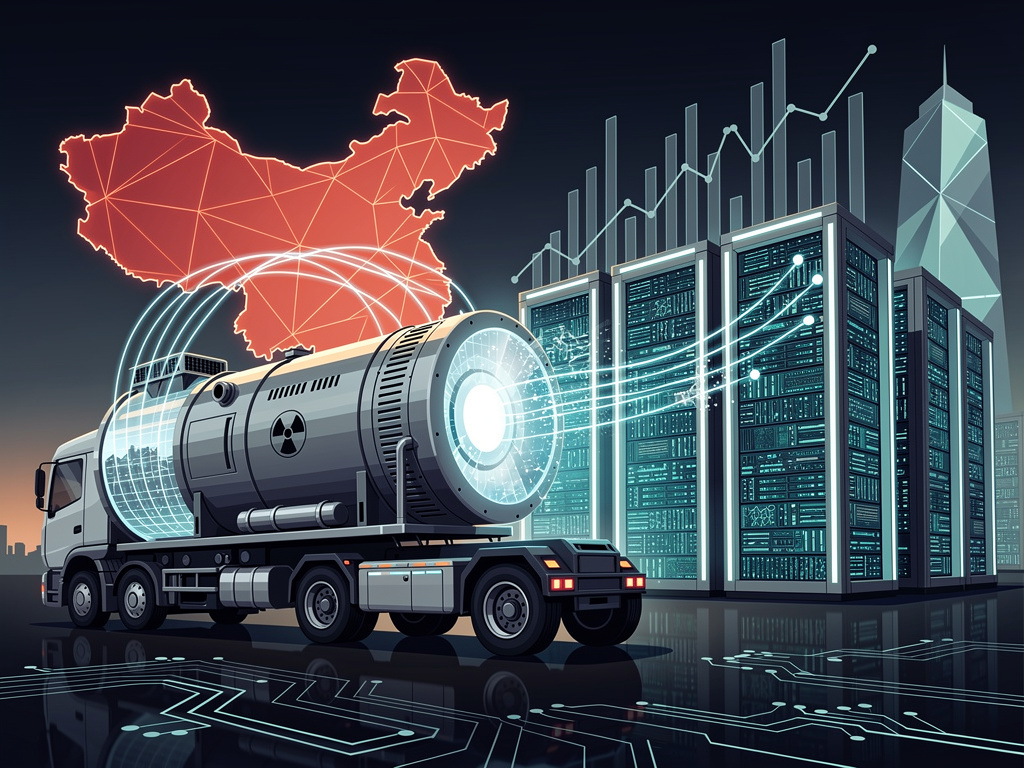
China just rolled out a nuclear reactor on a truck bed. It pumps 10 megawatts—enough for a midsize AI data center. No refueling for decades. Testing started this spring, led by Wu Yican at the Hefei Institute of Physical Science’s Institute of Nuclear Energy Safety Technology.
“The ‘nuclear power bank’ we proposed exemplifies the new generation of nuclear energy systems,” Wu told South China Morning Post. “This technology offers exceptional safety in a remarkably compact size and an operational lifespan of decades without recharging.”
And it solves battery woes. Remote islands. Disaster zones. Ships at sea. Even spacecraft. Wu calls it a fix for ‘battery anxiety’ in spots where grids falter or diesel fumes choke the air.
The prototype fits on a standard truck. Output hits 10MW steady. That’s power for thousands of homes or the humming servers training tomorrow’s models. Development took years. Now, the team runs simulation tests, eyeing real deployments soon.
Safety first. Designers baked in protections from the ground up. No water cooling risks like old plants. Compact core means less to go wrong. Wu pushes next-gen systems that stay approachable, flexible, intelligent.
China’s nuclear muscle flexes hard. Fifty-nine commercial units ran last year, churning 467.7 billion kWh—4.82% of the nation’s juice. Second to the U.S. globally. And coming: Linglong One, the world’s first commercial land-based small modular reactor, eyes startup in Hainan by mid-2026, per Reuters.
AI hunger drives it all. Data centers guzzle gigawatts as models balloon. Nuclear fits: clean, dense, always-on. “Nuclear power is an important driving engine for the development of AI, providing a stable, clean and highly resilient power foundation,” Wu said in the SCMP interview.
But. Across the Pacific, U.S. tech titans scramble. Microsoft inks a $16 billion deal to revive Three Mile Island’s 835MW Unit 1, targeting 2028 output. Google partners with Kairos Power for 500MW of small modular reactors by 2030-plus. Amazon pumps $500 million into X-energy, scouting sites for multi-GW capacity, as noted in recent Introl analysis.
Capex explodes. In Q1 2026 alone, Amazon, Microsoft, Google, and Meta dropped $130 billion on data centers and chips, per New York Times. Full-year tallies could hit $650 billion. Yet reactors lag years behind. China tests now. America plans later.
Mobile nukes shift the board. Truck it to a data center in the desert. Hook up offshore rigs. Backstop blackouts. Traditional coal stacks and diesel backups? Obsolete overnight. No emissions. No fuel runs every few days.
Wu sees symbiosis. “Nuclear power acts as a stable and resilient energy source that can meet the high computing demands of artificial intelligence,” he told Interesting Engineering. “At the same time, artificial intelligence is being integrated into the research and development processes of nuclear science.” AI speeds reactor design. Nuclear feeds AI’s thirst.
Bigger picture. China eyes microwatt batteries for pacemakers up to megawatt beasts for oceans and orbits. Cancer hits 5 million Chinese yearly; nuclear isotopes could diagnose, treat. Over the next decade, Wu predicts shakes in manufacturing, safety, meds.
U.S. firms signed a White House pledge in March to foot grid upgrade bills for their data centers, covering Google, Amazon, OpenAI. Pressure mounts on water use, local pushback. Projects stall. China builds.
This truck reactor? Not alone. It’s China’s edge in a power crunch. While Big Tech inks distant deals, Beijing hauls reactors to the need. Deployable. Scalable. Ready. The AI era demands juice that follows demand. China delivers on wheels.
Expect exports. Linglong One already draws foreign eyes. Truck nukes could ship too—powering allies’ AI hubs or remote bases. Global grids strain. Portable atomic answers arrive first from the East.


 WebProNews is an iEntry Publication