
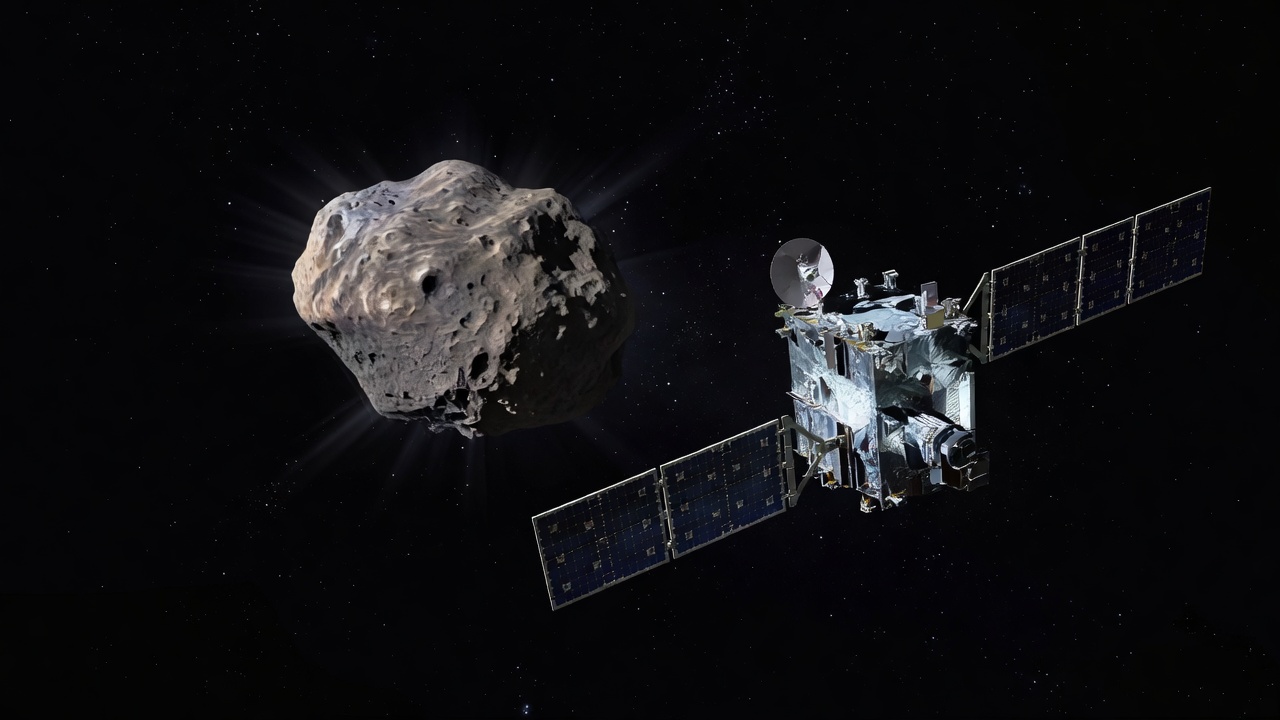
BEIJING — China’s Tianwen-2 spacecraft has reached one of Earth’s rare quasi-moons. The probe performed an engine burn on June 7, 2026, slipping into the vicinity of the asteroid 469219 Kamo‘oalewa. Amateur radio observers confirmed the maneuver. Official word from Beijing remains pending. Yet the data from German and Dutch telescopes leaves little doubt.
Kamo‘oalewa, also known as 2016 HO3, measures between 40 and 100 meters across. Roughly the size of the Statue of Liberty. It spins once every 28 minutes. One of just seven known quasi-satellites, the rock orbits the sun in near-perfect lockstep with Earth. This resonance creates the appearance of a distant companion. But it never truly circles our planet. (Gizmodo)
Beijing’s Ambitious Gamble on a Tiny, Fast-Spinning Target
The mission marks China’s first attempt to land on an asteroid and return samples. Launched May 28, 2025, aboard a Long March 3B from Xichang, Tianwen-2 carries 11 science instruments. It will map the surface from progressively lower orbits — 20 kilometers, then 3, then 600 meters, finally 300 meters. LiDAR, cameras and a sounding radar will scout landing sites. Then comes the hard part.
Planners prepared three sampling methods. A simple touch-and-go. An anchor-and-attach system with drills. And a hover approach that matches the asteroid’s rapid rotation. The target sample size sits between 20 and 100 grams of regolith. Explosives may expose subsurface material. Success is not guaranteed. The asteroid’s spin and uncertain structure — rubble pile or monolithic core — pose real risks. Even failure would yield valuable data. “Even if they’re unsuccessful… that would be super interesting,” said Christine Hartzell, quoted in Scientific American.
But why this target? Spectral data show Kamo‘oalewa reflects light much like lunar rocks collected by Apollo crews. Some researchers suspect it blasted off the moon’s far side millions of years ago, perhaps from the Giordano Bruno crater impact. Others point to the main asteroid belt as a more probable source. Samples could settle the debate. “Kamo’oalewa is one of seven known quasi-moons of Earth, so it’s in a kind of resonance orbit,” explained space journalist Andrew Jones in The Planetary Society. “It might even be a chunk of the Moon. It gives us an opportunity to do some serious science.”
Recent modeling reinforces the main-belt hypothesis. A 2026 study found such objects more common there than lunar ejecta. Yet only direct samples will decide. (Forbes)
The spacecraft now sits roughly 2,000 kilometers away. It will close in over coming weeks. First close images could arrive around July 4. Mapping will occupy the team through early 2027. Departure is scheduled for April 24, 2027 — China’s National Space Day. The sample capsule should reach Earth in November 2027, parachuting into Inner Mongolia.
That return will not end the mission. After releasing the capsule, Tianwen-2 will swing past Earth for a gravity assist. Its next destination: main-belt comet 311P/PanSTARRS. Arrival around 2035. The full campaign stretches over a decade. It tests solar-electric propulsion, long-duration deep-space operations and complex sample handling. All technologies needed for future Mars sample return and Jupiter exploration.
China’s space program has moved fast. Two successful lunar sample returns, including from the far side. A Mars orbiter and rover. Now this. The quasi-moon encounter builds experience with small, fast-rotating bodies. It also feeds growing interest in planetary defense. On Tuesday, state media reported plans for a coordinated ground- and space-based asteroid monitoring system. Early warning against potential threats. (Global Times via recent X reports)
Scientists worldwide watch closely. Patrick Michel, who has studied Kamo‘oalewa, noted that every new asteroid image brings surprises. Mikael Granvik calculated the main-belt origin is roughly 10 times more likely but said lunar material would dramatically constrain models of impact physics. The samples, however modest in mass, could rewrite textbooks on solar system history.
Yet engineering challenges dominate headlines inside China. The asteroid’s weak gravity. Its spin rate. Unknown surface strength. Mission papers describe the sampling as a demonstration with built-in redundancy. Three techniques. Multiple chances. Beijing learned from past missions. It applies those lessons here.
And the payoff extends beyond science. Quasi-satellites remain accessible for decades. Their stable orbits relative to Earth lower the energy needed for round trips. Some analysts already discuss future resource extraction — water ice, metals. A 2025 market study projected the global space and asteroid mining sector could reach $16 billion by 2035. (Forbes)
Tianwen-2 won’t mine. It will collect. It will photograph. It will measure. Then it will leave Kamo‘oalewa to its lonely dance around the sun. But the data and the returned grains will travel far. Into labs in Beijing, Europe, the United States. They may confirm a lunar birthplace. Or reveal an ordinary asteroid with an unusual path. Either answer sharpens our picture of how planets form, how impacts reshape moons, and how material moves across the inner solar system.
For now the probe inches closer. Cameras ready. Instruments primed. A small nation’s flag, in effect, planted on a rock that has shadowed Earth for centuries. China stands on the verge of adding the first asteroid samples from a quasi-moon to humanity’s collection. The wait for those capsules grows shorter. So does the gap between ambition and achievement in Beijing’s space effort.


 WebProNews is an iEntry Publication