
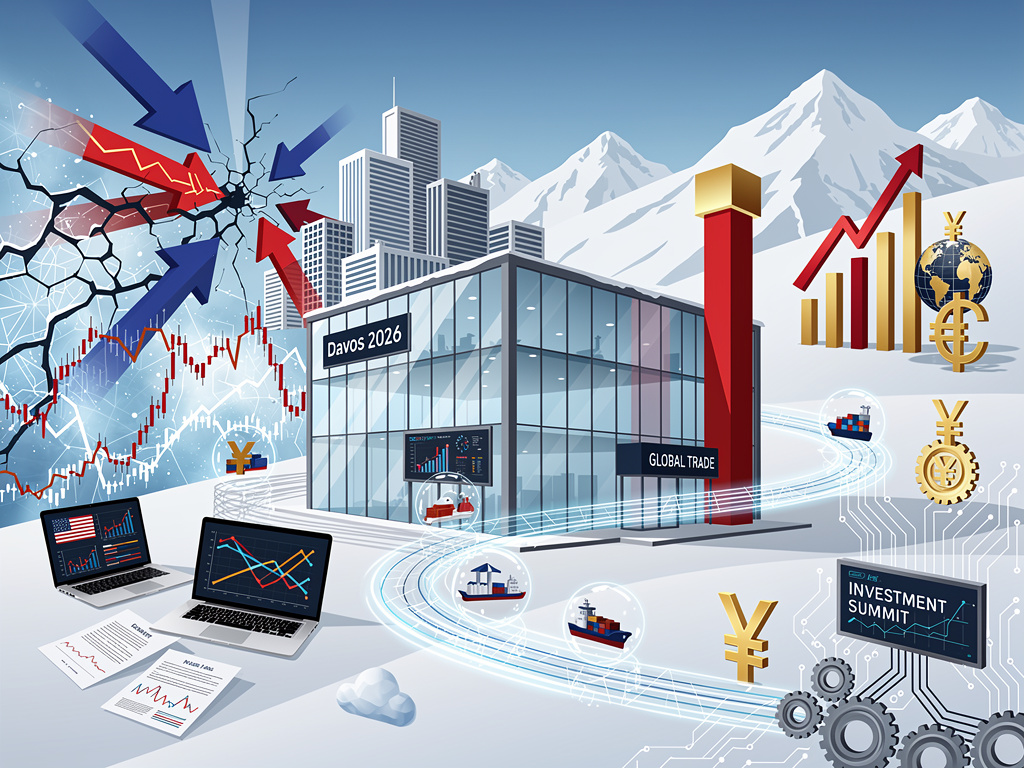
In the snow-swept streets of Davos, Switzerland, during the 56th World Economic Forum from January 19 to 23, 2026, China’s presence loomed large despite its subdued profile. While U.S. President Donald Trump dominated headlines with bombastic speeches and territorial ambitions over Greenland, Vice Premier He Lifeng delivered a measured call for multilateralism and free trade, positioning Beijing as a beacon of stability amid global fractures. This contrast underscored a pivotal shift, with analysts noting China’s strategic restraint as a masterstroke in an era of escalating tensions.
Trump’s address, drawing record crowds, featured praise for Xi Jinping—’I’ve always had a very good relationship with President Xi … he’s an incredible man. What he’s done is amazing, he’s highly respected by everybody’—yet highlighted persistent U.S.-China frictions, including elevated tariffs and technology curbs following a fragile one-year truce in October 2025. He Lifeng, leading China’s delegation, met CEOs like JPMorgan’s Jamie Dimon, Apple’s Tim Cook, and Bridgewater’s Ray Dalio, signaling Beijing’s pursuit of Western investment even as its growth hit a three-year low. CNBC captured this dynamic, emphasizing how China’s messaging on domestic demand and green transitions contrasted sharply with U.S. unpredictability.
Strategic Restraint in a Fractured Forum
He Lifeng’s special address urged nations to board the ‘giant ship’ of globalization, warning against protectionism as a ‘law of the jungle.’ He stressed China’s commitment to expanding imports via its ‘mega-sized market’ and never deliberately pursuing trade surpluses, while prioritizing domestic demand to boost consumption—retail sales grew just 0.9% in December, the slowest since the pandemic. The IMF’s 3.1% global growth forecast for 2026, below pre-COVID averages, amplified his plea for win-win cooperation compliant with WTO rules. World Economic Forum published the full transcript, highlighting China’s role in green infrastructure and finance.
European Commission President Ursula von der Leyen outlined potential ‘historic’ trade deals, including with India, while Canadian Prime Minister Mark Carney decried ‘a rupture in the world order,’ praising China as a ‘reliable and predictable partner.’ BlackRock CEO Larry Fink, WEF co-chair, suggested decentralizing future forums to cities like Detroit or Jakarta, declaring, ‘The mountain will come down to earth.’ These sentiments aligned with views from experts like Peter Alexander of Z-Ben Advisors: ‘With each passing day, it becomes evident that so long as China dominates production, all other nations have little leverage or ability to act.’ The New York Times noted China assuming ‘the mantle of being the adult in the room.’
Trade Tensions and Investment Overtures
China’s 37% share of global container shipments in the first three quarters of 2025 underscored its manufacturing dominance, yet Beijing hosted leaders like Ireland’s Micheal Martin and South Korea’s Lee Jae Myung, signaling rising confidence. Reuters reported He Lifeng’s low-key approach differing starkly from U.S. drama, with a global business founder quipping, ‘(It will) just watch all the chaos happening all over the world, and steer its own course, China will win.’ Reuters linked this to growth challenges and consumption boosts lagging.
Middle powers sought balance, as Jamil Anderlini observed: ‘Nobody really wants to be a client state either of the United States or of China.’ Singapore’s Tharman Shanmugaratnam called for U.S.-China rivalry to ‘benefit’ the world. Bloomberg detailed He Lifeng’s CEO meetings, while Bloomberg highlighted China’s defense of its growth model, aiming to be the ‘world’s market.’ Post-Davos, Trump threatened Canada with tariffs over perceived China ties, despite no broad deal.
Economic Signals Amid Geopolitical Rifts
Hai Zhao of the Chinese Academy of Social Sciences dubbed Davos a ‘watershed’ moment, predicting regional trade blocs as U.S.-centric models wane. Wei Wang of Tianjin University saw U.S.-Europe strains benefiting Beijing’s EU ties. The WEF’s summer event in Dalian reflected an eastward tilt. Eswar Prasad of Cornell remarked, ‘China definitely wants to assume the mantle of being the adult in the room, while the United States continues capriciously showing hostility.’ Reuters covered He Lifeng’s import vows.
Over 60 heads of state attended, with discussions on China’s economic trajectory, manufacturing, and U.S. relations drawing crowds, per WEF’s Kimberley Botwright. Jacob Cooke of WPIC noted non-U.S. Western brands eyeing China’s premium markets for vitamins and pets. Trump’s Greenland pivot, securing ‘total access’ without military means, eased some fears but spotlighted alliances. World Economic Forum summarized leaders’ insights.
Global Realignment and Future Forums
Davos 2026, themed ‘A Spirit of Dialogue,’ exposed geoeconomic confrontations topping agendas for the first time. UBS managers in Davos eyed Chinese tech as a dollar hedge amid loose policy. Demis Hassabis of Google DeepMind pegged AGI at five to ten years, but AI intertwined with trade woes. China Daily praised He Lifeng’s stabilizing reaffirmation of free trade. Global Times stressed China’s assets in trade, supply chains, and clean energy.
Attendees departed with warnings for Europe to compete with U.S. and China dynamism. Trump’s envoy Kirill Dmitriev’s presence hinted at broader diplomacy. As regionalism rises—’China Plus One’ evolving per WEF’s Kiva Allgood—Beijing’s quiet influence persists, leveraging production prowess and market size to navigate fractures.


 WebProNews is an iEntry Publication