
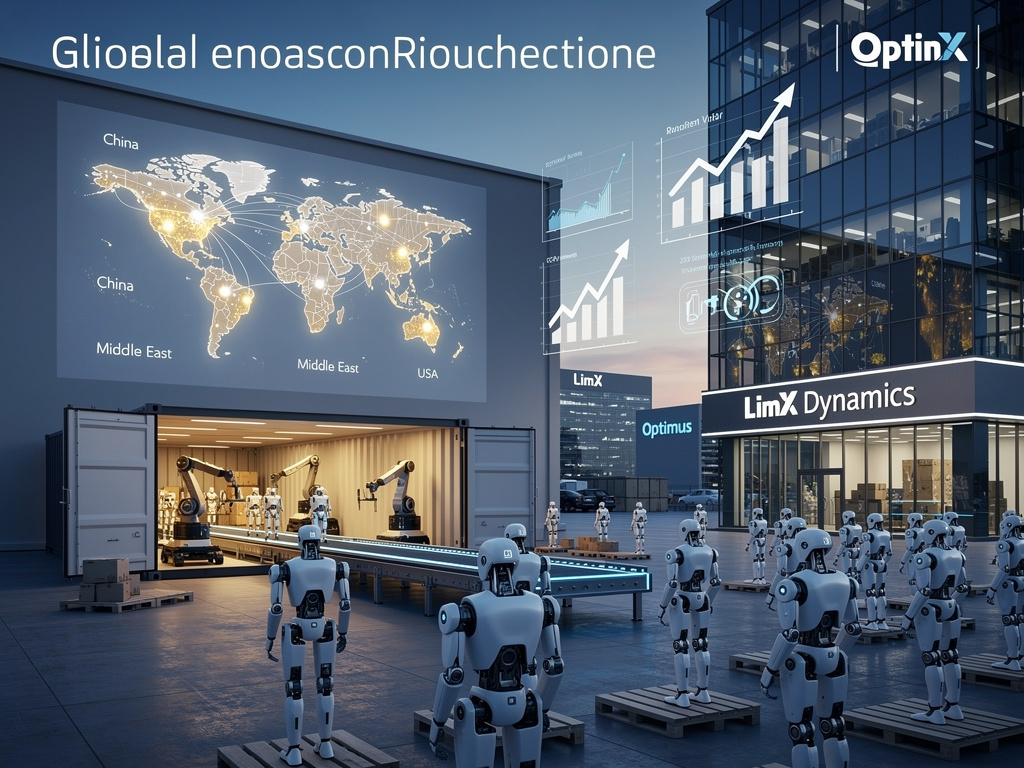
SHENZHEN, China—As Elon Musk’s Tesla races to deploy its Optimus humanoid robots in factories, Chinese startups like LimX Dynamics are plotting a bolder path: cracking open U.S. and Middle East markets with machines already shipping at scale. LimX founder Will Zhang, a former Ohio State University professor, revealed in an exclusive interview that his firm is finalizing funding from its first Middle East investor, paving the way for thousands of units to land in the region starting this year.
The Shenzhen-based company, backed by Alibaba, JD.com and Lenovo with $69.31 million raised as of July 2025, began delivering its full-sized Oli robot months ago. Base models price at 158,000 yuan ($22,660), undercutting rivals, while developer versions run nearly double at 290,000 yuan. Zhang emphasized partnerships over pure capital: “More than money, I’m focused on local partnerships,” he told CNBC.
LimX’s three-year blueprint kicks off in 2026 with several thousand robots headed to the Middle East for research, development and service trials—building real-world proof points for global sales. U.S. talks with business partners are underway, showcased at CES in Las Vegas, though details remain preliminary. Europe beckons too, with its vast yet splintered opportunities.
LimX’s Tech Edge Sharpens Global Ambitions
Central to LimX’s pitch is its new agentic AI operating system, COSA, unveiled earlier this month. It enables real-time body adjustments—like catching tennis balls or executing voice-commanded somersaults—ditching remote controls for autonomous chains of decisions. “We don’t think it has to be that the U.S. leads and China follows” in innovation, Zhang asserted to CNBC. Rapid progress, he added, means humanoids could work alongside people in five to 10 years.
China’s humanoid dominance is no fluke. Firms led by Shanghai’s AgiBot shipped the lion’s share of last year’s global total—roughly 13,000 units, quintupling 2024 volumes—far eclipsing Tesla and Figure AI, per Omdia data cited in Bloomberg. AgiBot alone moved 5,168 units, followed by Unitree and UBTech.
Morgan Stanley doubled its 2026 China sales forecast to 28,000 units, shifting from government and entertainment buyers to businesses. By 2050, annual sales could hit 54 million units domestically. “We expect sales to businesses to be the key driver this year,” analyst Shen Zhong told CNBC.
Tesla Optimus Faces Mounting Pressure
Tesla shipped Optimus units to business clients last year but holds off public sales until late 2027, Musk said at Davos. “The company will offer them for sale ‘when we are confident that there is very high reliability, very high safety and the range of functionality is also very high,’” he stated, per Axios. Musk envisions “more robots than people,” with Optimus eyeing $20,000-$30,000 pricing.
Yet Chinese rivals undercut on cost and speed. Unitree’s entry-level model sells for $6,000, AgiBot’s scaled-down version $14,000—half Tesla’s target—displayed at CES 2026, where Chinese bots dazzled with table tennis and kung fu, as reported by Times of India. Musk warned in April 2025: “I’m a little concerned that on the leaderboard, ranks 2 through 10 will be Chinese companies.”
AgiBot’s Genie Sim 3.0, built on Nvidia Isaac Sim, slashes training costs and bridges simulation to reality. The firm eyes U.S. expansion for labor-short sectors and promo roles, alongside Japan. Omdia projects global shipments soaring to 2.6 million by 2035.
China’s Supply Chain Arsenal Fuels Export Push
Beijing’s “15th five-year plan” spotlights embodied AI, subsidizing over 150 firms. Unitree preps a $7 billion IPO; UBTech, Hong Kong-listed, eyes 5,000 units in 2026, 10,000 in 2027 after $400 million raised. Xpeng’s Iron humanoid, with 60 joints and human-like gait, hits mass production next year using proprietary chips.
“China currently leads the United States in the early commercialization of humanoid robots,” Horváth partner Andreas Brauchle told CNBC. Supply chains yield cost edges: prototypes now $150,000-$500,000, targeting $20,000-$50,000. RBC Capital pegs global market at $9 trillion by 2050, China over 60%.
U.S. counters lag: Commerce Secretary meetings and potential executive orders loom, but China scales faster amid demographic crunches. Analysts like McKinsey’s Karel Eloot note hand dexterity gaps, yet Chinese demos—often polished—risk bubbles, warns Horváth.
Gulf Gateway Beckons Amid Geopolitical Flux
LimX’s Middle East foray aligns with regional AI bets, like Saudi’s Humaine eyeing data centers. No specific investor named, but Reliable Robotics distributes LimX in UAE, Saudi Arabia and GCC states. 2026 shipments target R&D case studies for services, testing Oli’s voice AI in diverse climes.
U.S. entry leverages CES buzz, local partners mitigating tariffs—echoing EV battles. China dominates shipments (top five firms), Tesla ninth. Figure seventh. As LimX valuation surges post-Middle East cash, Zhang eyes IPO but demurs.
Industry insiders watch warily: China’s manufacturing muscle versus U.S. AI prowess. “The depth of China’s supply chain means companies can develop and manufacture robots at a significant cost advantage,” Counterpoint’s Ethan Qi said to CNBC. The race intensifies, with humanoids poised to reshape labor worldwide.


 WebProNews is an iEntry Publication